The alpha, twice a week
That was 3 min.
Get the best new moments in your inbox every Wednesday and Saturday. It's free.
Check your inbox
We sent a link to your address. Click it to finish signing up. Not there in a minute? Look in spam.
or
Masters in Business · 3 min · Nov 7, 2026
AI’s investment risk is unclear returns, not unclear potential
 Ann Berry
 believes AI will be transformational, but says investors still lack rigor around returns on massive capital spending.
The episode’s best minutes
Full analysis- 26:09She expects early-stage companies to reach cash flow in two years3 min
- 21:11Running a company changed how she evaluates investmentsPro pick 2 min
- 48:11AI’s investment risk is unclear returns, not unclear potentialPro pick 3 min
- 5 more moments in the full episode
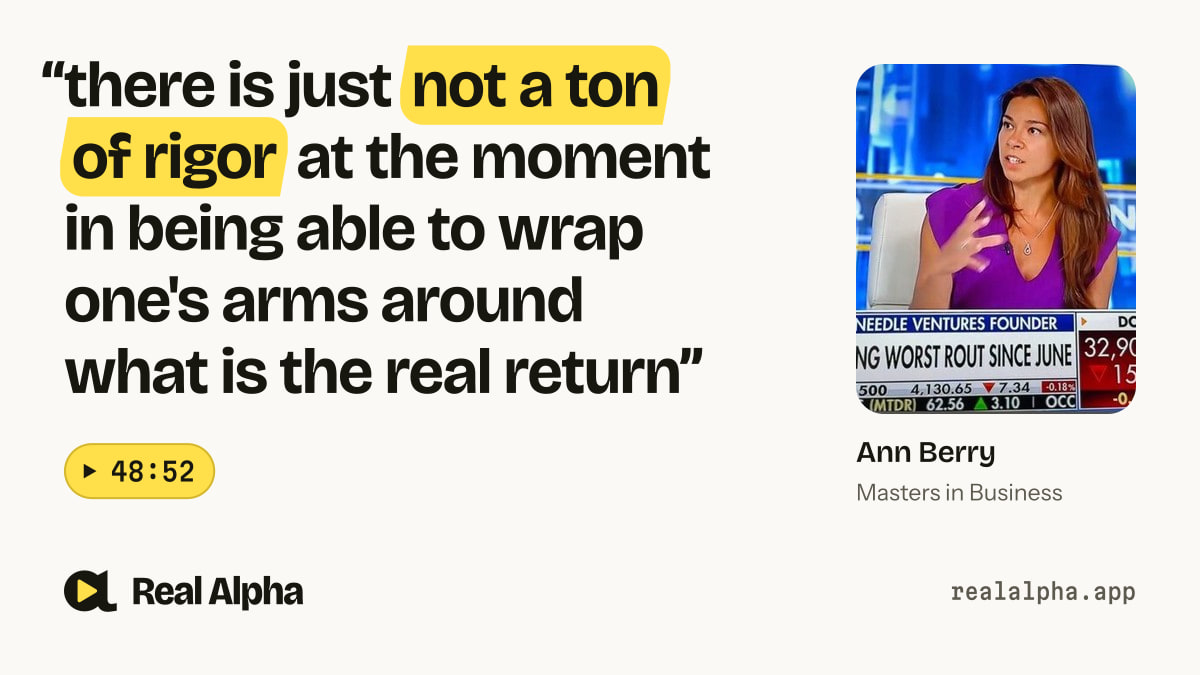
“there is just not a ton of rigor at the moment in being able to wrap one's arms around what is the real return”
 Ann Berryat 48:52 · Masters in Business
Takeaways Pro pick
- She believes AI’s impact is real, but its scale and timing are hard to measure.
- Big AI spending lacks clear return-on-investment analysis.
- She sees more valuation discipline in early-stage deals than in 2021–22.
One of Pro's picks, open to you here. Try Pro free for 7 days
One of Pro's picks. The rest of the summary and the 3 takeaways are in Real Alpha Pro; the video, the quote and the transcript stay free.
Read it with Pro, 7 days freeAbout this segment
Ann Berry believes AI will be transformational, but says investors still lack rigor around returns on massive capital spending. She sees more discipline in early-stage valuations than during the 2021–22 NFT and Web3 boom.

Ann Berry is founder and managing partner of Threadneedle.
Built investment experience at Goldman Sachs and Wheelhouse, then founded Threadneedle to pair capital with operating support.
- BR
Barry Ritholtz, Host
From “Providing Capital to Tech Companies: Masters In Business with Ann Berry | At the Money”, Nov 7, 2026. Watch the full episode
Thanks. We'll look at and fix what's off.
Transcript
From the transcript Masters in Business publishes with the episode.
- 48:13
My reaction is they're all legitimate concerns. And I raise that when I'm having interviews with CEOs of big. Companies in the space, Barry. And The reason I feel that way is not because I don't believe in the promise of AI. I absolutely do because I see it in the early stages, the most innovative, innovative to the most scaled. But as somebody who also spends a lot of time looking at public markets, trained by the discipline of looking at return on investment that comes from growing up in the private capital world, When you go and look at the earnings transcripts or listen to the earnings calls or look at the presentations or even read the analysts' research, there is just not a ton of rigor at the moment in being able to wrap one's arms around what is the real return that's being expected to these capex dollars. Now, the analogy
- 49:06
that people give is the internet age, right? The dawn of the internet. It's a terrible comparison. Tell me why you say that.
- 49:11
Well, these are real companies You talk about path to cash flow. Like Pets.com is the epitome of that space. And 20 years later, you have Chewy, which is what Pets.com could have been. It just was too costly then. Now these companies, they have scale, they have revenue. Some even have profits. It feels, plus the internet, You know, we had a sense of what the internet was going to do and it was connected, but we had print and we had video and we had other related things that the internet just made a whole lot more accessible.
- 49:49
This feels very much like an order of magnitude, like an industrial revolution, like change that's happening a hundred X faster. It just seems, and of course there'll be misallocation of capital. Like there always is every tech, innovation but a lot of things got funded during the internet it wasn't just that they didn't work out they were barely wisps of an idea it seems that what's getting funded are real things with real potential and in many cases actual revenue we can argue about two trillion dollar market caps clearly that's a giant number for a technology that we don't know how profitable it'll ultimately be.
- 50:36
And that's my point. That is my point, Barry, which is there are... We are in the world of tangible market caps. These are tangible numbers being tied to non-tangible, at least right now, returns. We know that there is gonna be an outcome that's tangible. It's the measurability that we're not able to see. That, to me, is where the concern lies. It's not whether the underlying technology will be transformational. I believe it will be. But how transformational and when is where the math becomes very difficult to unpack when you start looking at these valuations i just want to finish thought the one place i am seeing discipline is actually with these earlier stage companies if you roll back do you remember 2021 2022 anything that was an nft or web3 they were getting crazy valuations i'm not seeing that lack of discipline right now if i
- 51:24
which I do take some comfort from when it comes to the early stage investing.