The alpha, twice a week
That was 3 min.
Get the best new moments in your inbox every Wednesday and Saturday. It's free.
Check your inbox
We sent a link to your address. Click it to finish signing up. Not there in a minute? Look in spam.
or
Masters in Business · 3 min · Nov 7, 2026
She expects early-stage companies to reach cash flow in two years
 Ann Berry
 looks for execution-focused teams, a clear commercial problem and a path to cash flow.
The episode’s best minutes
Full analysis- 26:09She expects early-stage companies to reach cash flow in two years3 min
- 21:11Running a company changed how she evaluates investmentsPro pick 2 min
- 48:11AI’s investment risk is unclear returns, not unclear potentialPro pick 3 min
- 5 more moments in the full episode
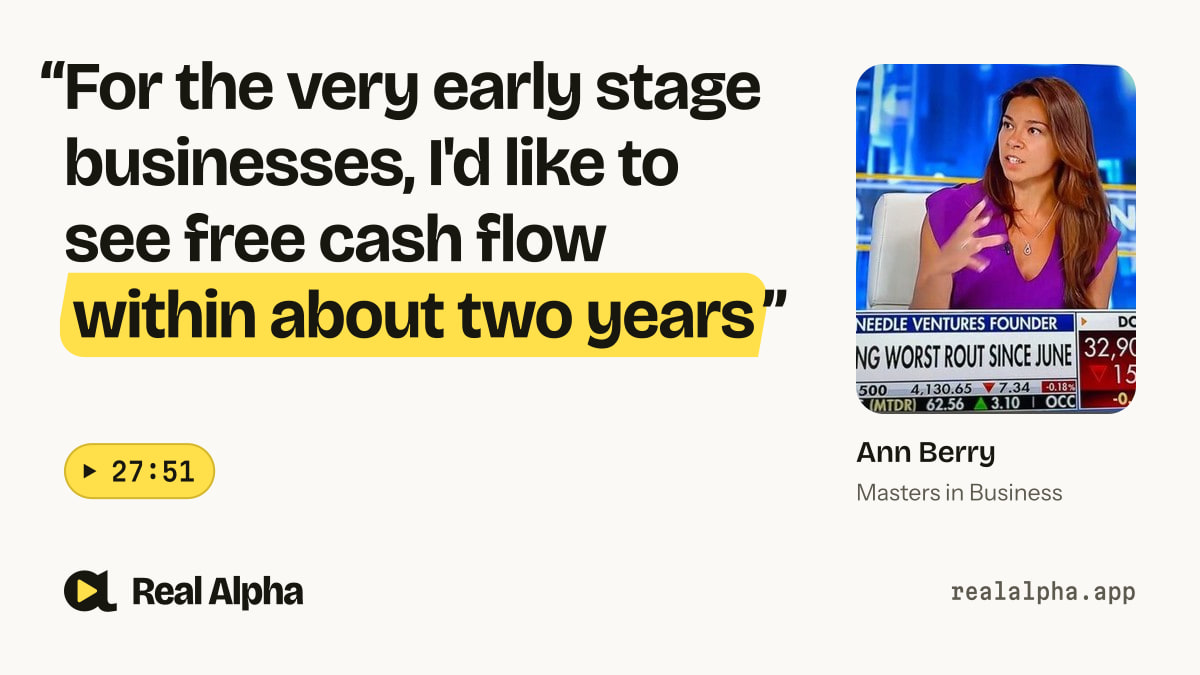
“For the very early stage businesses, I'd like to see free cash flow within about two years”
 Ann Berryat 27:51 · Masters in Business
Takeaways
- She looks for free cash flow within about two years at early-stage companies.
- A novel technology needs a credible path to commercialization.
- Mature businesses need a clear next chapter of growth.
About this segment
Ann Berry looks for execution-focused teams, a clear commercial problem and a path to cash flow. Her two-year target is a sharper screen than chasing growth alone.

Ann Berry is founder and managing partner of Threadneedle.
Built investment experience at Goldman Sachs and Wheelhouse, then founded Threadneedle to pair capital with operating support.
- BR
Barry Ritholtz, Host
From “Providing Capital to Tech Companies: Masters In Business with Ann Berry | At the Money”, Nov 7, 2026. Watch the full episode
Thanks. We'll look at and fix what's off.
Transcript
From the transcript Masters in Business publishes with the episode.
- 26:11
So you've invested across so many different stages. I want to define them. I want to have you define them for listeners. Everything from friends and family to seed to A-Round to an established company, private or public, that needs help integrating a new process or a new technology that'll unlock a whole lot of value. Tell us about the different stages that you consider.
- 26:38
So from the fund perspective, the earliest I would get to is the seed stage. Meaning after friends and family. After friends and family, yeah. I mean, I do those too. I do my own angel investing. I am friend and family to some of those in whom I've invested. And some of those have worked out incredibly well. But in terms of where the real rigor and the discipline of the patent spotting and looking for the repeatable themes, it's that sort of series A onwards, sometimes the seed, through to very mature companies.
- 27:08
And the thread, as I just said, is always looking for businesses where I do believe that there is a cultural focus on execution. And quite frankly, the ones where I've become involved and taken on an operating role are have been businesses with the potential to be great, but don't yet have that focus on executional excellence. And where I've dropped in, it's actually to bring that to the table in the blocking and tackling day to day. Now, there are a couple of other things that I do look for. I do focus on cash, even for the early stage businesses. A little unusually, a lot of venture capital folks, it's all about top line growth. The cash burn rate isn't as much of a focus for them.
- 27:44
Even from the get go, I'm focused on can this business be cash flowing? Fairly quickly, relative again to.
- 27:51
Others in the music community. Define quickly. Is that three months, a year? For the very early stage businesses, I'd like to see free cash flow within about two years, which for that sort of early stage is pretty quick. As we know, there are public companies into tech spaces that have gone public, IPO'd without having necessarily line of sight to free cash flow. But I can't help myself. I'm a private equity girl.
- 28:11
That's how I grew up. So I like to understand that level of financeable cash flow. The other thing that I would say, Barry, is I do like to understand with real precision what specific problem this company is solving. Because one thing I do see in my deal flow, I know you probably do too, there's some very exciting and interesting technologies out there and they're fabulous science experiments and great ideas. But is there a way to actually commercialize it? Is there a real business that can come out of it? And I've actually been surprised at how many young companies have been able to raise some money often for friends and family, because there's a novelty to what they're producing. But I haven't been able to get my mind around their ability to scale. Similarly, at the opposite end, when even it's investing in one
- 28:58
of these mature businesses, I want to know what the next chapter of growth can be for this company. It's not enough for it to just have stasis. What is it that it can do to transform its trajectory?