The alpha, twice a week
That was 5 min.
Get the best new moments in your inbox every Wednesday and Saturday. It's free.
Check your inbox
We sent a link to your address. Click it to finish signing up. Not there in a minute? Look in spam.
or
All-In · 5 min · Nov 17, 2026
Ali plans to go public but is waiting out AI-era volatility
 Ali Ghodsi
 weighs public-market visibility and capital against tender logistics and employee distraction from stock swings.
In this episode
Full analysis- 13:33Enterprise AI needs context, security, cost control, and control of IP4 min
- 44:01Recursive self-improvement requires four conditions5 min
- 29:41AI reveals why some engineers ship far more code3 min
- 38:57Ali plans to go public but is waiting out AI-era volatility5 min
- 50:05Ali sees legacy code as a finite cyber-risk backlog4 min
- 33:56AI can surface stalled decisions and culture drift4 min
- 24:10A survey analysis separated employee issues by department3 min
- 4:35Databricks' contrarian bets gave it years of head start3 min
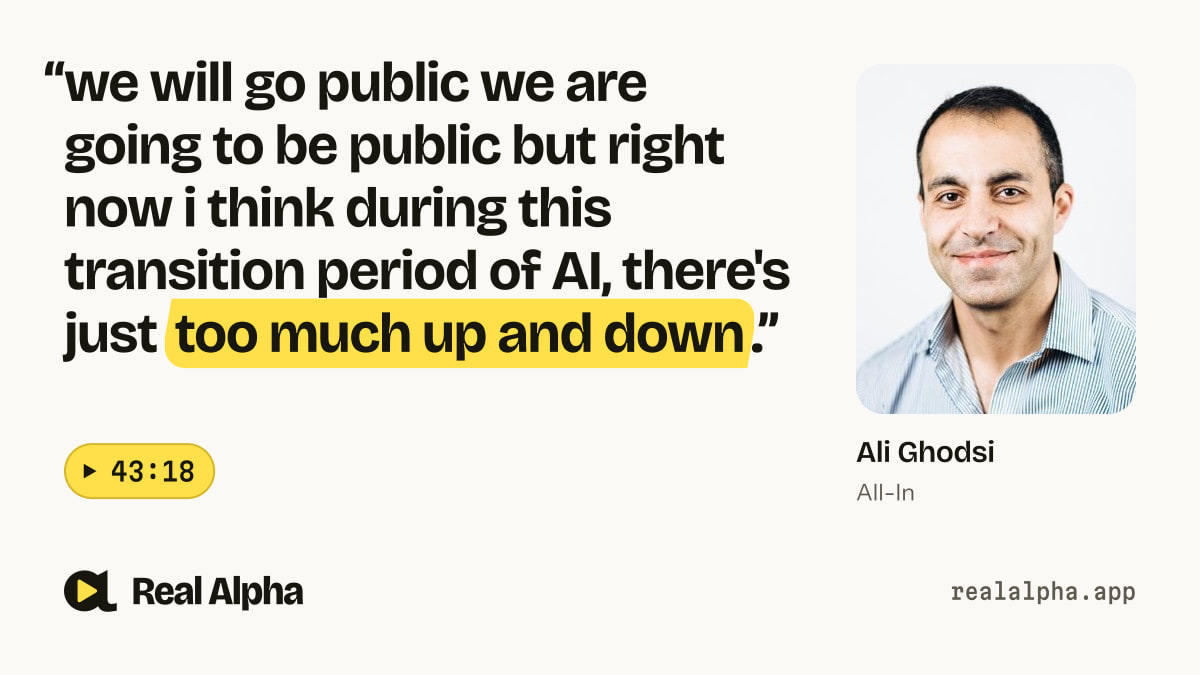
“we will go public we are going to be public but right now i think during this transition period of AI, there's just too much up and down.”
 Ali Ghodsiat 43:18 · All-In
Takeaways
- Public markets offer capital and recurring visibility.
- Annual tenders require substantial finance work.
- Stock swings can distract and unsettle employees.
About this segment
Ali Ghodsi weighs public-market visibility and capital against tender logistics and employee distraction from stock swings. He says Databricks will list, but not during this volatile AI transition.

Ali Ghodsi is CEO of Databricks.
Co-founded Databricks, which he has led as CEO since 2016, and helped create Apache Spark.

Chamath Palihapitiya, Host · Founder & CEO, Social Capital
Led Facebook's growth team; his firm backed Slack and AI chipmaker Groq.

Jason Calacanis, Host · Founder & CEO, LAUNCH
Early Uber angel; sold Weblogs Inc. to AOL; hosts This Week in Startups.

David Sacks, Host · Co-founder & partner, Craft Ventures
PayPal's first COO, founded Yammer; White House AI & crypto czar 2025–26.

David Friedberg, Host · CEO, Ohalo
Founded The Climate Corporation, sold to Monsanto for about $1.1B in 2013.
From “Databricks CEO: AGI Is Already Here, Why Companies Are Behind, and the Superintelligence Debate”, Nov 17, 2026. Watch the full episode
Thanks. We'll look at and fix what's off.
Transcript
Transcribed by machine (Whisper) from the episode’s audio, so a word may be off here and there.
- 39:02
decision? I know you've got a lot of pressure on you to do it, but you also have a lot of pressure relief valves in the vibrant secondary market. Yeah. Look, my goal is to make Databricks as successful as possible in the next decade or two. That's how I'm thinking about it. What's the right strategy to get there? I mentioned this alpha of what we're doing here, the products we're building, but we're getting into new markets. We got into the security market, go out into the marketing market. I'm focused on those. Then the question is, the path to get there is the best way and the fastest way for us to be public or to be private?
- 39:34
And I actually think that... Take me through that. What's on each side of the ledger for you? Yeah, I actually think that you get access to capital. You get much, much better marketing. It's like everybody knows about you. Every quarter, you have this big marketing event. You can tell your story again and again and again. Those are huge advantages. We have to organize our own tenders every year. Every year we do, finance has to go through this big process.
- 39:56
You know, I think we raised 20, 30 billion dollars and then we have to arrange. that it's a heavy lift. There is a marketplace that just does that. It's also probably a pretty emotional and distracting, I would think, right? Like people have to decide. Then you might lose people that, hey, they take $10 million off the table. Now they're like, maybe I don't want to come to practice anymore. I think the liquidity is a good thing because people know that they're going to get it every year and it kind of comes and it's like predictable.
- 40:18
And that's like the one time they have. And actually in the past, it's turned out since we started doing these a few years ago, it turns out that the money that we set aside for tenders, they never use up all of it. So most employees are bullish. Yeah. So most employees are like, no, this is good for you. You get signal from that, right? Who's selling? Who's not? It's a little bit of signal. It could be personal reasons.
- 40:37
But acquiring companies is a great reason to have equity. Yeah. We can, I mean, we haven't had a problem, you know, doing billion dollar acquisitions because they know because of the liquidity that we will provide. And then I think most people do the calculation is like, okay, if it's, you know, the business is $7 billion plus, and it's growing 70, 80%, they do the math. It's like, okay, I could, most people say, I want liquidity.
- 40:59
But then when you tell them like, okay, well, how much do you want to sell? We're growing 70, 80 plus. You know, can you do compounded growth of, you know, 1.7 to the power of three or four? And then they start scratching their heads like, okay, maybe I'll sell like 5%, you know? Yeah, sitting on your hands is a very important skill to learn as an investor and an employee with this kind of stock. I mean, listen, you do have to protect downside when you get in that space.
- 41:24
Who do you see as your competition right now? everybody says something like snowflake but i'm watching a market where as i said earlier anthropic is launching feature after feature cloudflare is looking at features next to them replit is looking features next to them everybody seems to be looking in their peripheral vision and because you can build software fast and because you have a lot of developers if those developers keep going up that ramp that you showed you only had 10 of people at that peak Which means as that 90% climb up there, your developer resources are going to go through the roof. So you have a decision to make. Do we just have less developers at the low end of the tail and be more profitable? Or do we invest all that developer time as they move up the ramp?
- 42:10
So how do you think about both of those issues? What to do with massive resources that this efficiency is creating? And then who is the competitor? And do you need to just keep making peripheral product moves? Yeah, we will make peripheral product moves. But maybe I should just start by saying, okay. So those were the upsides of going public. The downsides are, you know, is the reason why, you know, to answer your specific question, like, you know, why do we compete?
- 42:39
Who do we compete with? Why do we build these products? I don't want the market to force me that, okay, now it's down. And now it's, you know, sentiment is terrible this week. And now your stock is down. And when the stock is down, the employees literally are getting a pay cut. And I say, well, you know, you promised me I was going to make a million dollars. Actually, you said this is going to be 2 million in a couple of years.
- 42:59
but i'm looking at it right now uh and it's like 200k so you lied to me i'm leaving okay uh and then you know three months later it's like oh no no no actually the revenue is accelerating we were totally wrong it's up to the right now it's like oh okay wow it's great so there's like back and forth uh a little bit of a roller coaster that's what i want to avoid so that we can focus on that long term you know building the company towards the vision that we have in the long run without being distracted we will go public we are going to be public but right now i think during this transition period of AI, there's just too much up and down. And I think it's distracting to companies. It's distracting to CEOs. It's demoralizing to CEOs. You know, they call me, you know, they're like depressed because, you know, stock is down. They don't even understand
- 43:41
why. And then the stock is up. So that's what we're trying to avoid. I think it's an issue