The alpha, twice a week
That was 2 min.
Get the best new moments in your inbox every Wednesday and Saturday. It's free.
Check your inbox
We sent a link to your address. Click it to finish signing up. Not there in a minute? Look in spam.
or
Masters in Business · 2 min · Nov 18, 2026
All-in pricing rules now cover lodging and event tickets
 Lindsay Owens
 explains how drip fees and interface design hide a transaction’s real total, then outlines all-in pricing rules for lodging and tickets.
In this episode
Full analysis- 4:45Loyalty programs can penalize customers who keep coming back3 min
- 14:13Repair restrictions can turn one purchase into repeated charges4 min
- 18:07Public backlash can quickly force companies to change pricing3 min
- 7:23All-in pricing rules now cover lodging and event tickets2 min
- 9:47New York City requires cancellation by the sign-up method4 min
- 20:46Costco caps product markups and avoids personalized prices2 min
- 22:45Early studies found AI shopping agents often miss lower prices2 min
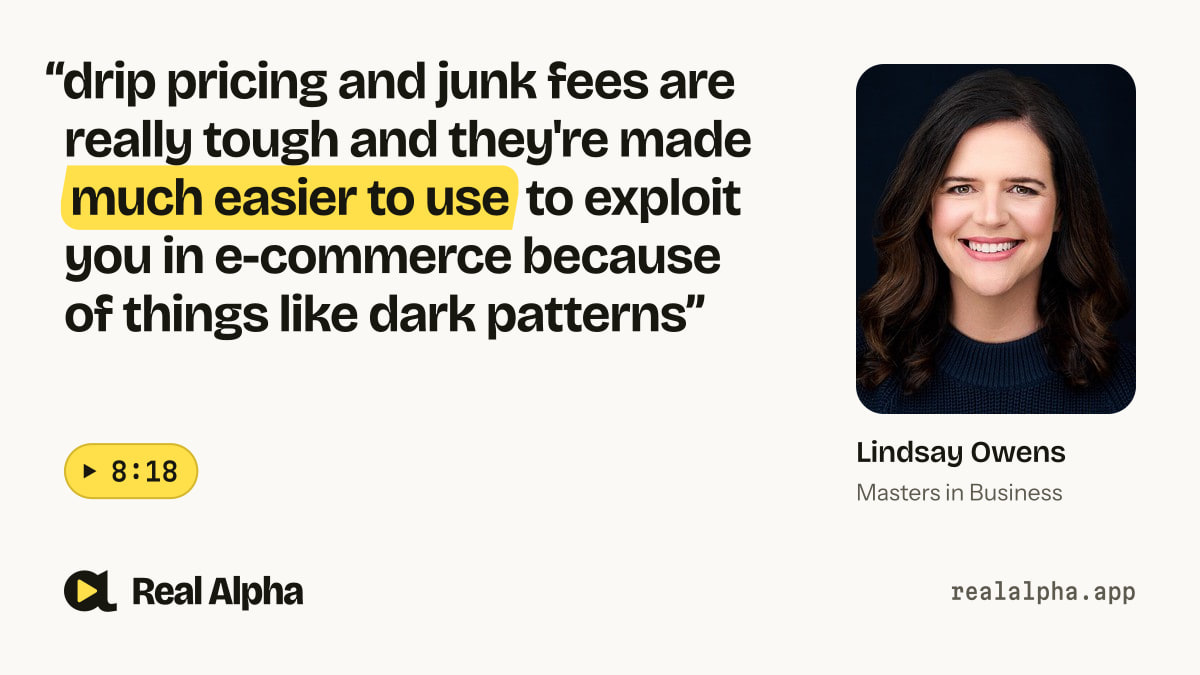
“drip pricing and junk fees are really tough and they're made much easier to use to exploit you in e-commerce because of things like dark patterns”
 Lindsay Owensat 8:18 · Masters in Business
Takeaways
- Drip pricing adds charges after a teaser price.
- Rules require upfront totals for lodging and event tickets.
- All-in prices help compare offers, not reduce the bill.
About this segment
Lindsay Owens explains how drip fees and interface design hide a transaction’s real total, then outlines all-in pricing rules for lodging and tickets. Those rules improve comparison shopping even when they don’t lower prices.

Lindsay Owens is CEO of Groundwork Collaborative.
Exposed corporate pricing power and profiteering, shaping debate on inflation, affordability and consumer protection.
- BR
Barry Ritholtz, Host · Columnist, Bloomberg Radio
From “At The Money: Shopping in an Era of Surveillance Capitalism | Masters in Business”, Nov 18, 2026. Watch the full episode
Thanks. We'll look at and fix what's off.
Transcript
From the transcript Masters in Business publishes with the episode.
- 7:26
Really, really interesting. Tell us about dark patterns and drip pricing. Are companies really doing last minute fees tacked on when you're about to engage in a transaction?
- 7:44
Yes. So drip pricing is the worst. It's this practice of sort of luring you in with a teaser rate or a low initial price only to tack on throughout the remainder of the transaction, drip, drip, drip, other fees such that the total price you pay at the end is much higher than the teaser rate. This is also in some settings called unbundling, something that you've certainly experienced in the airlines where the fare no longer includes things like your luggage or picking a seat, right? You have to pay extra for that. So drip pricing and junk fees are really tough and they're made much easier to use to exploit you in e-commerce because of things like dark patterns, the ways in which companies can manipulate user interfaces and make design choices that make it hard for you to see you know, that these fees have been
- 8:43
tacked on throughout the transaction. We do, thanks to the Federal Trade Commission rulemaking that happened at the end of the Biden administration, now prohibit drip pricing in two sectors of the economy. So instead, you have to see the full and total price up front. The first sector is short-term lodging. So if you've picked up an Airbnb or a VRBO recently, you probably noticed that you can now see the full price of a week's stay inclusive of things like cleaning fees and stuff like that that used to be tacked on at the end. And we also now require upfront pricing or all-in pricing in event ticketing.
- 9:24
So you can see when you hover over a seat to pick a concert seat, you now see the full price of the ticket. not just the price of the seat. So it includes the price of the fees and, you know, it doesn't make the price any cheaper, but it does allow you to do a better job of comparison shopping. And it makes it such that you at least know the full price that you're paying up front before you start the transaction.