The alpha, twice a week
That was 3 min.
Get the best new moments in your inbox every Wednesday and Saturday. It's free.
Check your inbox
We sent a link to your address. Click it to finish signing up. Not there in a minute? Look in spam.
or
Training Data · 3 min · Jul 15, 2025
AlphaFold's uncertainty estimates helped make its predictions usable
 Pushmeet Kohli
 says validation and access remain bottlenecks for AI-driven science.
In this episode
Full analysis- 24:17AlphaFold changed what biologists can work on nextPro pick 7 min
- 14:10AI-generated code can be both effective and interpretable6 min
- 20:03AlphaEvolve needs a trustworthy way to score its solutions4 min
- 2:19AlphaEvolve expands search from templates to full programs7 min
- 9:29Multi-agent refinement may surface ideas a single model misses5 min
- 33:57AlphaFold's uncertainty estimates helped make its predictions usable3 min
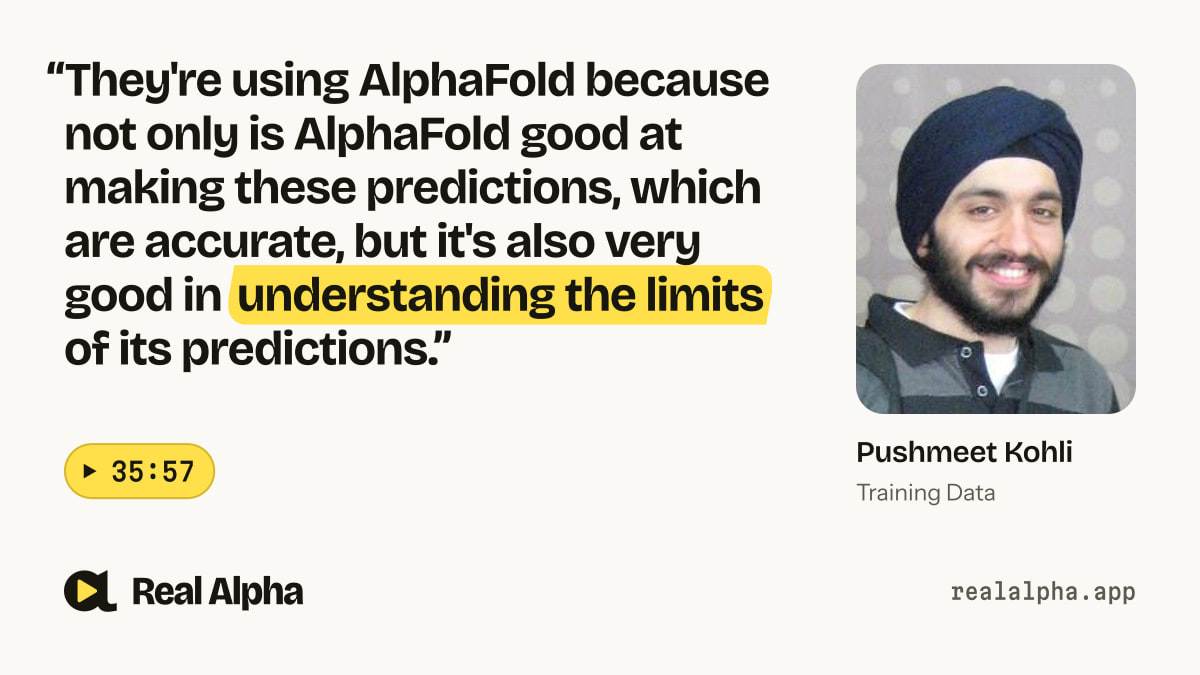
“They're using AlphaFold because not only is AlphaFold good at making these predictions, which are accurate, but it's also very good in understanding the limits of its predictions.”
 Pushmeet Kohliat 35:57 · Training Data
Takeaways
- Kohli says scientific discovery is already accelerating.
- Validation between digital models and reality remains a bottleneck.
- Communicating uncertainty helped scientists trust AlphaFold's predictions.
About this segment
Pushmeet Kohli says validation and access remain bottlenecks for AI-driven science. He credits AlphaFold’s uptake to signaling the limits of its predictions, not just producing them.

Pushmeet Kohli is a leads AI for Science at DeepMind.
Leads DeepMind's AI for Science unit behind AlphaFold, the Nobel-winning protein structure model, and AlphaEvolve.

Sonya Huang, Host · Partner, Sequoia Capital
Works with OpenAI and Anthropic; co-wrote Sequoia's essay on generative AI.

Pat Grady, Host · Co-steward, Sequoia Capital
Joined Sequoia in 2007; backed Snowflake, Zoom, ServiceNow and OpenAI.
From “DeepMind's Pushmeet Kohli on AI's Scientific Revolution”, Jul 15, 2025. Watch the full episode
Thanks. We'll look at and fix what's off.
Transcript
Transcribed by machine (Whisper) from the episode’s audio, so a word may be off here and there.
- 34:01
Really cool. Do you think we're going to have a fast takeoff moment moment for scientific discoveries? Do you think we're at the ramp of one? You think we're already there? I think we are in we are living through the middle of it. We just we don't like when you're in the middle, you don't really see it. But I think we are already in that era of air accelerated scientific discovery. What do you see as the biggest bottlenecks going forward?
- 34:24
I think sort of two elements. One is validation, bringing, bridging the gap between the digital and the real world. Right. How do you validate some of that? So that is one sort of key idea, right? And really sort of capturing what is important for the problem, right? And the second is sort of the other bottleneck is how do you make this technology accessible? You can build the most sophisticated technology if people don't know how to use it.
- 35:06
Then you will not have the impact that you want, right? Alpha fold 2, it was not just impactful and transformative because it had very high accuracy. Because even if it was quite accurate, it was not perfect. And suppose it was accurate on 99% of the things that it predicted. It's definitely not at 99%, probably at the 90 or 95% mark. But suppose even it was accurate at 99%. The one person who got unlucky with their prediction and then spent the next sort of one or two years chasing a wrong prediction would then sort of say that I should not use it.
- 35:55
I should not sort of use the predictions. So why is everyone using us? They're using AlphaFold because not only is AlphaFold good at making these predictions, which are accurate, but it's also very good in understanding the limits of its predictions. When it makes mistakes, it basically holds its hand and says, I've made a mistake. So now, if it is making your prediction and saying I'm confident, like most of the time, it's correct.
- 36:27
And that's great. This is something that the LLMs of today don't have. They don't have calibrated uncertainty. Should we close out with some rapid-fire questions? Yeah, sure.