Free with a sign-in.
The best 17 min of 41
DeepMind's Pushmeet Kohli on AI's Scientific Revolution
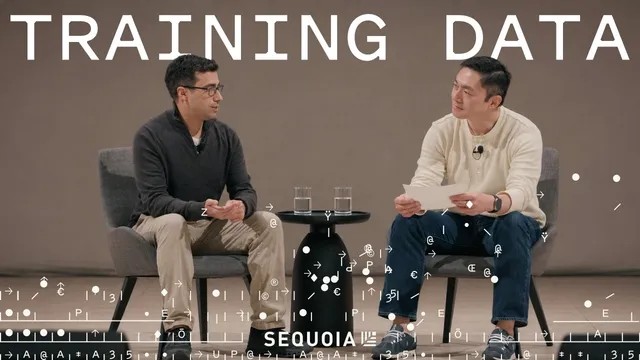
Pushmeet Kohli says evaluator-guided AI agents can discover algorithms and expand the problems scientists can tackle.
 Training Data · Sonya Huang & Pat Grady
- Pushmeet Kohli is a leads AI for Science at DeepMind.
The best minutes
- 24:17AlphaFold changed what biologists can work on nextPro pick 7 min
- 14:10AI-generated code can be both effective and interpretable6 min
- 20:03AlphaEvolve needs a trustworthy way to score its solutions4 min
Every moment plays free. PRO marks a write-up that's in Pro.
Also worth watching
- 2:19AlphaEvolve expands search from templates to full programs7 min
- 9:29Multi-agent refinement may surface ideas a single model misses5 min
- 33:57AlphaFold's uncertainty estimates helped make its predictions usable3 min
Skip the opening AlphaFold anecdote and show setup, the broad energy-and-society discussion, and the closing rapid-fire questions.
Full analysis · 6 min read
Real Alpha · Nov 11
Pushmeet Kohli says AlphaEvolve needs a trusted evaluator
- AlphaEvolve searches whole programs, and Kohli said it needs a function evaluator to score proposals.
- That makes evaluation design central, while physical results may still need real-world checks.
- Teams should budget for scoring, validation and uncertainty signals alongside candidate generation.
Free with an account
Read the rest of the analysis
6 sections, the 4 other voices it tests Kohli against, and what it means for you. Every episode we cut gets one.
Check your inbox
We sent a link to your address. Click it to finish signing up. Not there in a minute? Look in spam.
or
Signed up before? The same buttons sign you in. The episode, its moments and the transcript stay free.
AlphaEvolve's reach depends on scoreable proposals
Kohli said AlphaEvolve is useful wherever a function evaluator can quickly judge a proposed program. That is more specific than saying the system can solve any coding task.
The evaluator turns a research question into a score the system can use. That score can measure performance against a defined task, not whether a result is elegant.
For example, Kohli named C++, Python and Verilog, which describes chips, as languages AlphaEvolve can search. He also named data-center scheduling, where computer utilization offers a measurable target.
Kohli said AlphaEvolve can work with many fewer function calls than FunSearch. He said it can discover algorithms faster, though he gave no count for the savings.
The practical fit therefore depends on whether teams can define a useful score before scaling search. The transcript gives no count for the savings, so the efficiency comparison remains qualitative.
Our read
Our reading is that evaluator design shapes where AlphaEvolve fits. Model improvements matter most when teams can score proposals reliably and quickly.
Inspectable code gives engineers a reviewable result
Kohli's operational case for searching programs is that engineers can inspect and run the result. He said a neural-network policy could be harder to debug when something breaks.
That is a deployment argument, not proof that code is inherently safe. Readability lets specialists examine what the system produced, while tests still determine whether it works.
Earlier, Kohli contrasted FunSearch, which needed a researcher-supplied template, with AlphaEvolve's search over whole algorithms. This moves beyond a hand-chosen template, while leaving teams responsible for framing the task and evaluator.
In November 2026, Danila Shtan on Unsupervised Learning said engineers remain responsible for agent-produced code and pull requests. His point concerns engineering ownership broadly, not AlphaEvolve's scientific outputs, but it reinforces the accountability question.
For example, a team using generated scheduling code could keep the program reviewable and measure failures before rollout. The episode does not say how AlphaEvolve's generated programs are maintained after deployment.
Our read
Inspectable programs make review and debugging more plausible than opaque policies. They do not remove the need for expertise or testing.
Mathematics makes algorithmic progress easier to score
Mathematics offers a benchmark where an evaluator can settle a narrow result precisely. Kohli said Strassen's prior result used 49 multiplications for a four-by-four matrix, while DeepMind showed 48.
Kohli introduced AlphaTensor earlier as DeepMind's matrix-multiplication agent, but did not name it again beside the 48 count. The transcript points to that line of work, rather than establishing a new AlphaEvolve result.
The count is legible because it measures a defined result, not a human preference. That makes mathematics useful for checking whether search improved a specific objective.
In September 2026, Greg Burnham on The TWIML AI Podcast said automatic verification made unsolved math problems trackable. That comparison supports a narrower point than a general claim about scientific discovery.
In our reading, researchers still need to define the target and assess how the checker evaluates it. But a good check can make progress visible before anyone knows the best answer.
Biological experiments, chip performance and material behavior may not yield such a clean score. Math can establish progress on a defined problem, but not prove transfer to every field.
Our read
Crisp benchmarks help teams distinguish better answers from merely different ones. Extending that clarity beyond math remains a separate challenge.
Digital scores still need physical-world validation
Kohli said humans can evaluate proposals, depending on how many they need to assess and whether the relevant property can be judged effectively. That is different from saying people cannot scale.
He separately said elegance and simplicity are subjective, without crisp definitions and grounded in the human observer. Some goals therefore resist a single programmatic score.
Those are distinct issues. Human review can help with subjective judgments, while programmatic scoring supports repeated evaluation when outcomes are measurable.
Kohli said that if a computational model does not perfectly characterize reality, teams should validate the result in the real world. A digital score is then evidence to check, not the final answer.
In October 2026, David Friedberg on All-In said OpenAI's proofs worked because guesses could be tested quickly. He contrasted that loop with drug discovery and trucking, where physical-world testing means AI speeds work up far less.
That comparison aligns with Kohli's distinction between digital scoring and real-world validation. It does not imply that every scientific loop moves at the same speed.
 David Friedberg · All-In · Oct 10Math proofs fall fastest where the whole test loop runs in software
Our read
The evaluator is central to AlphaEvolve's usefulness, but its score is not always a sufficient test. Physical applications need checks against reality.
AlphaFold sped up one step in drug discovery
Kohli said determining a protein structure could take one to five years and might cost a million dollars. He also said roughly 37% of human proteins had known structures before AlphaFold 2.
He recalled a biologist who had spent ten years studying a protein, then checked AlphaFold 2's prediction against collected lab data. The anecdote is one case, not an estimate of average research time.
Kohli said work needing a synchrotron, six months and a million dollars could now take a second. He described AlphaFold's impact as advancing, accelerating and democratizing structural biology.
But he did not say that a protein structure prediction makes a drug. Target selection and molecule design remain steps, followed by toxicity checks and clinical trials.
Kohli said work that sometimes took two years could now take weeks or months. In October 2026, Tanishq Abraham on MTS called for models trained on clinical data and human biology.
Abraham's point cautions that promising earlier evidence may not translate to patients. So AlphaFold supports acceleration at one stage, not a claim that clinical development is solved.

Our read
AlphaFold made protein structures faster and more accessible. Drug development still depends on evidence beyond predicted structures.
Access and uncertainty shape whether scientists rely
Kohli named validation and access as bottlenecks for scientific AI. A useful output must reach researchers and show them when not to trust it.
Kohli said AlphaFold was definitely not 99% accurate, probably at the 90 or 95% mark. His 99% figure was hypothetical, not the reported estimate.
He warned that a researcher could spend one or two years following a wrong prediction. Confidence information can help users decide when to investigate further.
Kohli said AlphaFold's structures were made available to everyone, including researchers who lacked funding or instruments. Our reading is that availability solves only the first access problem.
Now teams can measure whether confidence predicts validation outcomes, rather than tracking accuracy alone. They can also test whether researchers can use the tool in their actual workflows.
Our read
Accuracy alone does not make a scientific tool usable. Confidence signals, validation routes and practical access help researchers decide when to rely on predictions.
What it means for you
- Map scoreable tasks. List work where a program can propose solutions and a reliable evaluator can score them. That is the clearest fit for AlphaEvolve's approach.
- Test code review. Have engineers inspect generated programs before deployment. Track which errors reviewers catch and whether the code remains understandable during debugging.
- Check real-world agreement. Compare digital scores with outcomes from physical tests or experiments. Record where the evaluator's rankings stop predicting reality.
- Measure uncertainty. Check whether outputs communicate their limits clearly enough to guide follow-up. Track how often confident predictions withstand validation.
What to watch
- Whether AlphaEvolve's evaluator approach extends from code and math to physical experiments.
- Whether AI-driven drug discovery shortens clinical validation, beyond accelerating protein-structure work.
- Whether scientific tools communicate calibrated uncertainty and reach researchers without specialized instruments.
Send this to science and engineering leaders defining AI evaluation budgets.
Watch Kohli explain when AlphaEvolve can score a proposal
Written by Real Alpha from the episode's transcript and the other moments it links, then checked against the transcript. Quotes are the speaker's exact words.
Minute by minute
A Pro write-up, open to you here. Try Pro free for 7 days
A Pro write-up. The minute by minute is in Real Alpha Pro; the episode, its moments and the transcript stay free.
Read it with Pro, 7 days free- 0:00AlphaFold solved a decade-old mystery
Kohli recounts a biologist who used AlphaFold 2 to identify a protein structure after a decade of lab work. The result matched data the researcher had already collected, illustrating how AI can change what researchers can investigate.
- 1:50The harness filters useful proposals
Kohli calls AlphaEvolve a milestone: an LLM paired with an evaluator and search protocol can discover algorithms and mathematical results. FunSearch completed a small function within a researcher-provided template; AlphaEvolve searches whole algorithms and, he says, can make discoveries with fewer function calls.
- 5:55Gemini expands the search
Kohli says stronger Gemini coding abilities help generate proposals that are syntactically correct and relevant to the task. Gemini Flash matters for generating candidates quickly, while AlphaEvolve can search across languages such as C++, Python and Verilog. The system needs a function evaluator to score proposals.
- 9:29Multi-agent systems improve with time
Kohli describes co-scientist as Gemini models playing different roles, including hypothesis generation, critique and ranking. He says its results can improve over days of refinement, possibly because the system can evaluate ideas better than it can generate them. He says the best agent configuration remains an open research question.
- 14:10Interpretable code can reveal structure
Kohli traces the work from AlphaZero and AlphaTensor to LLM-generated programs that engineers can inspect and debug. He says a 4-by-4 matrix multiplication result reduced the required multiplications from 49 to 48. In the cap set problem, he says FunSearch surfaced symmetries that mathematician Jordan Ellenberg recognized.
- 20:03Evaluators define where the system works
Kohli says AlphaEvolve can be used where an evaluator reliably measures how good a program is, and that humans could evaluate proposals if they can do so at scale. He says DeepMind used programmatic evaluators, while qualities such as elegance and simplicity may require human judgment. Physical experiments may also be needed when a computational model does not fully represent reality.
- 24:17AlphaFold shifts the scientific bottleneck
Kohli says AlphaFold 2 advanced, accelerated and democratized protein-structure research, including for scientists without access to expensive instruments. He says drug discovery still requires identifying targets, developing molecules and completing clinical trials, including toxicity assessment. Faster structural work removes one bottleneck, not the whole process.
- 31:19Validation and access remain bottlenecks
Kohli sees AI accelerating fields from healthcare and materials science to energy and coding, and says scientific discovery is already accelerating. He identifies two challenges: validating digital results in the real world and making the technology accessible. He also says AlphaFold communicates the limits of its predictions, while current LLMs lack calibrated uncertainty.
- 36:24Humans and AI will share breakthroughs
In the rapid-fire questions, Kohli names the wake-sleep algorithm and says he somewhat agrees that inference-time compute will matter, alongside test-time training and distillation. He is bullish on robotics over the medium to long term and sees humanoids as suited to human-designed spaces. He expects future scientific breakthroughs to involve humans working with AI.
Published Jul 15, 2025.
Transcript · 25 min read
Training Data, hosted by Sonya Huang and Pat Grady, with Pushmeet Kohli.
Transcribed by machine (Whisper) from the episode’s audio, so a word may be off here and there.
So I went to a biology conference and after I gave my talk, a biologist approached me and he said, Pushmeet, I have been working on this protein for the last 10 years. And I had collected so much lab data to characterize this protein, to figure out its structure, but somehow this has eluded, this has evaded all kinds of investigation and we still didn't know the structure. But we had all this data. If we knew the structure, we could sort of validate it very quickly. I ran AlphaFold 2. It gave me the structure. It perfectly fit the answer. I've been working on this for 10 years. Wow. What do I do next?
What happens when AI stops just answering questions and starts asking them? In this episode, Pushmeet Khali discusses DeepMind's Alpha Evolve, a breakthrough evolutionary AI system that discovers entirely new algorithms. Pushmeet reveals how coupling language models with evaluators creates something unprecedented, AI that can tackle decades-old math problems and generate human-interpretable code that outperforms expert design solutions. Pushmeet shares stunning examples of AI uncovering hidden mathematical truths and explains why we're witnessing the emergence of a new scientific method, one where AI doesn't just accelerate discovery, but transforms which problems we can even attempt to solve. Enjoy the show. Pushmeet, thank you so much for joining us today. We've all been eagerly waiting for the moment that AI is capable of making novel scientific discoveries.
Do you think that Alpha Evolve is that watershed moment? Yeah, so it's certainly a key sort of milestone. What we have shown is that you have an AI sort of model, a large language model, when coupled with a harness, is able to discover new algorithms. And not only that, it's basically able to view new mathematical results, which have been studied for many, many years.
Read the whole transcript
“With Alpha Evolve, we have removed that restriction.”
It seems like the rough kind of cognitive architecture, so to speak, of generating a bunch of algorithm candidates, evaluating them, and then, I guess, evolutionarily deciding which ones to keep and then going forward from there. And it seems like it roughly mirrors the scientific method. Is that intentional?
“the very first answer that you might get might not be very different from the baseline Gemini sort of model.”
“if you use a typical reinforcement learning agent on this kind of problem you might get better results, but it might come at the cost of interpretability.”
“i really trust this evaluation scheme if you give me a program i can tell you very concretely how good it is”
“Pushmeet I have been working on this protein for the last 10 years and I had collected so much lab data to characterize this protein”
So we have taken a big step, but we need to take a few more big steps. What domains do you think will be most lucrative for this family of models?
I think the question is, what is, I mean, the answer to your question is basically, what domains do you think are important for society? because AI is going to accelerate everything. It's going to accelerate healthcare. It's going to accelerate sort of the ability for us to develop more smart systems. from healthcare to sort of material science. Like if you think about the history of our civilization, we even describe our civilization in the sense of there was first, we were sort of cave dwellers and then we went into the stone age and then we sort of went to the iron age and then the bronze age.
And now depending on who you talk to, you're either in the silicon age or in the plastic age, whether you're plastic or feeling a bit sort of sad. But if you take a step back and you think about what has humanity achieved, what we have achieved compared to any other species is the ability to transform energy, to leverage energy, right? We have been able to leverage energy and do big things with that power. Now, if you can come up with, say, a new room temperature superconductor, that completely transforms your ability to handle energy. right what changes will it bring about in society they are hard to predict if you can if you can deal with energy in that way right if we can unlock fusion right and energy becomes so cheap every like like if you think about geopolitics if you think about economy a lot of it is about energy right and suddenly if energy sort of goes down to zero So what will be the impact on the economics of the whole thing?
Similarly, like if you think about like coding and if you have these agents which can code, what does that mean? If everyone can sort of code, like intelligence sort of is completely ubiquitous. Everyone has access to all these different things. So there will be dramatic changes and everything will be impacted. So from from materials to energy to sort of coding to health care.
“They're using AlphaFold because not only is AlphaFold good at making these predictions, which are accurate, but it's also very good in understanding the limits of its predictions.”
Must-read paper of the year. Must-read paper of the year? Oh, I would say Alpha Evolve or co-scientist. I like co-scientist. Favorite algorithm nobody talks about? Oh, the wake-sleep algorithm. And very few people know about it, But it's essentially the idea, it's a paper from MIT, from Kevin Ellis and Josh Tendenbaum, which sort of talks about, it's a way of sort of doing training where you find some exploration and then you somehow build the gist of it, right?
So think about sort of library construction. An analogy is library construction, right? You don't just want to write programs, but you want to also create the libraries that have common modules that will make all your future programs much easier to write. Very cool. Agree or disagree, inference time computes will be the next major lag of compute scaling. Somewhat agree. Okay, say more. so i think inference time compute will be very very important i think also test time uh sort of training time compute will be equally important right we also like if you look at distillation how powerful distillation sort of has been right so if these models have a have an ability to sort of understand and conceptualize what these models are able to do and come up with better inherent representations, then they just become much more effective in making predictions.
Maybe their sort of uncertainty improves and so on. They become more efficient even. Robotics, bullish or bearish? I'm bullish about everything. So I have to say bullish. Like, I think everything will be sort of, will have an impact. So, but the question is basically near term or longer term, right? In the near term, it will take some, sort of getting robotics to work is challenging. But like in the medium to long term, I think I'm bullish. Humanoid robots, bullish or bearish? We have constructed our world for humans, right? Like the human form. a lot of the non-natural world around us is made for humans, has been designed for humans, like from an architecture perspective, right? Now, humanoids have the same form as humans. So they will fit in, in all these different architectures that we have built.
Now, whether they are the most optimal thing, that is not clear, but they certainly sort of have an advantage that we designed everything for the human form, and now humanoids have the same form. Future Nobel Prizes in the sciences. Will all of them be won? by teams working with AI? No, I think we would be getting there, but I think like humans are still winning Nobel Prizes in the sciences. So I think there will come a point where AI will be indispensable. So it will be sort of humans and AI teams working together to achieving these amazing breakthroughs. Pushmeet, thank you so much for joining us today.
These are really fundamental, really general results that you're pushing forward at DeepMind. And we appreciate you joining us to share more about how you managed to do all this so far and what's ahead. Thank you. Thank you. We'll see you next time.