The alpha, twice a week
That was 4 min.
Get the best new moments in your inbox every Wednesday and Saturday. It's free.
Check your inbox
We sent a link to your address. Click it to finish signing up. Not there in a minute? Look in spam.
or
My First Million · 4 min · Oct 28, 2026
Amazon treated page speed as a hard product constraint
 Ethan Evans
 says Amazon tested page changes against sales, but speed set the hard limit: extra load time drove abandonment.
In this episode
Full analysis- 35:52Bezos passed on crowded, regulated markets6 min
- 45:28Amazon Prime began as a 100-day response to a weak quarter5 min
- 18:49Bezos used customer complaints to drive fast accountability3 min
- 2:49Bezos’s past wins made product dissent harder to hear6 min
- 10:27Reliability could matter more than brilliance at Amazon4 min
- 50:33Amazon treated page speed as a hard product constraint4 min
- 30:50Ethan nearly matched his Amazon pay on a 20-hour week3 min
- 1:03:41Ethan used Twitch to build coaching skills before going independent6 min
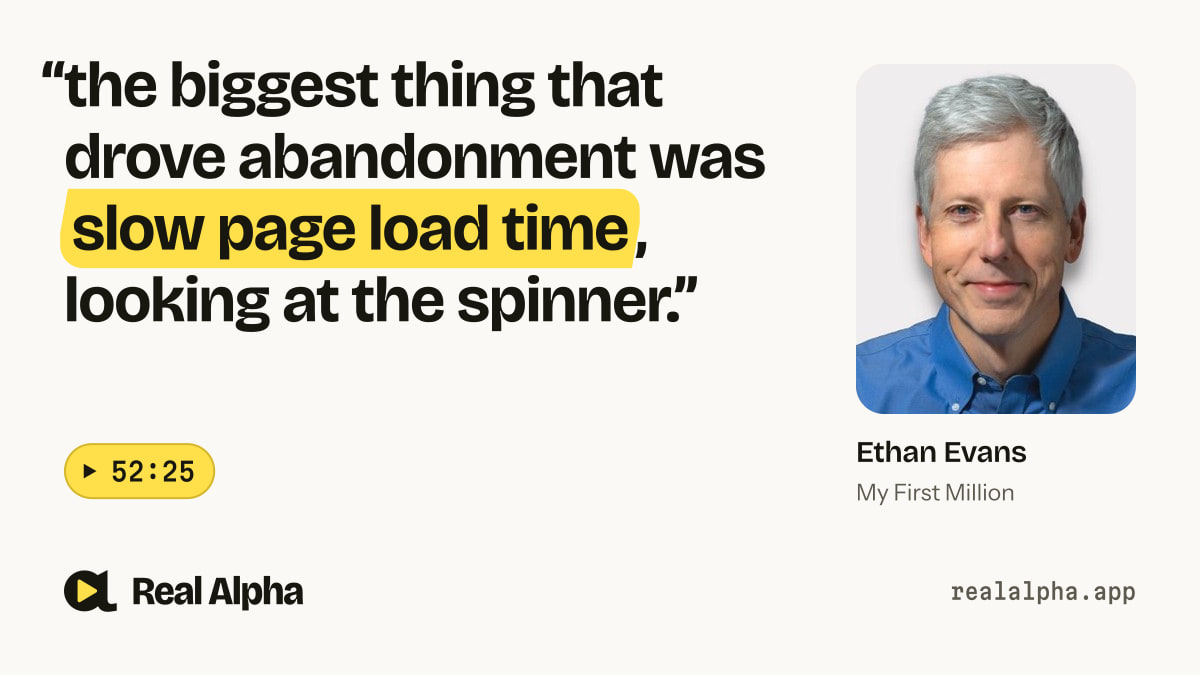
“the biggest thing that drove abandonment was slow page load time, looking at the spinner.”
 Ethan Evansat 52:25 · My First Million
Takeaways
- Amazon ran thousands of simultaneous A/B tests through WebLab.
- Teams had to add features without increasing load time.
- Clarity, low prices and delivery promises mattered more than visual polish.
About this segment
Ethan Evans says Amazon tested page changes against sales, but speed set the hard limit: extra load time drove abandonment. The design rule was to keep pages fast and make every addition load-time neutral.

Ethan Evans is a former Amazon VP and executive coach.
Invented Prime Video, Amazon Appstore and Prime Gaming, and led global teams of 800+ during 15 years at Amazon.

Shaan Puri, Host · Co-host, My First Million
Sold Bebo to Twitch in 2019; co-founded the crypto newsletter Milk Road.

Sam Parr, Host · Co-founder, Hampton
Founded the business newsletter The Hustle and sold it to HubSpot.
From “Ex-Amazon VP: What it's really like working with Jeff Bezos”, Oct 28, 2026. Watch the full episode
Thanks. We'll look at and fix what's off.
Transcript
Transcribed by machine (Whisper) from the episode’s audio, so a word may be off here and there.
- 50:44
Can I ask you a question about Amazon's website? I use Amazon as an example about why bad design is better than good design. And I use the example, like good design is used, I think, poorly. Good design means the customer does the desired action. But oftentimes, like a Brooklyn cool kid will think good design means like certain colors and flat like whatever this bullshit is but if you go to like amazon kindle which is their listing page which is like one of the top selling products i'd imagine on amazon it's like thousands and thousands or it's probably actually hundreds of thousands of words if you add up all the reviews it's mostly copy it's pretty ugly there are some photos but it is not what a 25 year old cool kid would ever design can you tell me about some of the A-B experiments that you guys ran
- 51:33
or what the strategy was for using copy versus like this beautiful, whatever the trend has been throughout the eras of like making things pretty. Yeah, well, first, everything at Amazon is A-B tested and the winner is what drives up sales. It's a program called WebLab and you run a WebLab and they have a complicated system so that thousands of competing experiments can be running at the same time And yet somehow they can distill the data for one experiment and tell you what it did.
- 52:07
So it is data-driven and it's profit-driven. Nobody cares about the pixels as long as they sell. There were many pushes in Amazon to make it prettier. And there were several design VPs hired who fought for that. The actual algorithm behind the Amazon homepage and Amazon pages for a long time was not what was on them, but how fast they load. because Amazon came of age when internet was still somewhat slow and they realized the biggest thing that drove abandonment was slow page load time, looking at the spinner.
- 52:42
So the biggest single metric was not what are you putting on there, but how you militantly could not add a millisecond to load time. You know, if you wanted to add a feature, you had to figure out how to do it load time neutral. So the overall design principle, I guess I'm telling you that was hidden behind the scenes, was speed equals sales. And beyond that, whatever goes on the website equals sales.
- 53:09
And pretty pixels didn't seem to matter. Clarity, having that buy box always be the same so you could find the buy button. And what could you put in the buy box that had an attractive offer? Low price, showing a discount, showing the delivery schedule. But mostly Jeff figured out low price drove business. I was there, I said I joined in 2005. That means I was there in sort of the recession of 2007, 2008.
- 53:42
Amazon froze hiring for a little while and I had been in a couple of startups that had run out of money. So I started looking over my shoulder like, oh, is it time to get the resume sharp again? Amazon profited during that time because since we had focused so much on low prices, when money got tight, more people converted to online shopping.