The alpha, twice a week
That was 6 min.
Get the best new moments in your inbox every Wednesday and Saturday. It's free.
Check your inbox
We sent a link to your address. Click it to finish signing up. Not there in a minute? Look in spam.
or
Latent Space · 6 min · Nov 10, 2026
An MCP should cover the whole product
 Zeno Rocha
Resend treats MCP as a full product surface, from OAuth and RBAC to official integrations.
The episode’s best minutes
Full analysis- 7:01Email delivery depends on pacing and reputationPro pick 5 min
- 38:02An MCP should cover the whole product6 min
- 58:26Markdown pages can correct AI pricing answers7 min
- 5 more moments in the full episode
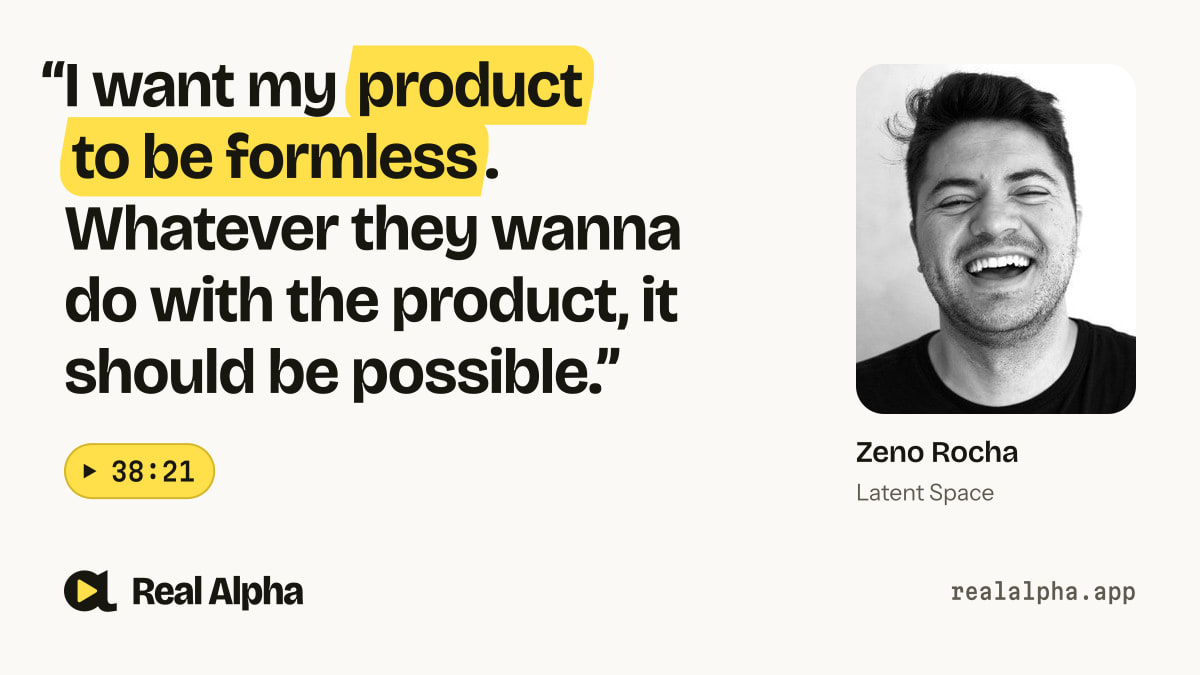
“I want my product to be formless. Whatever they wanna do with the product, it should be possible.”
 Zeno Rochaat 38:21 · Latent Space
Takeaways
- Build remote MCP on OAuth and a real permissions model.
- Official, maintained integrations can affect buying decisions.
- Full product coverage includes billing and account management.
About this segment
Resend treats MCP as a full product surface, from OAuth and RBAC to official integrations. Zeno Rocha argues tool coverage should match the dashboard, including account and billing actions.

Zeno Rocha is cofounder and CEO of Resend.
Co-founded Resend, an email platform for developers, and launched React Email, open-source components for building email templates.

Shawn Wang (swyx), Host · Co-founder, AI Engineer
Wrote “The Rise of the AI Engineer” and founded Smol AI, maker of AI News.

Alessio Fanelli, Host · Founder, Kernel Labs
Partner at Decibel, backing technical founders who build developer tools.
From “Designing for Agents — Zeno Rocha, Resend”, Nov 10, 2026. Watch the full episode
Thanks. We'll look at and fix what's off.
Transcript
From the transcript Latent Space publishes with the episode.
- 38:07
Yeah, everyone was saying MCP was dead, right, a couple months ago. Like, yeah, the only thing that matters is the CLI. What I've noticed is that I stopped paying attention to w-what-what's in, what's out, and I, I really think about these problems as like, "Okay, how do I want my product to be?" Well, I want my product to be formless. Whatever they wanna do with the product, it should be possible. So that, that's why we've always been API first.
- 38:35
Uh, you know, I had no idea how much this would help us down the line, but I knew, yeah, like if-- I will never be able to cover all the use cases, so let me just give the API. You do whatever you want. And with the MCP, it's just fascinating, like every month, like at least two X growth. And now in August, these numbers are even more. This was before the end of August. I think it was one point two million by the time it ended. But, um, yeah, like p-people are starting to work from Cloud Desktop or, uh, Codex. And if work starts from there, then you need those integrations, right?
- 39:12
It's just super important. I just wanna clarify as well. Sure. Uh, so you know, you, you showed us sort of like the month-by-month numbers on the MCP thing. Mm-hmm. It picked up from like, let's say fifty percent month-to-month growth, which is already super high. Mm-hmm. Then it starts to double basically every month. Mm-hmm. Did you do investment into MCP, or you just had an MCP, and it just, after some time, it gets picked up? Well, the, the fun fact about that, our very first MCP was built by Yoko from a16z, our investor.
- 39:39
[laughs] Oh, wow, value add. Yeah, right. [laughs] Brilliant. So she, she built the, the open source version. It was a remo-- uh, a local MCP. And, and then it started to grow like, like crazy. And I was like, "Man, why are people using-- It's, like, so hard to set up MCP." This was, uh, last year. And then- Yoko. [laughs] Yeah, exactly. And so she built that, uh, and then I just asked her, "Hey, can you transfer to our org?" It was like, just like an engineer building something. And it was nice to see after the traction it was getting.
- 40:11
But to do the MCP right, to do the remote one, we had to go back and revisit our entire permissions model because we needed OAuth. And then we were like, "Okay, now we have a blocker. Let's build OAuth." So then we build OAuth, and it's like, okay, RBAC, let's look at that. Like, let, let's look at how users, uh, have access to each one of the resources. So it was a whole journey to build OAuth, and then after we had OAuth, okay, now we have the remote MCP, and then it's distribution. So then, okay, now we have the remote MCP. Okay, great, great, great.
- 40:45
Observability is in place. Great, great. Okay. All the Datadog dashboards. Okay. Now all in, let's talk to everyone, and that was hard too. Like, uh, it's not as easy-- I wish I had all your connections. Uh, it's not as easy to- You, you can talk to me. Yeah. [laughs] You're just supposed to talk to me. Uh, but, like, talking to the labs and trying to get into, like, the, the official stores and plugin marketplace and stuff like that. So do you think that actually matters? Oh, for sure. Yeah.
- 41:12
So I, I think sometimes, like- Mm-hmm... I've been on the other side where I try so hard to get these partnerships, we launch it, and then nothing. Oh, man. Right? So- Mm-hmm. [laughs] Which one matters? So as a consumer, I make decisions now based on, do I have the access to that data or not? So as a, as a buyer of B2B software, if I go to the cloud connectors and I don't see the company listed there- Mm...
- 41:38
with an official MCP, like for-- We had this. Like we had a pl-- We were using Plausible and PostHog. Plausible had an MCP built by Sentry. I don't care. If the Plausible doesn't maintain that and that's not official, I c- I don't-- I cannot trust that as much. Even though I love the Sentry team and I trust that team, but I need the owner of the software to own this piece of integration too. Oh my God.
- 42:02
And I made the call like, "No, we are getting rid of Plausible, and we're just gonna use, uh, PostHog here because I have the MCP there." And I did that as a, as a B2C consumer too. I'm like into running, and then I'm like, "Oh, let me..." Like Strava, Strava has an MCP. I can, like, access my runs, so I use Strava because of that. So, uh, and if there's like, "Oh no, we have an MCP, but you have to connect like this," like the XMCP, for example. I have to do, like the, the local one. It's just so frustrating.
- 42:34
It works on the desktop client, not on my phone. Like Like, to me, it's just... Yeah, if it's not there, I don't use it. Apart from, okay, it is officially maintained by the vendor or whatever- Mm-hmm... what makes a good MCP versus a so-so MCP? Even for hours, as I, as I interact with that, there were ti-- I always-- Like, it's always collapsed, right? The, the tool calls, I'm always opening and trying to understand, like, what did it do?
- 43:00
And just a couple days ago, like, there was one call where it couldn't put everything on the contacts for some reason, and then I'm like, "No, this shouldn't happen." Like, how much data are we sending? Maybe we're sending way too much data to the client. So that's something that I noticed. Like, the amount of tools, this was a bigger concern earlier. Like, oh, if you have way too many tools, it get confused.
- 43:22
I don't see that as much anymore. Uh, and in fact, we're just adding more to the MCP. Oh. Like, we had, like, maybe, I don't know, twenty tools when we launched, or even less than that. Now we have, like, eighty-something tools. What the fuck? [laughs] Yeah. And, like, I'm adding more and more. Like, the, the long tail of tool-- uh, of, like, the, the footprint. That's what I've noticed. Like, you can do, like, only ninety percent of what your dashboard does- Uh-huh... and that's one way of doing it, or you can do one hundred.
- 43:56
Getting to one hundred percent coverage of what your dashboard can do is actually very, very difficult. 'Cause now you're doing usage, billing, team invites, account provisioning, deletion. Should that be exposed as an API or not? Like, it's, it's really hard. Like, it's a- Yeah... it's a difficult problem. Yeah.