The alpha, twice a week
That was 5 min.
Get the best new moments in your inbox every Wednesday and Saturday. It's free.
Check your inbox
We sent a link to your address. Click it to finish signing up. Not there in a minute? Look in spam.
or
Latent Space · 5 min · Nov 10, 2026
Email delivery depends on pacing and reputation
 Zeno Rocha
Gmail meters large sends based on early engagement, so providers pace queues and warm IP pools.
The episode’s best minutes
Full analysis- 7:01Email delivery depends on pacing and reputationPro pick 5 min
- 38:02An MCP should cover the whole product6 min
- 58:26Markdown pages can correct AI pricing answers7 min
- 5 more moments in the full episode
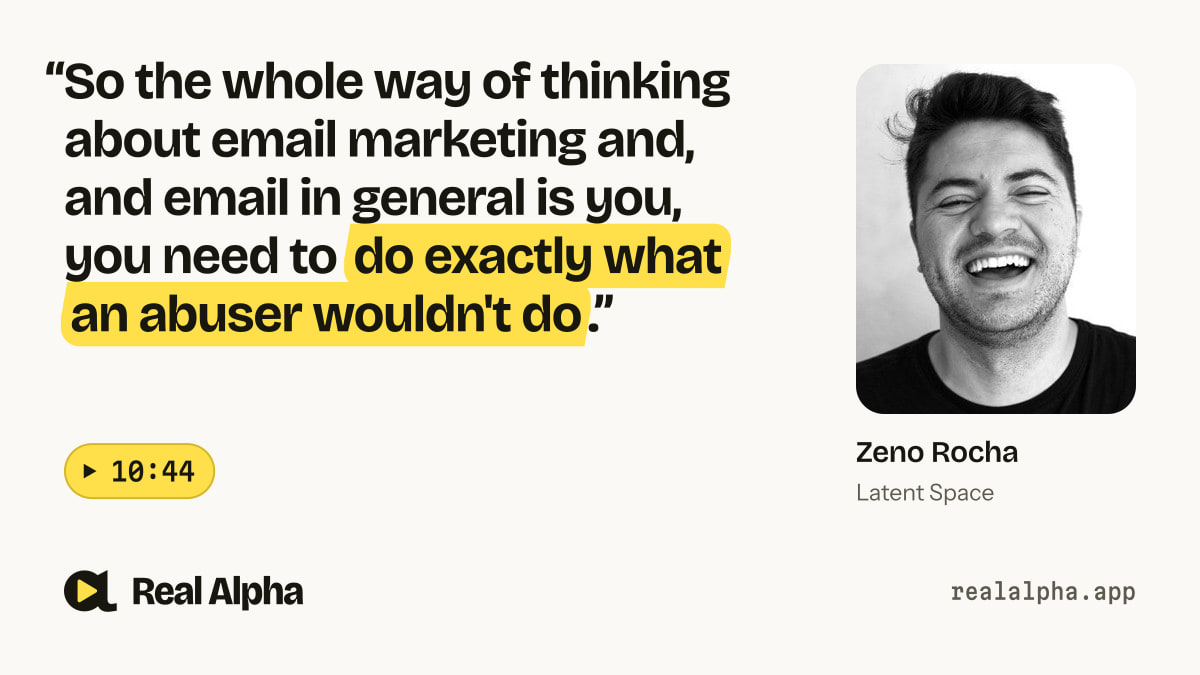
“So the whole way of thinking about email marketing and, and email in general is you, you need to do exactly what an abuser wouldn't do.”
 Zeno Rochaat 10:44 · Latent Space
Takeaways Pro pick
- Prioritize engaged recipients early in a large send.
- Space batches and manage throughput for each provider.
- Look for abuse patterns such as new domains and sudden bursts.
One of Pro's picks, open to you here. Try Pro free for 7 days
One of Pro's picks. The rest of the summary and the 3 takeaways are in Real Alpha Pro; the video, the quote and the transcript stay free.
Read it with Pro, 7 days freeAbout this segment
Gmail meters large sends based on early engagement, so providers pace queues and warm IP pools. Zeno Rocha explains how abuse patterns shape sender safeguards.

Zeno Rocha is cofounder and CEO of Resend.
Co-founded Resend, an email platform for developers, and launched React Email, open-source components for building email templates.

Shawn Wang (swyx), Host · Co-founder, AI Engineer
Wrote “The Rise of the AI Engineer” and founded Smol AI, maker of AI News.

Alessio Fanelli, Host · Founder, Kernel Labs
Partner at Decibel, backing technical founders who build developer tools.
From “Designing for Agents — Zeno Rocha, Resend”, Nov 10, 2026. Watch the full episode
Thanks. We'll look at and fix what's off.
Transcript
From the transcript Latent Space publishes with the episode.
- 7:06
Some people would just, you know, "Okay, I can use Twilio, I can use SendGrid, I can use you guys." Yeah. But what goes into making a tool to just mass send emails? What do people not think about? Yeah. There's just a lot of different things you can do because landing on the inbox, especially when you're doing high volume, is different from, like, when you're scaling just, like, an, a-an app where you throw GPU at the problem, or you just scale more vertically or horizontally, whatever it is.
- 7:32
With email, you gotta respect the rules of the game, and how Gmail behaves is differently from Outlook and differently from Yahoo Mail, and it's an industry that is fascinating because it's so old school and it relies a lot on, on contacts. But what we found early on was like, okay, we ha- we knew nothing about this world, and so, and, and coming from this perspective, like extremely naive, was the best thing that ever happened.
- 8:01
Uh, like, honestly, like, it was the best thing because, like, there's no preconception of what is right, what is wrong. So for them, for example, every single app, you go and then first thing you see is, like, this form that you gotta fill out about, like, how many emails we're gonna send, what's the volume, what are you trying to do? And then you go through a human verification process. Two days later they accept you or, or deny you. Most of the times they're gonna deny you. And I was like, "This doesn't make any sense," right?
- 8:27
[chuckles] Like, why are we blocking people? So I know I'm gonna remove that friction completely, and the friction will be on us. We're gonna figure that out. Of course, now four years, three years in, in-into this business, I get it why they do that. [laughs] There's just so much fraud and phishing and abuse across the board. I don't talk too much publicly about that, but we build, like, all sorts of crazy systems internally for that.
- 8:53
But to your question, like, how you architect that, like for example, when you're sending an email to 100,000 people, if you just throw 100,000 emails, uh, like, to Gmail, what Gmail will do is they're gonna throttle the emails because it's way too much, and they, they wanna see the engagement. So what you do is, like, they see, like, okay, are people opening the emails? Are people archiving, deleting right away or, or not interacting?
- 9:19
Okay, depending on those initial, uh, interactions, then what I'm gonna do with the rest of the emails will dictate that, that beginning. So there are clever things you can do where 100,000 people put the most engaged audience members in the beginning of that queue. You have to put that in a queue. You, you need to-- It's an art and a science where you gotta space out each batch. [chuckles] So, and space out between the different providers too, and yeah, now we're, like, buying different IP blocks.
- 9:50
You gotta look at the history of the IP blocks, distributed folks into different IP pools, and then balance the IP pools over time. So it's a whole crazy infrastructure game. How automated can that be or is there a lot of human judgment still? Yeah. It's a lot of automation, for sure. Yeah. Uh, and I think over time we learned that, okay, this is how fast we can send for new customers. Of course, if you're sending more, then maybe you can send faster, but there's a, a, a throttle that we have to do to protect you as a sender.
- 10:27
So, like, what Gmail and all these players will wanna see is, like, a graph that is consistently sending more and more, versus what most people do, which is, like, you send once to a big audience, and then you never send again. And then it's empty, and then boom, uh, you send it again. One, uh, once a week? Twice a week? Yeah. And those are patterns that an abuser will have, right? Mm. So the whole way of thinking about email marketing and, and email in general is you, you need to do exactly what an abuser wouldn't do. It's the opposite of that. So what, what's a, a abuser do? They buy a domain.
- 11:03
We have now... Like, there was a Japanese gang that recently came. They, they brought, like, maybe 20,000 domains at recent. Like, those are 20,000 different TLDs registered in different domain registrars, and we look for every single factor there. So they, they come in, it's a domain that was bought two days ago, so- Mm... very new domains, they, they get bad reputation. Then you, you look at the website, is it returning 200 or basic things like that. Some people don't even set that up or they do, like, a lookalike domain.
- 11:36
So they're like, "Oh, maybe I'll do another domain for code outreach." That's terrible because it's, it looks like you're phishing, right? Like, because you're, you're using a domain that looks, like, the same. So all these little things, and they just do s- they send a lot of emails all at once, and then they never send again. So you kinda gotta reverse engineer how phishing works and, and build a platform [chuckles] that does exactly opposite of that. Do you have a list somewhere, or do you recommend people go to some well-known lists?