The alpha, twice a week
That was 3 min.
Get the best new moments in your inbox every Wednesday and Saturday. It's free.
Check your inbox
We sent a link to your address. Click it to finish signing up. Not there in a minute? Look in spam.
or
Zero: The Climate Race · 3 min · Oct 29, 2026
Battery growth depends on better markets for grid services
 Kristian Ruby
 says batteries need revenue from price spreads and grid services, but European markets for those services are immature.
The episode’s best minutes
Full analysis- 6:17A diverse power mix can keep European electricity prices low4 min
- 10:48Battery growth depends on better markets for grid servicesPro pick 3 min
- 22:04Efficient electrification can make demand growth look slow2 min
- 4 more moments in the full episode
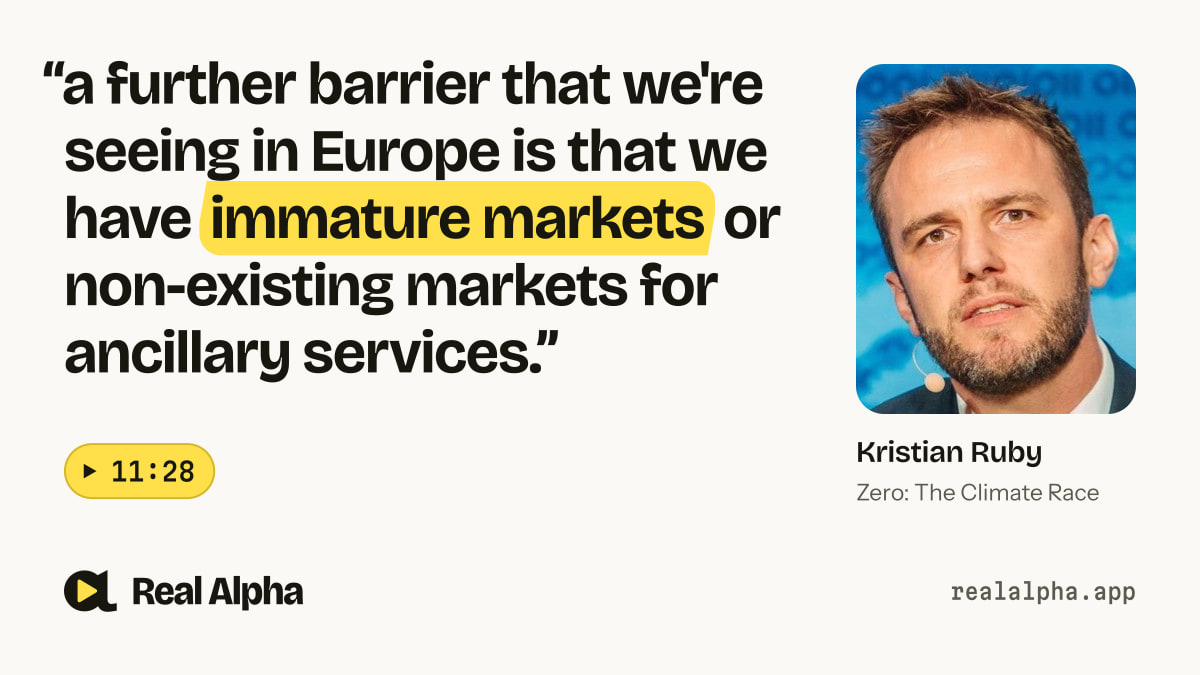
“a further barrier that we're seeing in Europe is that we have immature markets or non-existing markets for ancillary services.”
 Kristian Rubyat 11:28 · Zero: The Climate Race
Takeaways Pro pick
- Battery operators can stack revenue from ancillary services.
- Europe needs markets for fast frequency response.
- A French supermarket freezer system was hacked, ruining frozen goods.
One of Pro's picks, open to you here. Try Pro free for 7 days
One of Pro's picks. The rest of the summary and the 3 takeaways are in Real Alpha Pro; the video, the quote and the transcript stay free.
Read it with Pro, 7 days freeAbout this segment
Kristian Ruby says batteries need revenue from price spreads and grid services, but European markets for those services are immature. He also warns that connected infrastructure creates new cybersecurity risks.

Kristian Ruby is a secretary general of Eurelectric.
Leads Eurelectric, the federation representing more than 3,500 European utilities across power generation, distribution and supply.
- AR
Akshat Rathi, Host · Reporter, Bloomberg
From “The big questions over European electrification | Zero: The Climate Race”, Oct 29, 2026. Watch the full episode
Thanks. We'll look at and fix what's off.
Transcript
From the transcript Zero: The Climate Race publishes with the episode.
- 10:50
It's a good question. Why is it not going even faster when you see other geographies where it's really happening at high pace? I do think that we are seeing significant changes in the European market. I would say that the big shift we're seeing in investments is one transitioning from renewables towards storage, batteries, but also to co-located projects, hybrid projects. That said, I think essentially the business model around batteries is one that works on spreads. So it works on volatility and it's also a matter of whether other technologies are available to essentially handle this. I think a further barrier that we're seeing in Europe is that we have immature markets or non-existing markets for ancillary services.
- 11:38
For example, a fast frequency response, which is one of those services that a battery can provide and also help create a business model by value stacking for the operator of the battery. So there are some frameworks that need to come in place. We also advocate an actual storage strategy. The European Commission is beginning to look into flexibility assessments for each member state, non-fossil flexibility to get away from fossil fuels as the flexibility technology and over to batteries, pumped hydro and other types of storage. So there's a number of regulatory things that we need to look into.
- 12:16
But then I also think that we will see this come. The last thing that gets a lot of political attention in Europe on this is sovereignty. We are transitioning away from the peaceful world of globalization where you want it to trade freely and we are entering a much more complicated geopolitical environment where weaponization of supply chains is a real thing, choke points, and where you need to make sure that what you add to the system is de-risked and is safe so that foreign powers cannot all of a sudden shut down your system or manipulate how the system is working. Unfortunately, we are seeing this not with specific battery installations in Europe for the moment, but I think we all heard of the story of supermarkets that all of a sudden were manipulated to have much higher degrees in their freezers and destroying food. So evil intent
- 13:13
directed towards our critical infrastructure systems is a real thing that we need to be keenly aware of in this new era.