The alpha, twice a week
That was 4 min.
Get the best new moments in your inbox every Wednesday and Saturday. It's free.
Check your inbox
We sent a link to your address. Click it to finish signing up. Not there in a minute? Look in spam.
or
Machine Learning Street Talk · 4 min · Jan 9, 2025
Benchmark comparisons need a fixed compute budget
 François Chollet
 says added test-time compute can lift scores, often logarithmically.
In this episode
Full analysis- 10:49Compute amplified ideas more than raw spendingPro pick 5 min
- 30:11ARC methods solved different kinds of tasksPro pick 6 min
- 41:55Program synthesis works better as graph search than code generationPro pick 5 min
- 22:52Pooling ARC 1 entries pushed the score to 81%4 min
- 1:22:13Chained LLM guesses make agents unreliable3 min
- 48:33Benchmark comparisons need a fixed compute budget4 min
- 26:56ARC 2 reserves its private set for the final leaderboard3 min
- 55:09Chollet sees consciousness as a consistency check for reasoning3 min
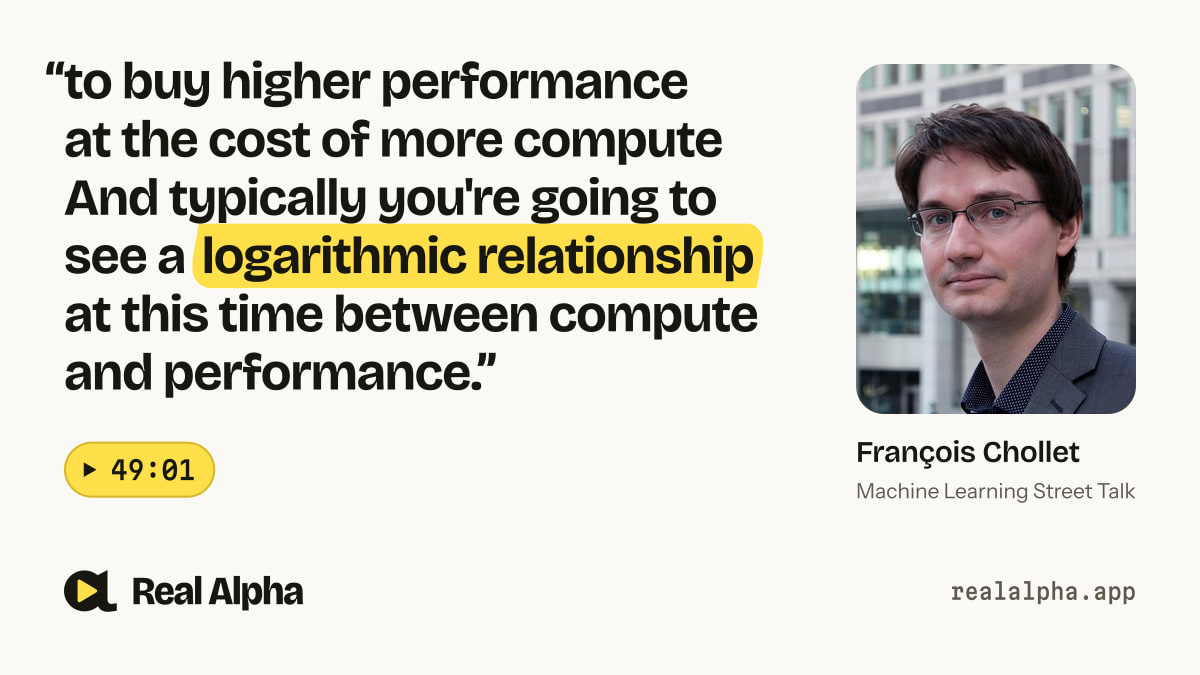
“to buy higher performance at the cost of more compute And typically you're going to see a logarithmic relationship at this time between compute and performance.”
 François Cholletat 49:01 · Machine Learning Street Talk
Takeaways
- Scores rise with test-time compute, often logarithmically.
- Compare systems only under matched compute budgets.
- Brute-force search could solve ARC with enough compute.
About this segment
François Chollet says added test-time compute can lift scores, often logarithmically. He argues benchmarks need equal budgets to compare systems fairly.

François Chollet is an AI researcher and Keras developer.
Created Keras and the ARC-AGI benchmark at Google, then co-founded Ndea with Mike Knoop to pursue AGI through program synthesis.
- TS
Tim Scarfe, Host · Host, Machine Learning Street Talk
From “François Chollet on OpenAI o-models and ARC”, Jan 9, 2025. Watch the full episode
Thanks. We'll look at and fix what's off.
Transcript
Transcribed by machine (Whisper) from the episode’s audio, so a word may be off here and there.
- 48:46
yeah absolutely do you think you know just talking about benchmarks in general do we need to incorporate the compute budget in the benchmark yes absolutely and i think this is going to be a very pressing need in in the future and in particular next year for the public leader world of arc because it's always possible with you know test time compute like test time search test time training and so on to buy higher performance at the cost of more compute And typically you're going to see a logarithmic relationship at this time between compute and performance.
- 49:24
And it kind of means that if you want an apples to apples comparison between two systems, you have to look at the compute budget. You can only compare systems that are using the same amount of compute. And for instance, if you look at the 01 model from OpenAI, you cannot really attribute to it a fixed score on ArcGIS unless you're also limiting yourself to a certain amount of compute. It's always possible to logatmically improve your performance by just throwing more compute to the problem. Of course this is true for O1, but even before that it was also true for brute force program search systems. Assuming that you have the right DSL, then extremely crude, basic, brute force program enumeration can solve all at human level. It would just take, you know, hundreds of millions of dollars of compute
- 50:23
to crack the entire data set that way. So it's an extremely inefficient, extremely stupid idea, to be honest. But in theory, it's possible, right? Philosophically speaking, do you think there's always a commensurate relationship between the amount of compute that is taken to do a task What I mean by that is when we use language and when we use cognitive tools, we might not think we're using compute, but the universe presumably expended a lot of compute in order for those things to emerge.
- 50:51
So in some sense, is it really possible to compress the amount of compute that we use? I think so. I think humans are tremendously compute efficient. And you see this in the fact that, let's say you're solving hard tasks, for instance, You can solve the entire private test set and only expend a few calories, basically. You could say, okay, but it's because we're just using extremely little energy pair operation that our brain does. It's actually not true at all. If you're comparing transistors and neurons, for instance, you find that neurons are tremendously more energy-hungry than transistors.
- 51:32
It just so happens that we are managing to solve extraordinarily hard problems using a comparatively small amount of neural differentiations. And we're just tremendously energy efficient compared to current AI. And we're going to have a GI when we get to the same level of energy efficiency.