The alpha, twice a week
That was 3 min.
Get the best new moments in your inbox every Wednesday and Saturday. It's free.
Check your inbox
We sent a link to your address. Click it to finish signing up. Not there in a minute? Look in spam.
or
Machine Learning Street Talk · 3 min · Jan 9, 2025
Chained LLM guesses make agents unreliable
 François Chollet
 says each LLM step is a fallible guess, so chaining steps compounds the chance of failure.
In this episode
Full analysis- 10:49Compute amplified ideas more than raw spendingPro pick 5 min
- 30:11ARC methods solved different kinds of tasksPro pick 6 min
- 41:55Program synthesis works better as graph search than code generationPro pick 5 min
- 22:52Pooling ARC 1 entries pushed the score to 81%4 min
- 1:22:13Chained LLM guesses make agents unreliable3 min
- 48:33Benchmark comparisons need a fixed compute budget4 min
- 26:56ARC 2 reserves its private set for the final leaderboard3 min
- 55:09Chollet sees consciousness as a consistency check for reasoning3 min
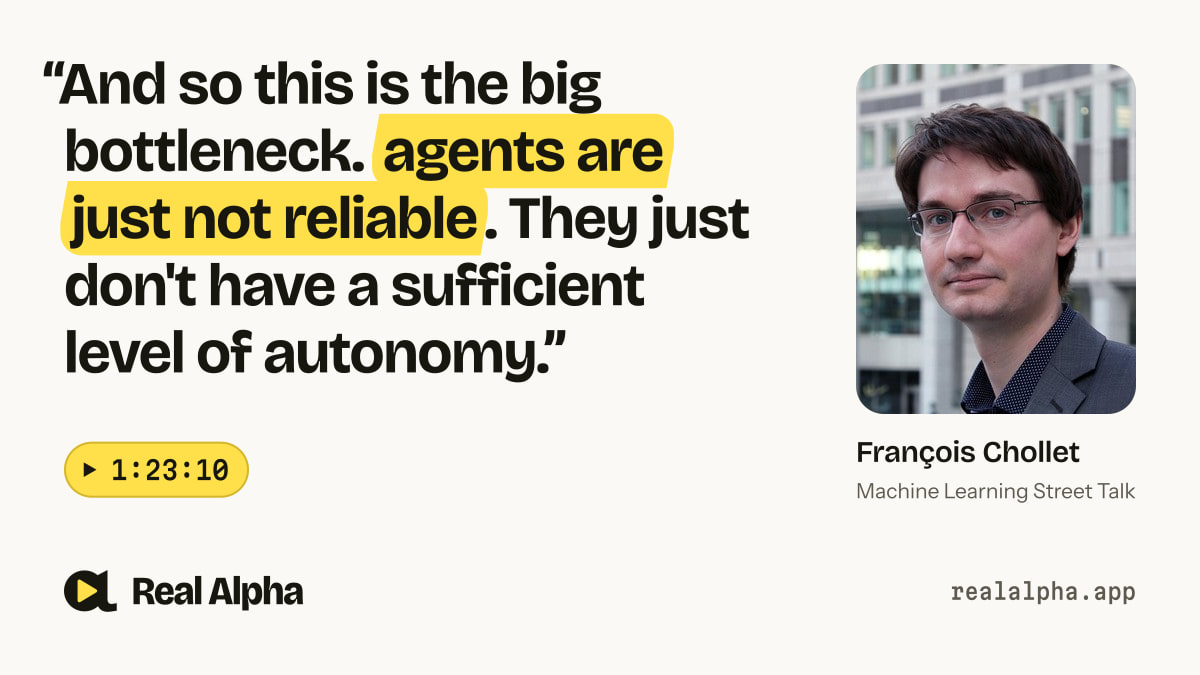
“And so this is the big bottleneck. agents are just not reliable. They just don't have a sufficient level of autonomy.”
 François Cholletat 1:23:10 · Machine Learning Street Talk
Takeaways
- Each model output is a useful but fallible guess.
- Chaining guesses compounds the chance of a bad outcome.
- Human task breakdowns can provide an external structure.
About this segment
François Chollet says each LLM step is a fallible guess, so chaining steps compounds the chance of failure. Human-designed task breakdowns can supply guardrails, but he says agents aren't yet autonomous.

François Chollet is an AI researcher and Keras developer.
Created Keras and the ARC-AGI benchmark at Google, then co-founded Ndea with Mike Knoop to pursue AGI through program synthesis.
- TS
Tim Scarfe, Host · Host, Machine Learning Street Talk
From “François Chollet on OpenAI o-models and ARC”, Jan 9, 2025. Watch the full episode
Answers “Are AI agents ready for real work?” See all 210 answers
Thanks. We'll look at and fix what's off.
Transcript
Transcribed by machine (Whisper) from the episode’s audio, so a word may be off here and there.
- 1:22:26
Right so you know agents have been older age for quite a while now. People started talking about agents being in the future something like almost two years ago, like a year and a half ago-ish, and so far agents have not really taken off. The fundamental problem here is that LLMs are not quite reliable. If you look at one-fourth of an LLM, you can think of the LLM as a guessing machine, right? And the guesses it makes are much better than random, obviously. They're very useful guesses. They're directionally accurate, but they have some probability of being wrong. And when you look at an agentic workflow, you are chaining many of these guesses. And so the likelihood that you will end up not where you would like to be gets dramatically higher as you chain more guesses like this. And so this is the big bottleneck.
- 1:23:25
agents are just not reliable. They just don't have a sufficient level of autonomy. And so people say that with better models this will get fixed. I think it's an empirical question. I'm waiting to see when agentic workflows actually start working. I don't think we're there today. I've softened my position a tiny bit on this. I agree because of the ambiguity problem they are misdirected and when you chain this they're very misdirected.
- 1:23:53
There is something to be said for just having more computation at hand. So I interviewed the guys that did the AI scientist paper. And certainly if you take Claude Sonnet 3.5 and you say, generate me an entire paper, it will be banality beyond belief. It will just be a sketch. And what they did was they decomposed it into lots of agent workers that just, you know, on the Google Maps analogies, just kind of zooming in and zooming in and zooming in many, many, many times over.
- 1:24:18
And it produced dramatically better results. Yeah, this makes sense. I think this basically tracks the idea we were talking about earlier of system 2 being something like iterated system 1 with strong guardrails. And the guardrails are very important. So in this case the superstructure is provided by the human programmer. The human programmer is kind of breaking down the problem into the right sub-problems and sort of like orchestrating the whole thing in the right way. And then each sub problem can actually be solved by guessing and producing good enough guess. Amazing. When's ARC v2 coming up?
- 1:24:58
Early next year probably. So we are currently finalizing human testing. So as I mentioned,