The alpha, twice a week
That was 3 min.
Get the best new moments in your inbox every Wednesday and Saturday. It's free.
Check your inbox
We sent a link to your address. Click it to finish signing up. Not there in a minute? Look in spam.
or
Sources · 3 min · Nov 17, 2026
Bending Spoons' playbook made it a fit for Airtable
 Howie Liu
 says Bending Spoons knows what it can underwrite and avoids far-out bets, making its offer and process predictable.
In this episode
Full analysis- 0:29AI changes the economics behind Airtable’s SaaS model5 min
- 31:49Multiplayer agents offer a less crowded opportunity4 min
- 36:07AI agents can help small businesses do work they cannot staff6 min
- 12:25Airtable's cash helped return value to common shareholders6 min
- 5:56Capital was not the main constraint in building Hyperagent3 min
- 51:47Hyperagent turns competitor research into code changes4 min
- 9:03Bending Spoons' playbook made it a fit for Airtable3 min
- 18:18A holiday coding sprint pushed Liu to build Hyperagent5 min
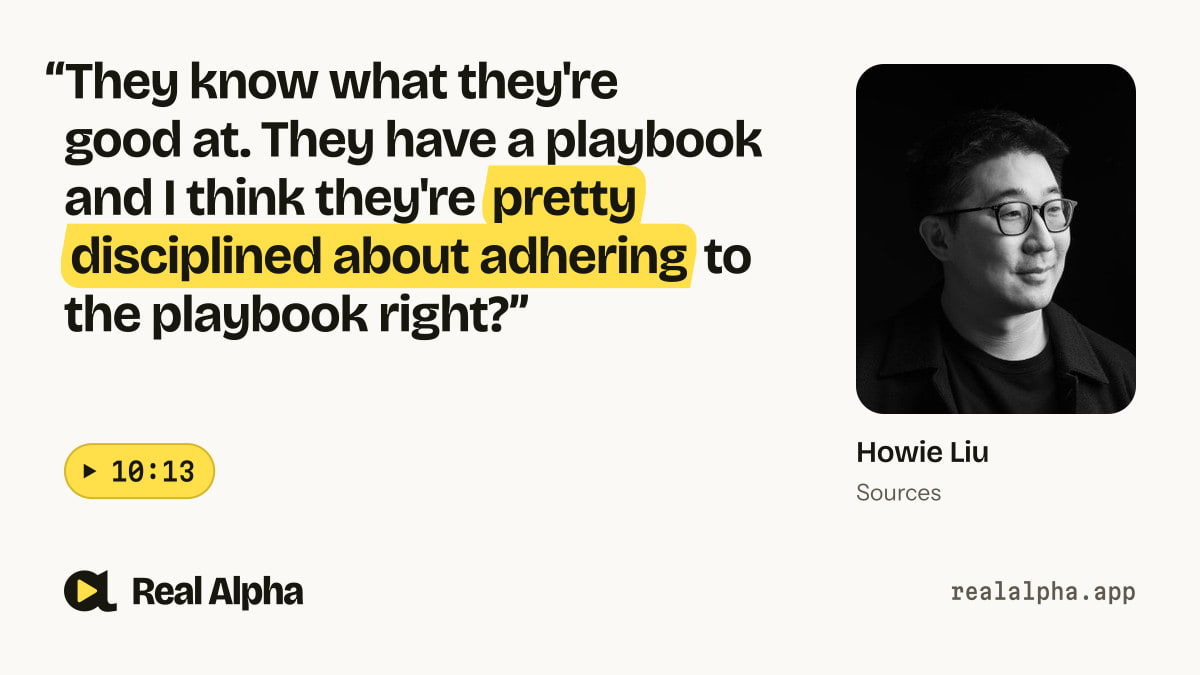
“They know what they're good at. They have a playbook and I think they're pretty disciplined about adhering to the playbook right?”
 Howie Liuat 10:13 · Sources
Takeaways
- The acquirer focused on businesses it could understand and underwrite.
- Liu valued a predictable process and a buyer that would hold assets.
- He contrasted that with deals that can stall or become data-gathering exercises.
About this segment
Howie Liu says Bending Spoons knows what it can underwrite and avoids far-out bets, making its offer and process predictable. He valued a transparent buyer over M&A processes that can stall or turn into data gathering.

Howie Liu is founder of Airtable and founder of Hyperagent.
Co-founded Airtable and now leads Hyperagent, building AI agents that learn and take on business workflows.

Alex Heath, Host · Founder & host, Sources
Left The Verge to start Sources in 2025; it has made over $1M since, mostly from sponsors.
From “Airtable’s founder on why AI breaks the SaaS playbook”, Nov 17, 2026. Watch the full episode
Thanks. We'll look at and fix what's off.
Transcript
From the transcript Sources publishes with the episode.
- 9:06
On the bending spoon side, obviously you're not there. You've gone on to HyperAgent and I don't want you to speak for them, but when you look at what they've done, It's a very interesting acquirer for a company like Airtable. I mean, they've got Evernote, Vimeo, WeTransfer, AOL. They've collected a lot of these assets. Great brands. Well, they're amazing brands. You could argue that they're from a different era, like you were talking about the era that Airtable came up in.
- 9:29
What was it about them? I mean, I'm sure you had options of where you could sell the business, but you mentioned their integrity and all of that, but I think they're not a company that's super well understood, especially even in the United States. And I'd love to kind of know more from you on why that was the right home.
- 9:46
For one, I think they are becoming better understood now, right? Obviously, they're publicly traded in the US. And I think as they've kind of gained more scale and started to buy kind of more and larger and arguably higher quality assets than when They're making a brand for themselves. You can read about it in the S1. I think they're very transparent about how they run their business. I think there is something very pure about the fact that they know who they are.
- 10:16
They know what they're good at. They have a playbook and I think they're pretty disciplined about adhering to the playbook right? Like they're never going to go and pay a you know crazy multiple for some exotic kind of far out bet right? They're gonna buy a high quality business. That they understand, that they can deep dive into the economics and cohorts of. And in their models, they can make it work such that they have a fair price they're willing to offer that gets the deal done, right?
- 10:45
And they've bought public companies, As you mentioned, where that offer was enough to basically get the company's board to agree in their fiduciary duty to sell because that was the best outcome for the business. And I think they've done and are doing the same in the private. Markets case, including with Airtable. And obviously you've seen Miro and some of the other companies they bought. Look, I think there's a lot of value I ascribed to a high integrity transparent actor that you get exactly What you expect, right?
- 11:18
You know, because the truth is, like, there's also a lot of, you know, kind of shadier, you know, types of actors in the M&A world. Like, you have sometimes acquirers who, you know, may lead you on, may take you all the way And the worst case would be like, you know, then it just becomes a diligence or kind of a data mining exercise and doesn't actually go anywhere. It doesn't, you know, or yet even worse than that, if you have antitrust risk, et cetera, which, you know, thankfully we didn't invest.
- 11:46
In this case, that could be even more complicated, right? We obviously all saw that with Figma and Adobe, which that was just a long distraction, I think, for both companies that ultimately did not culminate in a deal. So my opinion is, You know, it's kind of like there is a fair price these days for SaaS. I think you can see the public markets and how they value SaaS businesses. And, you know, you have a very high quality, high integrity actor that is exactly what they claim to be.
- 12:17
And, you know, they can transact very efficiently. And I think for our shareholders, for board, et cetera, you know, that was the best option for us.