The alpha, twice a week
That was 8 min.
Get the best new moments in your inbox every Wednesday and Saturday. It's free.
Check your inbox
We sent a link to your address. Click it to finish signing up. Not there in a minute? Look in spam.
or
a16z Podcast · 8 min · Nov 23, 2026
Biology needs cleaner data, while dataset value decays
 Joy Jiao
 says biological experiments vary across labs, making clean, high-signal data especially valuable.
In this episode
Full analysis- 13:17Thousands of agents can find patterns humans miss in biology3 min
- 54:27AI found a diagnosis after 20 years without one3 min
- 1:02:23AI could let one person launch multiple biotech programsPro pick 3 min
- 35:32Manufacturing records expose a strong use case for agents5 min
- 43:51Biology needs cleaner data, while dataset value decays8 min
- 22:03Agents can monitor trial operations and find eligible patients8 min
- 59:15OpenAI uses trusted access for biological model capabilities3 min
- 30:08AI could make regulatory review more continuous6 min
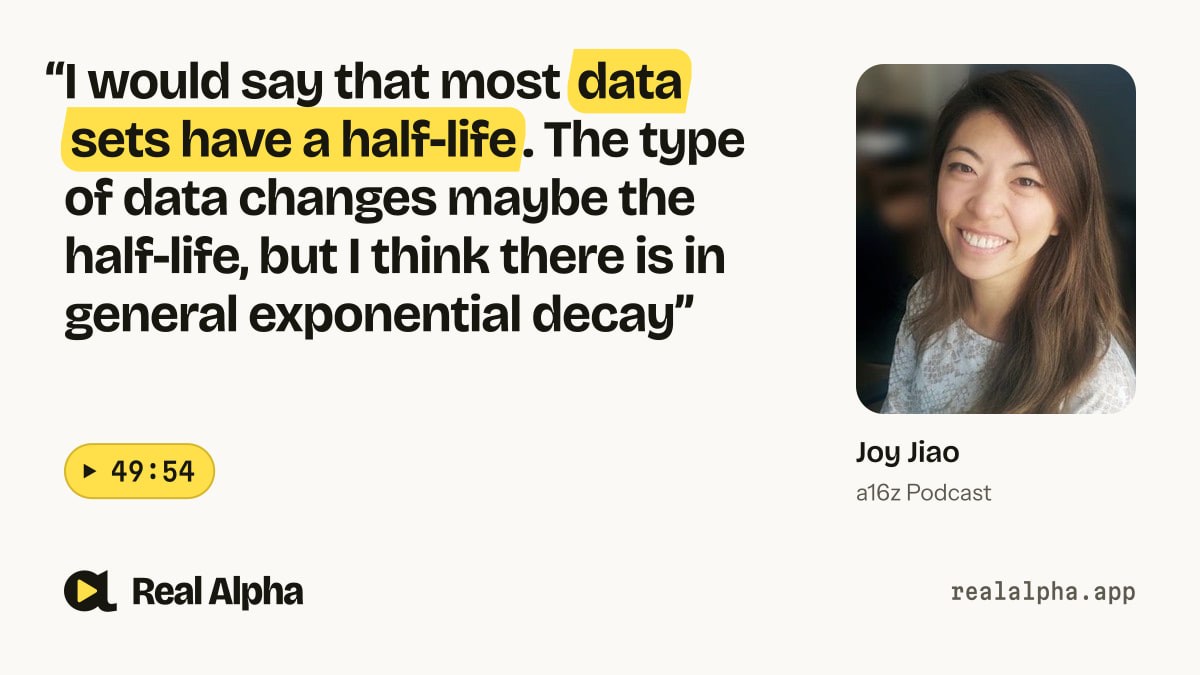
“I would say that most data sets have a half-life. The type of data changes maybe the half-life, but I think there is in general exponential decay”
 Joy Jiaoat 49:54 · a16z Podcast
Takeaways
- Lab-to-lab variation can obscure the signal in experimental data.
- A dataset's value can decay as related data teaches similar capabilities.
- Biology needs fresh real-world data that synthetic code cannot replace.
About this segment
Joy Jiao says biological experiments vary across labs, making clean, high-signal data especially valuable. Dataset advantages decay as substitutes emerge, but biology remains data-hungry because it cannot be fully simulated like code.

Life sciences research lead, OpenAI
Leads OpenAI’s life sciences team, advancing AI models for basic research and drug discovery across biology.
- JR
Jay Rughani, Host · a16z
- JC
Jorge Conde, Host · a16z
From “Why OpenAI Acquired a Biotech Startup”, Nov 23, 2026. Watch the full episode
Thanks. We'll look at and fix what's off.
Transcript
Transcribed by machine (Whisper) from the episode’s audio, so a word may be off here and there.
- 44:00
are the shallow pockets that where we need more data. If OpenAI could make, wave a magic wand and say, I wish this kind, these kinds of data sets existed to help make our models even better. Do you have a wish list of what those data sets could look like or would be? Yeah, definitely. I think data is one of the biggest bottlenecks when it comes to training models, Because I think, you know, as people tend to say trash in, trash out, if you don't have really high quality data, generally your model's not going to learn anything useful.
- 44:37
We see this a lot in biology versus, you know, things like coding or even chat GPT conversations where, you know, a user is going to type a sentence and that sentence is what it is. There's kind of no noise around that. But in biology, you know, you can't, one lab can do a set of experiment, get one set of results. another lab can do exactly the same protocol and maybe it's an elevation difference, maybe it's like a temperature difference or something in the air, they just get something completely different.
- 45:04
And so I think noise is one of the more, it's what makes life sciences very difficult to train on. And, you know, we see this a lot with, you know, cell perturbation data, for example. And there's also a lot of biases in the experimental techniques that you do. So for example, when you do gene knockdowns for perturbations and you measure what happens to a cell afterwards, there's biases in the way that you capture the molecules and in the way that you read the molecules.
- 45:34
And so all of these noise will just kind of amplify. So I think, you know, the type of data I wish we had more of is, you know, really clean, low noise data where, you know, the signal is highly penetrant and we can be able to train on that signal. And our team really, you know, kind of adds in this like life science knowledge across the pipeline of model training. And that means, you know, like things in pre-training, things in mid-training, and things in reinforcement learning or post-training.
- 46:04
And so a lot of the bottleneck, too, is after we get the data, trying to shape the data into a way that the models can use in our training process. Concretely, you know, what I think is like noiseless and biology are kind of like sequencing data. You know, here's like the genome of the tree of life. Like that is not noisy because once you know what a letter is in a genome, that letter is what it is.
- 46:26
And then, you know, things, for example, like structural biology, which is also a lot more low noise because you roughly know the shape of a protein. Of course, the proteins move around. They can change shapes, what we call conformations. But this is still kind of a lot less noisy than if you look at, for example, human health data. The electronic health records are notoriously noisy. And this is because human health in general is a point in time, right?
- 46:54
But you're kind of moving through time where there is the current state of health is not your permanent state. People get sick, people get better. There's also noise in what doctors write down. There's noise in, you know, when patients choose to go to the hospital or not. And so that data is actually incredibly difficult to train on than something that is, you know, just very low noise, high signal, like structural biology.
- 47:18
So we spend a lot of time with founders. We're working on, you know, their startups. And, you know, we see many founders whose ambition is to generate data that will be interesting to you. And in fact, there is an entire crop of company emerging, the Data Factory. Indeed. They're out there. They're listening to you intently. They're sitting on the edge of their seats. what would you advise a founder that is has the ambition to build a data factory that is that is a good question i definitely have you know personally experienced the flood of people trying to sell us different types of data i think the the data takes many different forms there are people just trying to sell us kind of experimental data say hey i did an experiment do you just like want the raw numbers um here's like a csv file there's also people who you know more kind of do what
- 48:20
we might call like human expert data or you know things that are like here's like what a person is doing. Maybe a person asked a question, and then here's like a definition of what a good answer is. I think there's different uses for these two types of data. For, you know, the kind of like CSV file of numbers, this is a maybe fundamental capability of the model in order to understand the natural world. And that is very useful. The other type is, you know, kind of more what we think about post-training, which is you have a model now, it has a lot of raw intelligence, But you need to bring out that intelligence in a way that it's able to communicate with the user.
- 49:01
And so here's, you know, where all of these rubrics come in. That's like, did the model, like, give you a proper background? Did it talk about these different points? Did it talk about its certainty or uncertainty in its final answer? And so I think, you know, we do need both in order to make a model that is maximally useful for everyone. I don't have, like, specific advice. I do think, you know, the things that we look for is generally high quality and, you know, for raw experimental data, there are some just very obvious tricks that we would do to see, okay, does this data contain signal?
- 49:35
Is it clean? And I think, you know, for the kind of more post-training shaped data, a lot of that is just kind of you have to read it and see if it makes sense. The models are actually getting quite capable now that we can kind of, you know, have another model evaluate the data and tell us if the data is good. So it's kind of like gone full circle in a way. Does your appetite for new data asymptote over time or is it something you just expect will persist?
- 50:03
I would say that most data sets have a half-life. The type of data changes maybe the half-life, but I think there is in general exponential decay and how valuable a data set is over time. And that's just because, you know, we're very hungry for data. And if we can't train on one data source, we'll find another substitute. And generally, when data sets are somewhat correlated, if they're from the same field, then there's what we call positive transfer between the data sets.
- 50:31
And so let's say we're unable to get one type of data, we'll train on lots and lots of other types of data and we'll eventually get that capability that we really wanted anyway. So I would say that, you know, there's not all data will be permanently useful, but I think the need for more and more complex data is going to be constant. To build on Jorge's question, so you're saying that the demand for an individual data set might experience exponential decay.
- 50:58
Yes. But let's say OpenAI or the large labs demand for training data in general. Do you expect that to exponentially increase over time, linearly grow, decay over time as well? I don't think it'll decay over time. I would expect it to grow possibly linearly. And some of this is because, you know, we're just getting really good at generating our own data, either through partners or through, you know, the model just thinking really hard and generating new synthetic data for us.
- 51:31
And so I think we're still going to need kind of like fresh new data. I think the difference between life sciences and coding is that we're very grounded in a physical world. And so you can't really fully simulate like a human. If you gave a human a chemical, how are they going to react? That is, we don't have, you know, today a physically mechanistically grounded way to model that. But versus, you know, something like coding, you can't have the model generate a code base and you can have other agents operate on that code base on your synthetic data.
- 52:00
right? That doesn't quite apply to biology. And so I do expect biology to kind of, you know, remain more data hungry than something like coding over time. So by the way, for all of the