The alpha, twice a week
That was 5 min.
Get the best new moments in your inbox every Wednesday and Saturday. It's free.
Check your inbox
We sent a link to your address. Click it to finish signing up. Not there in a minute? Look in spam.
or
a16z Podcast · 5 min · Nov 23, 2026
Manufacturing records expose a strong use case for agents
 Ashoka Rajendra
 explains how agents could reconcile process knowledge across a biotech and its manufacturer, then flag deviations in batch records.
In this episode
Full analysis- 13:17Thousands of agents can find patterns humans miss in biology3 min
- 54:27AI found a diagnosis after 20 years without one3 min
- 1:02:23AI could let one person launch multiple biotech programsPro pick 3 min
- 35:32Manufacturing records expose a strong use case for agents5 min
- 43:51Biology needs cleaner data, while dataset value decays8 min
- 22:03Agents can monitor trial operations and find eligible patients8 min
- 59:15OpenAI uses trusted access for biological model capabilities3 min
- 30:08AI could make regulatory review more continuous6 min
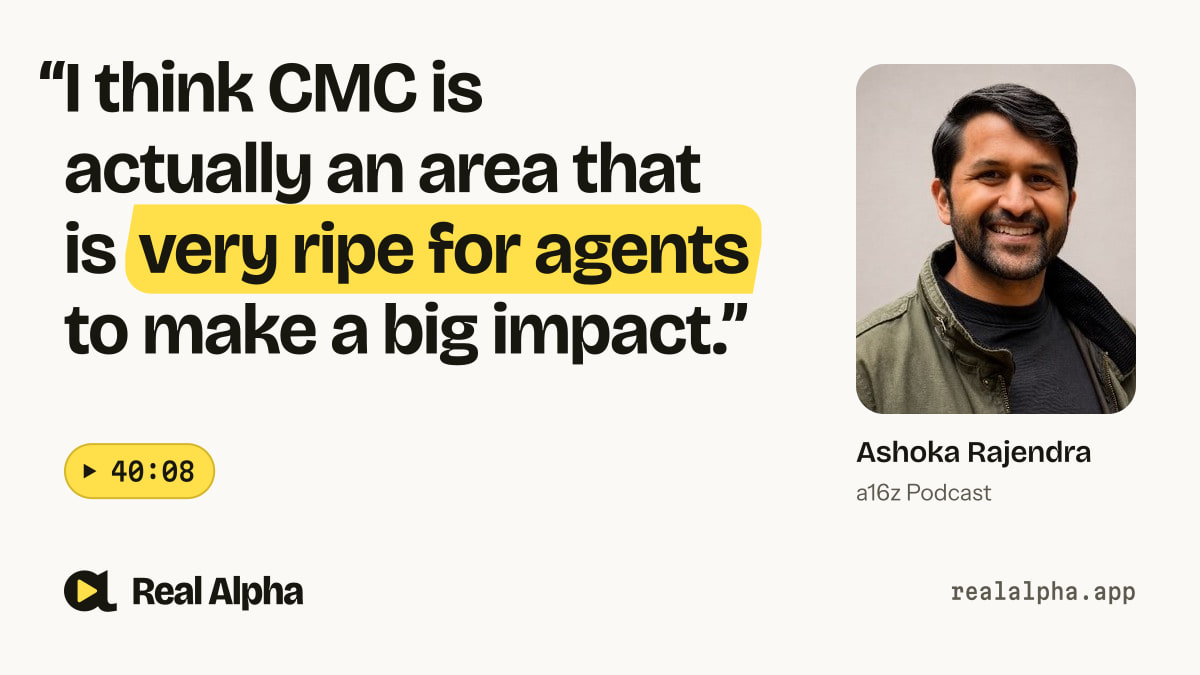
“I think CMC is actually an area that is very ripe for agents to make a big impact.”
 Ashoka Rajendraat 40:08 · a16z Podcast
Takeaways
- Tech transfer means reconciling each organization's processes and capabilities.
- Agents can compare batch records with tolerances and investigate deviations.
- CMC manufacturing may be a major agent opportunity beyond clinical work.
About this segment
Ashoka Rajendra explains how agents could reconcile process knowledge across a biotech and its manufacturer, then flag deviations in batch records. A freezer excursion can trigger a quality investigation and delay trial supply.

Life sciences team member, OpenAI
Built Orchestra Bio’s AI platform for coordinating drug development, then joined OpenAI’s life sciences team after its acquisition.
- JR
Jay Rughani, Host · a16z
- JC
Jorge Conde, Host · a16z
From “Why OpenAI Acquired a Biotech Startup”, Nov 23, 2026. Watch the full episode
Thanks. We'll look at and fix what's off.
Transcript
Transcribed by machine (Whisper) from the episode’s audio, so a word may be off here and there.
- 35:41
So the last big sort of boulder to break when you're thinking about development is manufacturing. And manufacturing is extraordinarily complex, as many of the steps in the process of making a medicine are. The complexity there is also, it's a very expensive part of the process, right? The companies invest. incredible amount of money in getting their manufacturing processes right and making sure that they meet the regulatory requirements for ultimate approval. Any mistake, and you talk about this in your experience with orchestra bio, any mistake in the manufacturing side of the house can have ripple effects or even tsunami-like effects on delaying clinical trials, delaying approvals. Can you talk a little bit about what you saw in the trenches and what can go wrong with respect to manufacturing
- 36:31
and what AI can help make things, what AI can help make go right. Yeah, absolutely. So, you know, folks in the industry are really familiar with like, how do you transfer knowledge between parties and groups, right? And we talk a lot about managing context at scale, managing information at scale. And, you know, to use an analogy, you know, just because like I can read, you know, a recipe of a Michelin star chefs, you know, something that they're going to cook, does not make me a Michelin star chef.
- 37:00
I tell that to Jorge all the time. So when you think about the manufacturing of, you know, biologics, small molecules, these are the most incredibly complex set of recipes, procedures, and know-how that increasingly, for cost and speed reasons, are being externalized to CDMOs, you know, domestically and overseas. And the trade-off of that is you need to take your knowledge and know-how of what works at lab scale or at pilot scale, you know, the equivalent being like in your kitchen or in a restaurant, and get that to clinical trial scale and commercial scale.
- 37:39
So, you know, in manufacturing, there is the tech transfer process. How do I take my know-how and transfer it to this other organization? Then there is the actual manufacturing runs required to get this batches created and into clinical trials. And then lastly, the scale up for actual commercial launch. And at every step in the process, you need to constantly surveil every single parameter of every single component of your process.
- 38:08
How people physically move in the facility, the environmental signals, every single thing people scribble down, you need to be constantly surveilling and monitoring that. So that is a prime example of where agents can help. Because when you think about you're transferring your process to another organization, you're trying to do this reconciliation and gap analysis effort of what can we do and what can they do and meticulously reconcile your process that works to their process that they're trying to replicate or scale up.
- 38:39
Then when you get into just the manufacturing of the batch, there are so many instances, you know, even in cell therapy, where the batches could be waiting in quality control and they're not released yet to patients because you need to go through a very meticulous process of reviewing all the different parameters and attributes that were recorded in the manufacturing of this. So agents can help with things like, look, today, a lot of manufacturing is on paper batch records, reading the handwriting, looking through all the different parameters, reconciling that against the established ranges, but then doing investigations, figuring out, you know, we had a temperature deviation.
- 39:18
And an example that somebody at a well-known pharma said is like, how do we know if a temperature deviation and a refrigerator issue can delay our clinical trial? And it's like, well, what do you mean by that? Well, if an agent scans through and sees that you had a temperature deviation where, you know, the freezer went out for, or refrigerator went out for three or four hours, do we have data to know that that's tolerable?
- 39:41
And in fact, do we actually have a facilities issue? And if we have a facilities issue, that might be a systemic problem that we need to address where we need to possibly rerun this batch. We need to solve this facilities problem. All of that can converge in delaying a batch being ready for the trial itself. So you're tracing through complex procedures and a corpus of knowledge of how do we run a very precise process at scale properly within the appropriate tolerance ranges.
- 40:12
And this, I think, a lot of attention has been placed on clinical and regulatory, of course. But I think CMC is actually an area that is very ripe for agents to make a big impact.