The alpha, twice a week
That was 4 min.
Get the best new moments in your inbox every Wednesday and Saturday. It's free.
Check your inbox
We sent a link to your address. Click it to finish signing up. Not there in a minute? Look in spam.
or
TBPN · 4 min · Nov 10, 2026
Buy rare cars later in their depreciation curve
 Ed Bolian
 looks for rare cars whose steepest depreciation is behind them, and explains how overlooked production numbers can reveal scarcity.
The episode’s best minutes
Full analysis- 40:58The Nvidia scandal could unite Congress against chip sales6 min
- 49:48Nvidia must accept that its chips are strategically important5 min
- 1:02:44Buy rare cars later in their depreciation curve4 min
- 5 more moments in the full episode
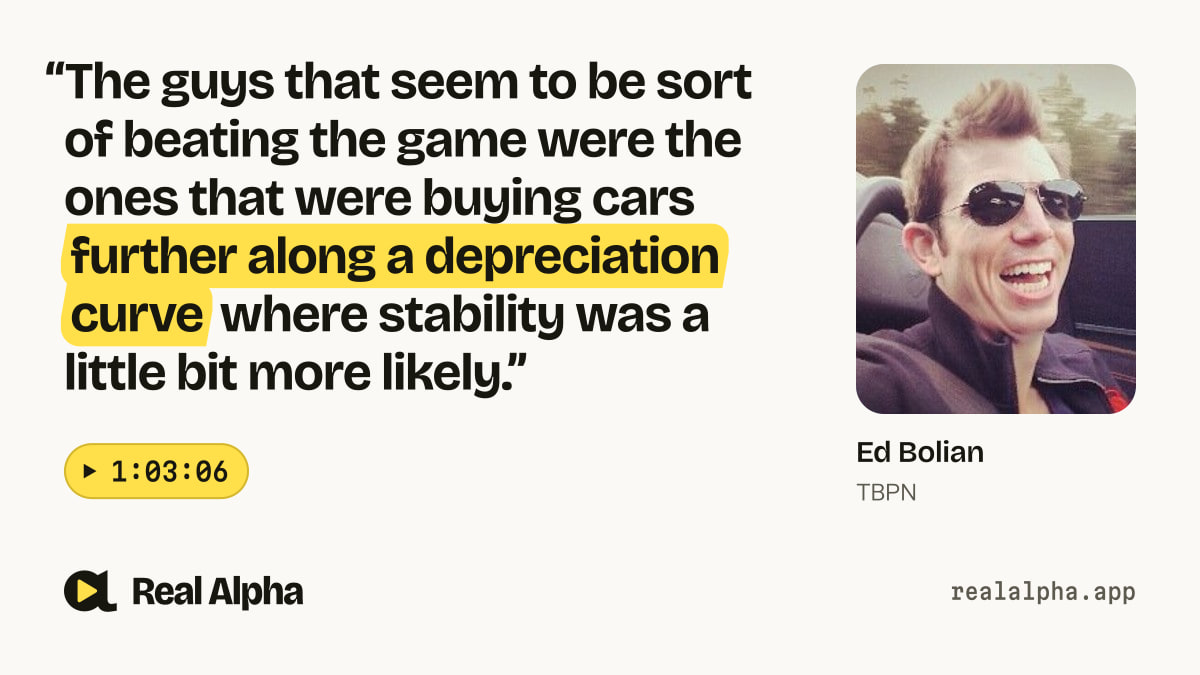
“The guys that seem to be sort of beating the game were the ones that were buying cars further along a depreciation curve where stability was a little bit more likely.”
 Ed Bolianat 1:03:06 · TBPN
Takeaways
- Start with a car you genuinely like, not an investment thesis.
- Look for rare cars whose depreciation has largely stabilized.
- Production details can reveal scarcity the market has overlooked.
About this segment
Ed Bolian looks for rare cars whose steepest depreciation is behind them, and explains how overlooked production numbers can reveal scarcity. That mix of taste and research can help collectors avoid paying for a new-car premium.

Founder & CEO, VINwiki
Founded VINwiki after organizing the 2013 New York-to-Los Angeles Cannonball record run.

John Coogan, Host · Co-host, TBPN
Co-founded Soylent and Lucy; OpenAI bought his show TBPN in April 2026.

Jordi Hays, Host · Co-host, TBPN
Founded Branded Native; co-founded fintech Capital, which Rho bought.
From “Chris Miller (Chip War) Joins, The Name's Huang. Alice Huang. The Markets. Shaken, and stirred.”, Nov 10, 2026. Watch the full episode
Thanks. We'll look at and fix what's off.
Transcript
From the transcript TBPN publishes with the episode.
- 1:02:53
You know, that really is it. You have to start with something that you really, really like. Whenever you're thinking about something that might be defined as like an alternative investment class Yeah. It's it's not something that you set out like Dave Ramsey style, like you should go get some gigantic loans for rare exotic cars and just see what happens. One thing that I learned early on while I was selling cars is that the ones that... The guys that seem to be sort of beating the game were the ones that were buying cars further along a depreciation curve where stability was a little bit more likely. And the way I used to phrase it is that I tried to look like I won the lottery ten years ago. Yeah.
- 1:03:29
Because with rare and interesting cars, generally, there will be some initial depreciation as people are trying to buy the newest, latest, greatest, biggest, baddest, whatever. But I wanted to try to avoid depreciation. I call that my greatest allergy is automotive depreciation. And so I was looking for cars that seemed rare, but also seemed like they were at a point where they were a lot more stable and potentially starting to go back up, which it was still relatively unheard of, you know, in the early, you know, 2009, two thousand fifteens when I was selling cars every day. And so I loved the Lamborghini Murciélagos since it came out.
- 1:04:03
I just thought it was the coolest car. I loved the heritage and lineage of the v 12 Lamborghinis, especially the manual transmission cars. And I learned that they were a lot more rare than really anybody seemed to know. As manufacture... Manufacturers started to bring out these sequential manual paddle shift cars, the thought was that it was about a 90% take rate. But it turned out, now we've now learned that it was about 99%. So for the Ferraris and Lamborghinis where there was a manual versus a paddle shift option, almost all of them were paddles. And so that made them much more rare than, you know, we expected. And usually rare just means nobody bought it when they were new. And that's true because back then, the only way that they could make cars faster was to make the transmissions work better.
- 1:04:47
And so now I realize that they were rare and that's a lot of the ideology around the VINWiki app is how do we document rarity and significance in cars that might eventually, you know, have something to do with the value.
- 1:04:58
Is manufacturer data getting more reliable over time? Because it feels like there were that like that 90 to 99% discovery, that was unique. That's a gold mine. But is that also going to happen in a 2026 car run that where, you know, some manufacturer, they're vague about it or they give incorrect information and then ten years down the line, we discover through chronicling the VINs that there's some oddity with some spec that's extremely limited.
- 1:05:28
There is some chance that there will just be something that's overlooked as being important. Lamborghini didn't think it mattered for anybody to know how many of specific cars they were doing. Yeah. In the same way that, like, Porsche wouldn't necessarily think about how it... How much it matters of how many they build of a certain paint to sample color Mhmm. Or something like that. Those are the types of granular data points that might be uncovered later down the road. Sure. Because it is... There is a lot more documentation now.
- 1:05:57
The companies have grown up through all of the different ways that they have combined corporately, and so it's a little bit less likely that that sort of thing will happen. And the cars are a little bit more homogeneous Mhmm. You know, with some exceptions being like nine eleven's range from $150 up to $400. And they... You know, there's different permutations of how they're configured and obviously the profitability changes alongside that.