The alpha, twice a week
That was 3 min.
Get the best new moments in your inbox every Wednesday and Saturday. It's free.
Check your inbox
We sent a link to your address. Click it to finish signing up. Not there in a minute? Look in spam.
or
The Mishal Husain Show · 3 min · Nov 13, 2026
Cameron says Britain’s economic problems are domestic
 David Cameron
 argues that Brexit’s economic effect is hard to separate from the pandemic and the Ukraine war.
The episode’s best minutes
Full analysis- 12:57Care-cost caps need insurance to share the riskPro pick 4 min
- 25:18Cameron says Britain’s economic problems are domestic3 min
- 3 more moments in the full episode
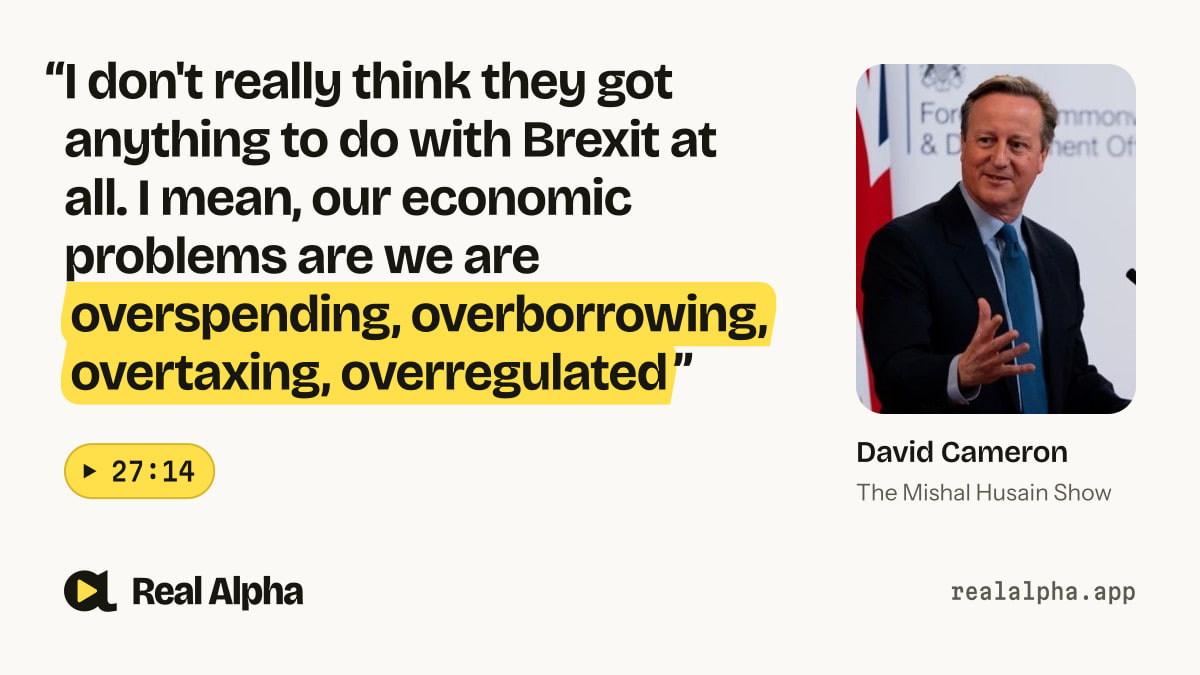
“I don't really think they got anything to do with Brexit at all. I mean, our economic problems are we are overspending, overborrowing, overtaxing, overregulated”
 David Cameronat 27:14 · The Mishal Husain Show
Takeaways
- He says the Brexit counterfactual is hard to measure.
- He points to overspending, borrowing and overregulation.
- He argues against reopening the membership debate.
About this segment
David Cameron argues that Brexit’s economic effect is hard to separate from the pandemic and the Ukraine war. He says the country should tackle its own fiscal and regulatory problems while making the EU partnership work.

David Cameron is a former UK prime minister and foreign secretary.
Made dementia research a political priority, helped double investment, and now champions the search for an Alzheimer’s cure.

Mishal Husain, Host · Host, The Mishal Husain Show
From “David Cameron on Ending Alzheimer’s, Brexit and a Possible Comeback | The Mishal Husain Show”, Nov 13, 2026. Watch the full episode
Thanks. We'll look at and fix what's off.
Transcript
From the transcript The Mishal Husain Show publishes with the episode.
- 25:31
And do you think Britain has ended up poorer? No, I mean, I think that... Well, that's a very difficult question. If you look at the, you know, I think we have to try and deal with the facts. I mean, since Brexit, we've grown faster than Germany, about the same as France, pretty similar to Italy. We've had a sort of, you know, would we have grown even faster if we'd stayed in? It's a hard, I mean, we were doing very well in 2015, 2016. We were fastest growth in the G7. The economy was going very strongly.
- 26:01
Employment was growing strongly. But since then, we've had COVID. We've had the Ukraine war, which caused inflation to rise to 11% in this country. Stripping out those things in the counterfactual is hard. But I don't run away at all from the things I said during the referendum. I thought the best answer for us was the best of both worlds, which was being in, but with these special sets of arrangements we had out of the Euro, out of Schengen. I got us out of ever closer union and with better restrictions on paying benefits to people coming to the UK and all the rest of it. But look, I lost that argument. There was a referendum, fair and square.
- 26:39
I was very careful that the rules of that referendum, we didn't put our hand on the scale in any way. I argued with everything I had for us to stay in. I lost. And lost your job. I said that. And I decided to resign because I thought the country needed a new prime minister because I'd been on so much on one side of the argument, I wouldn't have the credibility. But as I say, my position is that we've got to make the partnership model work.
- 27:17
And I think we can. And I think that's, I think I'd also make one other point, which I think is quite important. If you look at economic problems we have, I don't really think they got anything to do with Brexit at all. I mean, our economic problems are we are overspending, overborrowing, overtaxing, overregulated, and far too much being spent on working age welfare. Those are a set of problems that have nothing to do with Brexit. We need a government that is capable, actually gets spending under control, gets taxes down, helps entrepreneurs. deals with our borrowing problem, reforms the welfare, and massively deregulates so we can build houses, build infrastructure. None of those have got anything to do with Europe. So that's sort of, in a way, that's my point. Do we really want to go into another
- 27:59
decade-long debate about whether we should be in or out when actually we should deal with our own problems while making the partnership model work? I think, now you're getting me fired up, but I think I would advise my party to focus on that rather than reopen the argument.