The alpha, twice a week
That was 4 min.
Get the best new moments in your inbox every Wednesday and Saturday. It's free.
Check your inbox
We sent a link to your address. Click it to finish signing up. Not there in a minute? Look in spam.
or
The Mishal Husain Show · 4 min · Nov 13, 2026
Care-cost caps need insurance to share the risk
 David Cameron
 explains why his government delayed a cap on care costs and why he now sees insurance as part of the answer.
The episode’s best minutes
Full analysis- 12:57Care-cost caps need insurance to share the riskPro pick 4 min
- 25:18Cameron says Britain’s economic problems are domestic3 min
- 3 more moments in the full episode
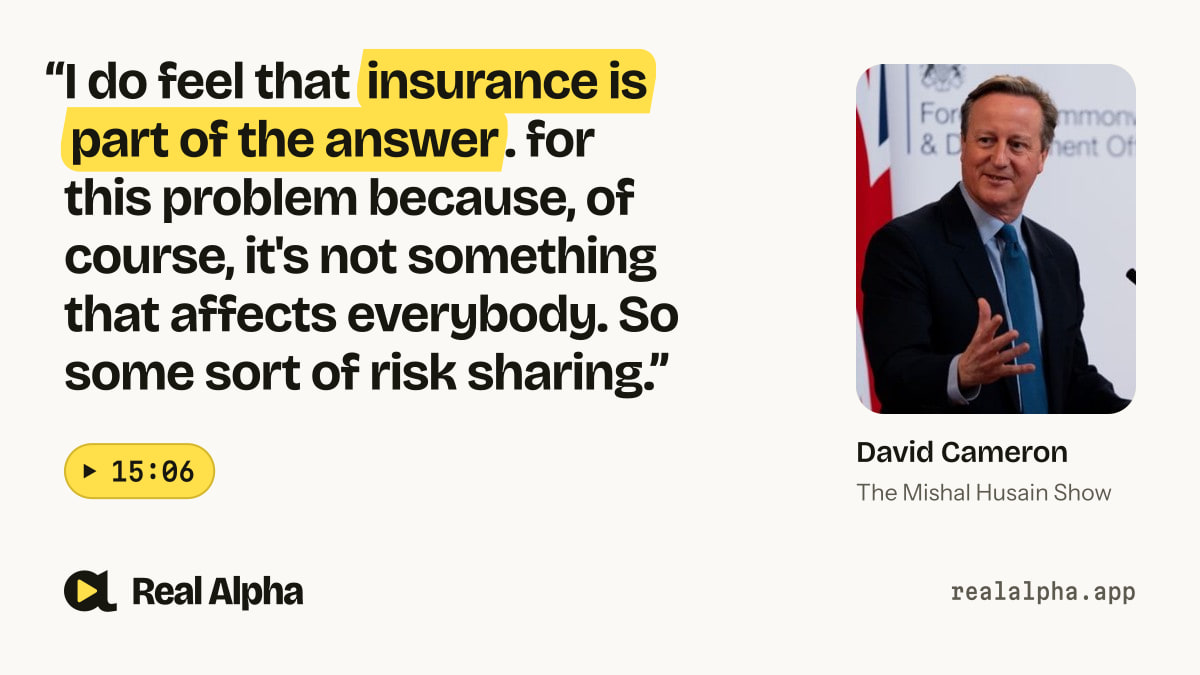
“I do feel that insurance is part of the answer. for this problem because, of course, it's not something that affects everybody. So some sort of risk sharing.”
 David Cameronat 15:06 · The Mishal Husain Show
Takeaways Pro pick
- A care-cost cap would protect people facing catastrophic bills.
- His government worried the subsidy would mainly benefit homeowners.
- He now sees insurance as a way to share the risk.
One of Pro's picks, open to you here. Try Pro free for 7 days
One of Pro's picks. The rest of the summary and the 3 takeaways are in Real Alpha Pro; the video, the quote and the transcript stay free.
Read it with Pro, 7 days freeAbout this segment
David Cameron explains why his government delayed a cap on care costs and why he now sees insurance as part of the answer. The trade-off is limiting catastrophic bills without putting the full cost on taxpayers.

David Cameron is a former UK prime minister and foreign secretary.
Made dementia research a political priority, helped double investment, and now champions the search for an Alzheimer’s cure.

Mishal Husain, Host · Host, The Mishal Husain Show
From “David Cameron on Ending Alzheimer’s, Brexit and a Possible Comeback | The Mishal Husain Show”, Nov 13, 2026. Watch the full episode
Thanks. We'll look at and fix what's off.
Transcript
From the transcript The Mishal Husain Show publishes with the episode.
- 13:10
The other part of this, and again, you talk about it in the podcast, is the care element and particularly that emotional intensity and the costs that... better involved in caring for someone with Alzheimer's. In your mother's case, you paid for that care. You could afford that. But I wondered if knowing what you know now, you look back on a decision you made as prime minister to pause the plan that you had to cap care costs and whether you see it differently now.
- 13:38
Yeah, I think, look, the idea of capping care costs is a good one. And we not only commissioned it through the Dilnot report, but then we legislated for it. But we did delay it once or twice. It was meant to come in, but then I left office. Why it's the right decision is that basically a number of people are paying catastrophic costs for long-term care in care homes. And it is slightly the fickle finger of fate. One person living at number 22 Acacia Avenue doesn't get dementia, keeps their home, pass it on to their children. Next door, they get Alzheimer's. They have to sell the house to pay for care. But what we found, look, at difficult times in government was, of course, that cap is quite a big subsidy to relatively better off people because they are homeowners with assets and savings. And so the reason
- 14:30
it was put off was thinking, well, at a difficult economic time when we were having to get the budget deficit down, get the country's finances in order? Is this really the top priority? The disappointment I have is that the aim of a cap really is to say, if we cap the costs, then the insurance industry should be able to come in and do the rest, actually, of sort of saying, right, well, if there's a cap, then you can insure against having to pay up to that cap.
- 14:55
And they weren't willing. They weren't willing. And one of the things I've sort of discovered since leaving office is, I'm frustrated I didn't know more about it at the time, was actually there have been occasions in insurance situations where governments have stepped in. So, for instance, with the potential costs of insurance against terrorist incidents, actually the government stepped in and set up a system.
- 15:18
And I do feel that insurance is part of the answer. for this problem because, of course, it's not something that affects everybody. So some sort of risk sharing.
- 15:28
You do see it differently now then. I always knew it. Was a terrible cost. But if you'd had this experience then, you might have thought harder about it because I know you said that it's one of your biggest regrets.
- 15:39
Well, it is a regret, but it's a regret we didn't do it and didn't see it through, but we sort of set it up for it to be done. But I think that the reason we didn't do it wasn't that we were idle or feckless or weren't thinking. We thought through very carefully but thought this is, you know, a two, three billion pound cost and it's mostly going to go to better off people. So we needed to find a way of making it work. And I think, you know, looking back, this insurance idea, I think, is the right one. I mean, Andy Burnham, all credit, is looking at, how we pay for social care. This is a broader set of reforms. You've got to look at, you know, how we, the quality of the care that we provide and all those other things. But I hope when he looks at this particular issue, which is the catastrophic costs of paying for long-term care, often in a
- 16:27
care home, I think there's a real role for insurance. And I think that's where we should be looking.
- 16:31
He said that politicians of his generation, he would include himself, obviously, but also you were cowardly in ducking this.
- 16:39
Well, look, we certainly didn't I mean, you know, as far back as 1997, Tony Blair said, I don't want my children to grow up in a country where people have to sell their home to pay for care. So we've all not managed to solve this problem. I think the Dilmot cap or something like it comes close. But I think it's got to be combined, in my view, with an insurance based solution, because I think that's the way to not put an unnecessary burden on less well off people to pay for better off people to pay for their care.