The alpha, twice a week
That was 3 min.
Get the best new moments in your inbox every Wednesday and Saturday. It's free.
Check your inbox
We sent a link to your address. Click it to finish signing up. Not there in a minute? Look in spam.
or
Lenny's Podcast · 3 min · Nov 2, 2025
Canva spent two years rewriting its editor without shipping
 Melanie Perkins
A front-end rewrite expected to take six months took two years, leaving the product team unable to ship.
The episode’s best minutes
Full analysis- 8:03Build from the future you want, then work backward6 min
- 23:43Canva spent two years rewriting its editor without shippingPro pick 3 min
- 26:20Investor rejections helped sharpen Canva’s pitch5 min
- 5 more moments in the full episode
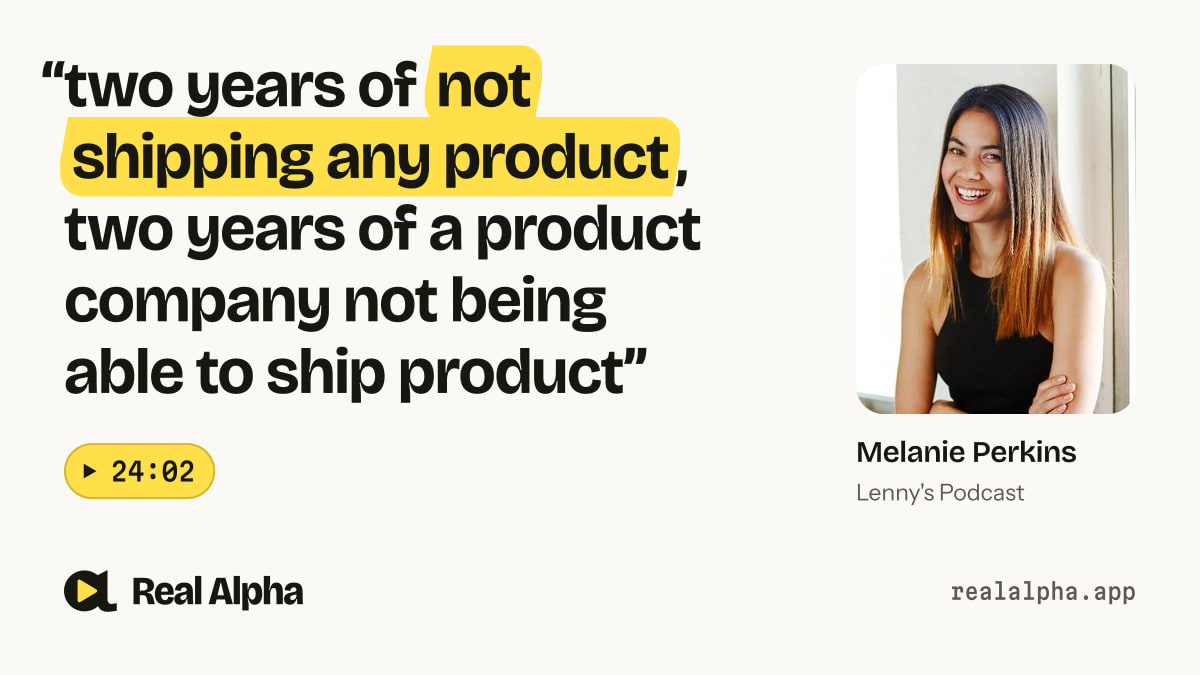
“two years of not shipping any product, two years of a product company not being able to ship product”
 Melanie Perkinsat 24:02 · Lenny's Podcast
Takeaways Pro pick
- The rewrite enabled cross-platform work and more editor collaboration.
- The team made progress visible with a board of project stages.
- Weekly check-ins helped make a frustrating period feel more manageable.
One of Pro's picks, open to you here. Try Pro free for 7 days
One of Pro's picks. The rest of the summary and the 3 takeaways are in Real Alpha Pro; the video, the quote and the transcript stay free.
Read it with Pro, 7 days freeAbout this segment
A front-end rewrite expected to take six months took two years, leaving the product team unable to ship. Melanie Perkins describes using a progress board and weekly check-ins to keep the difficult work moving.

Melanie Perkins is CEO and co-founder of Canva.
Co-founded Canva and leads its mission to empower everyone to design, while steering its pledge to do good.

Lenny Rachitsky, Host · Host, Lenny's Podcast
Spent seven years at Airbnb; his product newsletter has over 1M subscribers.
From “She turned 100+ rejections into a $42B company | Melanie Perkins”, Nov 2, 2025. Watch the full episode
Thanks. We'll look at and fix what's off.
Transcript
Transcribed by machine (Whisper) from the episode’s audio, so a word may be off here and there.
- 23:48
we thought it would take about six months. It was really important because it was critical for cross platform. It was critical for right to left. It was critical because we could only have five people working in our editor at any point in time because of the way the code base was structured. and we thought it was going to take six months and then it took two years and it was two years of not shipping any product, two years of a product company not being able to ship product and like that is such a core motivation for our team is like shipping something, seeing great customer feedback and then that kind of makes everyone feel happy and like we've got momentum And it just felt like we're in a dark, dark tunnel.
- 24:28
We could hardly see the end of the tunnel. We didn't really know how long it was going to take because it had to take as long as the tunnel was going to take. And it was, you know, a very hard time because, you know, other people would be launching this and that. And it was, we weren't. Eventually we got out of that tunnel and it was extremely important that we did that work. We've now got two and a half thousand engineers and were able to deliver amazing things that would have just like been completely infeasible.
- 25:03
And simultaneous collaboration was like so many things were baked into this. But, yeah, it was not a fun period of time. A product company not shipping product is not really a recipe for fun. For two years. For two years. I feel like every builder listening to this knows exactly what you've been through and maybe not on that scale in those stakes. but you start on something oh yeah it'll be take a few weeks and then a year later you're still working on it totally how did just was the mood really uh i don't know sad internally just that must have been like two years that's a long time not to ship anything just what was it like internally during that period i think it was kind of everything internally like we we made it into a bit of a game we had this game board and i bought these little like uh rubber ducky sort of
- 25:49
bath toys and we had this um so we had all the little the components represented as a bath toy on this um board and there was like all these stages of like home that kind of went launched in product there was an emergency lane at the end of it was home and hosed and we like did these weekly stand-ups where everyone would come in and talk where their bath toy was at And kind of just like we tried to make it fun and for the team.
- 26:15
So it was partly fun and it was partly distressing as all of our investors were like, hey, you know, that thing.