The alpha, twice a week
That was 5 min.
Get the best new moments in your inbox every Wednesday and Saturday. It's free.
Check your inbox
We sent a link to your address. Click it to finish signing up. Not there in a minute? Look in spam.
or
Lenny's Podcast · 5 min · Nov 2, 2025
Investor rejections helped sharpen Canva’s pitch
 Melanie Perkins
 says she believed investors were wrong, but used their objections to improve the deck.
The episode’s best minutes
Full analysis- 8:03Build from the future you want, then work backward6 min
- 23:43Canva spent two years rewriting its editor without shippingPro pick 3 min
- 26:20Investor rejections helped sharpen Canva’s pitch5 min
- 5 more moments in the full episode
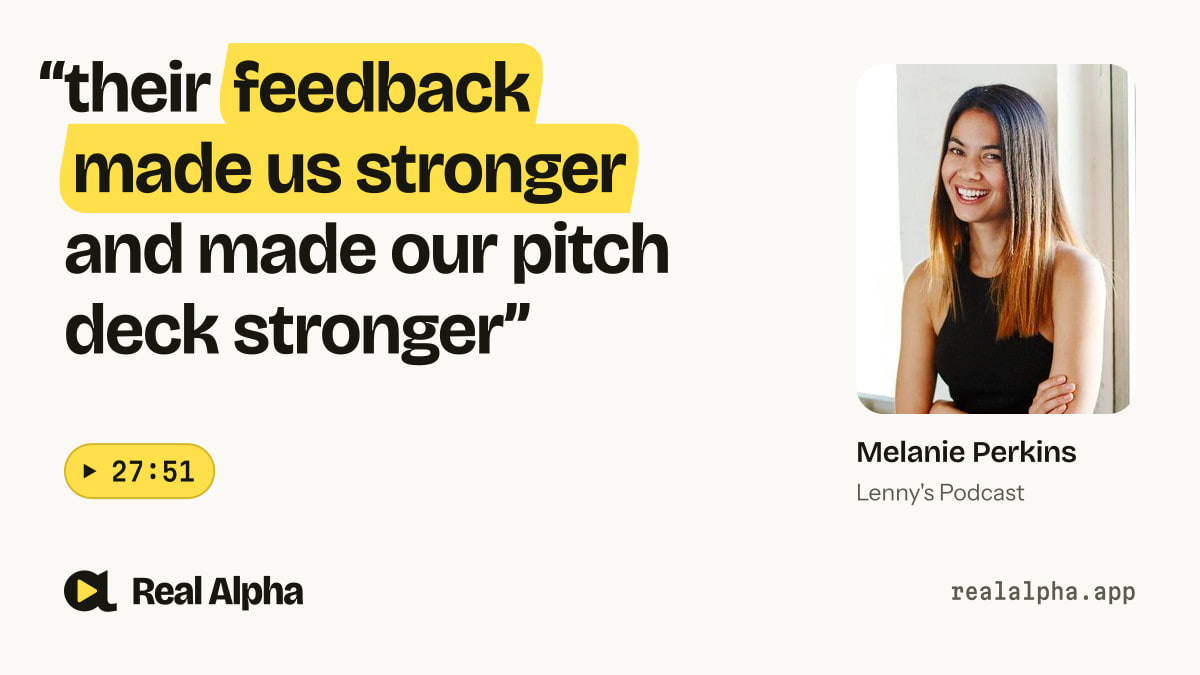
“their feedback made us stronger and made our pitch deck stronger”
 Melanie Perkinsat 27:51 · Lenny's Podcast
Takeaways
- Treat rejection as feedback, not a verdict on you.
- Add answers to recurring objections directly to the pitch.
- Speak to many investors, while accepting some will never agree.
About this segment
Melanie Perkins says she believed investors were wrong, but used their objections to improve the deck. She added evidence on market size, competitors and the problem so the vision was easier to grasp.

Melanie Perkins is CEO and co-founder of Canva.
Co-founded Canva and leads its mission to empower everyone to design, while steering its pledge to do good.

Lenny Rachitsky, Host · Host, Lenny's Podcast
Spent seven years at Airbnb; his product newsletter has over 1M subscribers.
From “She turned 100+ rejections into a $42B company | Melanie Perkins”, Nov 2, 2025. Watch the full episode
Thanks. We'll look at and fix what's off.
Transcript
Transcribed by machine (Whisper) from the episode’s audio, so a word may be off here and there.
- 26:24
So I think it was both things at the same time. It was bonding, let's say. Okay. Speaking of investors, speaking of other hard times, there's a very famous story about Canva. early on, you pitched over 100 investors and over 100 investors said no to you when you were just starting Canva. I think that's more that investors than any founder I've talked to actually tries to pitch. It's impressive you tried that hard and went for so many pitches and finally got someone to take a bet. Now you are something like a $40 billion company making 3.3 billion ARR. I think there's something like 240 million monthly active users. One of the hottest private companies in the world? Just how does this feel? I don't know. It was really clear in my mind that it was the future and I thought the investors were wrong, frankly. But investors also gave really helpful feedback
- 27:16
and feedback often in the form of rejection. So they would say, oh, your market's not big enough. And I would say, it's going to be huge. And I'd add a new page in my pitch deck that said how big the market I believe was. And then they'd say, you're the same as some of the company. And I'd say, coupled with rejection, and I would say, hey, now I've got a new slide in my pitch deck that shows all the players and the huge gap in the market that we believe we're going to fill.
- 27:41
Or most investors knew absolutely nothing about design or the industry that we're in. And so we then ended up with the first few slides saying, here's the lay of the land today, here's the problem that we're going to solve. And so while it was extraordinarily frustrating, their feedback made us stronger and made our pitch deck stronger and it was sort of like you know from that chaos to clarity at the start it was just like this idea and then through the copious amounts of rejection the pitch deck got stronger and more refined so then when people you know the first time I remember I spoke to someone for hours and they eventually got it they were really committed to understanding what we were trying to do but then you know not everyone has six hours to understand a concept and so being able to take all the gems of wisdom from that conversation
- 28:25
and have that understood really clearly in a really short period of time and have all of the reasons that people were rejecting us pre-answered in that initial pitch deck was really important. And I think that's probably one of the reasons why, you know, when I look back at our 2012 pitch deck, it's so valid and really still captures what we're doing today. And so I think that rejection in some ways makes you stronger if you can persist through. Well, I think beyond that, I've never heard this part of the story. It's not just persisting, it's actually iterating and taking feedback that you're hearing to continue to evolve the pitch to a place where, okay, I finally get what you're doing.
- 29:02
That is such a cool part of the story. How much of that vision and product changed throughout that journey versus just the way you pitched it and convinced people? It was pretty consistent, but the way we articulated it changed greatly. And so, for example, I wouldn't in the early days articulate the problem very much. I spent into like, here's the cool solution. And so then the first few pages became very much more problem based. So because if people don't understand the problem, then they can't understand or care about your solution. And so there was a lot of a lot of refinement on the way it was articulated. And but the actual vision itself, I think, was pretty consistent through. I'm guessing a lot of founders ask for your advice on raising money, getting started, having gone through so much rejection early on. What do you what's your
- 29:45
general advice to folks that are having a hard time fundraising? I mean, I can only go on my experience, but I think it's sort of like the dark tunnel analogy. Oh, chaos to clarity. Let's go read that one. It's a slightly friendlier analogy. And I think just taking the rejection and turning into things that you can control. So I can control my pitch deck. I can control the number of people I'm speaking to. And I just spoke to literally everyone. And I think that like continuing to use it to refine it rather than taking it as a personal rejection. I think it's really important to think like, how can I improve? How can I help someone to understand it? Some people are never going to understand it. I remember pitching an investor that had the lean startup book on there, behind them when I was pitching them. And they were never going to like Canva because we were
- 30:31
not the lean startup. That was not the way that we're approaching it whatsoever. So there's some people that are just going to never like you. And that's okay. I think it's important to find some people that do like what you're trying to say and trying to do. And kind of finding your tribe, I think. I think as an investor, this is really interesting to hear because it tells you there are companies like Canva out there that everyone's turning down. A hundred investors passed on that