The alpha, twice a week
That was 4 min.
Get the best new moments in your inbox every Wednesday and Saturday. It's free.
Check your inbox
We sent a link to your address. Click it to finish signing up. Not there in a minute? Look in spam.
or
The Information's TITV · 4 min · Sep 22, 2026
Clay routes AI tasks by cost, speed and information quality
 Kareem Amin
 says Clay fine-tunes models on customer and industry signals, then routes tasks to suit cost or quality needs.
In this episode
Full analysis- 10:13Khosla would tax capital gains like wages to fund job transitions8 min
- 20:32Khosla favors independent AI oversight over government approval8 min
- 39:55Clay plans for AI progress without assuming scaling continues5 min
- 33:35Clay is targeting $240 million in ARR this year3 min
- 36:40Clay routes AI tasks by cost, speed and information quality4 min
- 28:47Human-made goods could gain value as AI spreads2 min
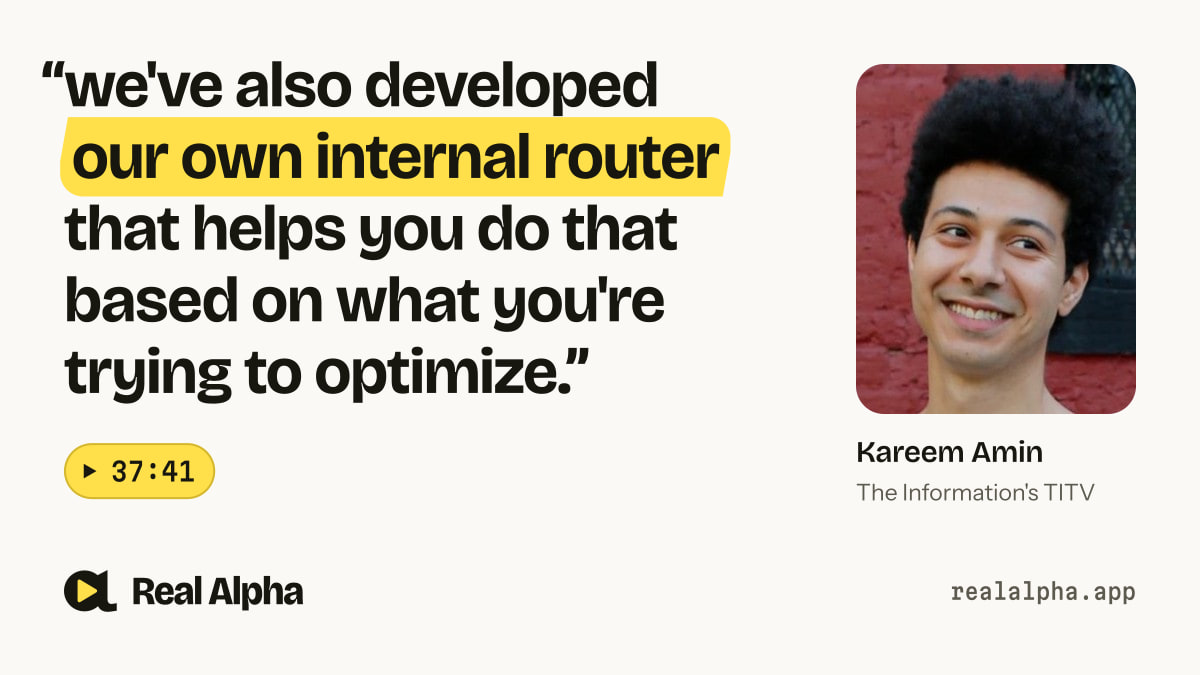
“we've also developed our own internal router that helps you do that based on what you're trying to optimize.”
 Kareem Aminat 37:41 · The Information's TITV
Takeaways
- Clay fine-tunes models using customer and industry information.
- Its router chooses models based on the task's needs.
- The team looks to replace repeatable model tasks with code.
About this segment
Kareem Amin says Clay fine-tunes models on customer and industry signals, then routes tasks to suit cost or quality needs. Repeatable work can be coded instead of using paid inference.

Co-Founder & CEO, Clay
Co-founded Clay, the AI go-to-market platform, after serving as VP of Product at The Wall Street Journal.

Akash Pasricha, Host · Host, TITV
Led The Information's Pro subscription and co-wrote its flagship newsletter, The Briefing.
From “U.S. & China Begin AI Safety Talks, Vinod Khosla’s Pitch for Tax Reform in the AI Era”, Sep 22, 2026. Watch the full episode
Thanks. We'll look at and fix what's off.
Transcript
Transcribed by machine (Whisper) from the episode’s audio, so a word may be off here and there.
- 36:53
Karim, I want to ask you, so a couple months ago, you guys announced that you were using open-weight models yourselves to power... a lot of your tools tell me a little bit about you know how much post training you guys doing to these models have you been finding that the open weight models have been fine as is walk me through a little bit of what it's like on the ground yeah we do we do a bunch of post training i mean we're collecting a lot of information about what people um want what kind of information they want about companies how they're growing their specific business and so we take all of that in I think the way to think about Clay is it's a self-improving revenue engine.
- 37:32
So we see who your best customers are, and then we try to get more like them. And so a lot of the post-training is, in every industry, what are people doing to find customers, and how can we get them to that information faster? But open-weight models have been super helpful, and we're kind of agnostic about what models we use. we let the customers choose, and now we've also developed our own internal router that helps you do that based on what you're trying to optimize. Is it cost? Is it information? Is it speed or quality of information? Right. And so I saw some tweets over the past couple of days talking about sort of the proportion of token use that is going to open-weight models versus closed-source models.
- 38:16
I mean, that's the big chart that everyone seems to be watching. So internally for you guys, for the tokens that your customers are using, what is the proportion of open weight right now? I think it's growing quickly. But I wonder, I mean, I'm curious what the question behind the question there is, because that's not something that we, for example, track really deeply. It's kind of like it's changing all the time.
- 38:41
And for us, what we want to really do is to say, how do we get you to the best information and the cheapest way possible? So I would say that that proportion is growing, but we're always tweaking it and optimizing it so that you get the answer that you need. I mean, the question behind the question for me is really just what is the world three years from now, right? Are we looking at a world where it's 75% open weight or is it still sub 50, sub 30?
- 39:11
Like I'm sort of trying to get to what you think the proportion could be for your company down the line. I think the way we're doing it right now, I think more of those actions are moving to open weight models when we find that there are, and this is actually a general thing that I'm looking at as well, is if something is repeatable, can we write code to do that so that it doesn't have to go through models and you're paying inference?
- 39:36
And then with our router, we're trying to make sure that we're moving the information to the model that's correct for that level of question or kind of like query. And so for us, we're constantly trying to do that to optimize costs for both us and for customers. So I think it's good. But you won't say if it's over or under 50. Not yet.