Free with a sign-in.
The best 22 min of 47
U.S. & China Begin AI Safety Talks, Vinod Khosla’s Pitch for Tax Reform in the AI Era
Vinod Khosla argues that AI-era tax reform can support displaced workers without slowing AI development.
 The Information's TITV · Akash Pasricha
- Vinod Khosla · Founder, Khosla Ventures
- Kareem Amin · Co-Founder & CEO, Clay
The best minutes
- 10:13Khosla would tax capital gains like wages to fund job transitions8 min
- 20:32Khosla favors independent AI oversight over government approval8 min
- 39:55Clay plans for AI progress without assuming scaling continues5 min
Also worth watching
- 33:35Clay is targeting $240 million in ARR this year3 min
- 36:40Clay routes AI tasks by cost, speed and information quality4 min
- 28:47Human-made goods could gain value as AI spreads2 min
Skip the opening show setup and Khosla's sports and prediction-markets discussion.
Full analysis · 7 min read
Real Alpha · Nov 11
Vinod Khosla says roughly $300 billion could fund AI job shifts
- Khosla said his tax changes could generate roughly $300 billion yearly for people displaced by AI.
- He later offered a $400 billion figure, but the transcript does not say what each estimate includes.
- The proposal makes a case for transition funding, not a fully specified budget.
Free with an account
Read the rest of the analysis
6 sections, the 5 other voices it tests Khosla against, and what it means for you. Every episode we cut gets one.
Check your inbox
We sent a link to your address. Click it to finish signing up. Not there in a minute? Look in spam.
or
Signed up before? The same buttons sign you in. The episode, its moments and the transcript stay free.
Equal tax rates leave two revenue estimates unresolved
Khosla's central proposal is to tax capital gains at labor-income rates, then fund support for people displaced by AI. The pitch is to protect people without preserving every current job.
At 15:06, Khosla said the tax changes could generate roughly $300 billion a year. But he had just mentioned other tax breaks. The transcript does not specify which measures that estimate includes.
At 19:05, he later said the changes could generate about $400 billion. He gave no period, and the episode does not reconcile that figure with the annual estimate.
The host raised carry-forward losses and stepped-up basis for inheritances. Khosla later named MLPs and step-up basis among tax breaks.
At 13:28, Khosla said people earning more than $10 million a year pay 40% of capital gains. The episode provides no calculation or rate schedule behind that statistic.
Daron Acemoglu made a related case on The Mishal Husain Show in October 2026. He said more even capital and labor taxes could curb incentives to over-automate.
That is a separate rationale, not evidence that Khosla's revenue estimate holds. For a finance team, the needed test is a provision-by-provision model showing exemptions and timing.
“"just make capital gains the same as taxes on labor"”

Our read
The proposal's direction is clear, but its revenue case is not yet auditable. A budget built around it needs assumptions the episode does not provide.
Protecting people still depends on an unbuilt transition system
Khosla distinguished protecting people from preserving their current jobs. His policy goal is to cushion workers without blocking AI adoption.
At 11:45, he said maybe two-thirds of farm, assembly-line, and cubicle jobs could be replaced by AI capable of doing those jobs. He also offered a separate 80% by 80% estimate.
Khosla framed that second estimate as a rule of thumb. He said AI could do 80% of 80% of jobs, yielding 64%. That arithmetic is not a measured displacement rate.
The revenue promise still needs a delivery system. Khosla did not detail who qualifies, how long support lasts, or what benefit each person receives.
For example, he said a handmade ceramic mug could be worth ten times a basic mug costing a dollar or two. That forecast about human provenance does not estimate how many jobs it creates.
Khosla's interest in rapid adoption is explicit. He said the U.S. must move fast on AI, while the episode leaves the transition mechanism unspecified.
“"we have to protect people, not the jobs they have"”
Our read
The principle is protection through transition, not job preservation. The interview does not explain how to identify displaced people or make support adequate.
Khosla's electoral pitch has no tested constituency
Khosla's political case is a framing hypothesis, not evidence of a coalition. He said he designed the pitch to reach 75 million to 100 million voters.
He cited roughly 75 million voters for Trump's election as a reference point. That number is not a poll on his proposal.
When asked whether he had taken the ideas to lawmakers, Khosla said he had not. Instead, he imagines candidates using tax fairness to defend fast AI adoption.
He hopes a presidential candidate adopts the platform in 2028. He allowed exceptions for primary-home and farm sales, but did not define eligibility or estimate their revenue effects.
Chamath Palihapitiya made a nearby point on All-In in November 2026. He said voters were rejecting an economy that leaves wage earners insecure.
That supports the salience of fairness, not the electoral viability of Khosla's exact tax plan. The cross-party appeal remains untested with lawmakers.
 Chamath Palihapitiya · All-In · Nov 7Voters are rejecting an economy that leaves wage earners behind
Our read
The voter count is a campaign frame, not a forecast of support. Founders should distinguish a legible political message from an enacted funding plan.
Independent oversight still lacks a clear enforcement chain
Khosla drew a line between oversight and permission. He favored independent review and government consultation, not government approval of models.
His stated concerns were delay and capture. He said government review can slow development, while government itself can be captured.
That leaves practical questions open. Khosla did not specify who funds the board, selects members, requires lab access, or acts on a failed review.
Max Tegmark made a contrasting point on Into the Impossible With Brian Keating in October 2026. He said government is the only entity able to demand more information from labs.
Tegmark's point concerned OpenAI's responses to allegations about data use and agents. It is a contrast to Khosla's preference, not a direct test of his proposed oversight system.
Bill Gates described external monitors checking model actions against explicit constraints on Decoder in October 2026. That makes monitoring more concrete, but access and enforcement remain unresolved.
For teams deploying AI, an independent test matters only if reviewers can inspect enough and someone owns escalation.
“"I do like the idea of shared independent organizations"”
 Max Tegmark · Into the Impossible With Brian Keating · Oct 23AI labs can keep the public in the dark
 Bill Gates · Decoder · Oct 22Gates sees three routes to AI control
Our read
Independent review may help, but independence alone does not guarantee access or consequences. The proposal needs a clear answer on who can compel action.
Clay automates sales tasks while keeping human judgment
Amin confirmed Clay's $240 million ARR target for this year and said the company expected to double next year. That is company guidance, not realized revenue or a measure of labor saved.
Clay has moved from company and people data to go-to-market infrastructure, then toward agents handling less deterministic growth tasks. As its CEO, Amin was describing the company's own roadmap, not offering independent proof of savings.
Amin said agents should handle rudimentary tasks while people contribute customer and business judgment. He also said sales will still need direct human interaction.
For example, Amin said Clay might identify a customer interested in a new product and message them, or prepare a rep with notes. Those are specific workflows, not evidence that an entire sales role disappears.
That boundary is a product choice as much as a labor forecast. Automation's value depends on where judgment and customer trust remain necessary.
Angela McNeal made a related point on MTS in November 2026. She said workflows improve through iteration and work better on constrained tasks.
A useful test is to track completed tasks, exceptions, human interventions, and customer response. Do not count every automated step as a job removed.

Our read
Clay's growth target shows commercial ambition, not the net employment effect of sales agents. The operating question is which work they complete and where people remain involved.
Amin plans for scaling without treating it as a law
Amin said scaling trends are observations, not laws, and teams should plan for more than one capability path. He also said he was not building frontier models and had no deep insight on takeoff.
Separately, Clay routes tasks by cost, speed, and information quality. Amin said repeatable work can be coded instead of sent through models, helping reduce paid inference.
Amin said open-weight use was growing, but declined to say whether it was above or below 50%. That makes task economics more useful than a single model-share target.
Under the status quo scenario, Amin imagined Clay moving beyond finding prospects and preparing sales reps. It could help decide what product to build, ship features, interview customers, and revise.
His RSI view was different. He suggested there could be one winner per vertical in either future, while companies in an RSI scenario might need far fewer people.
Amin still saw room for human sales expertise, unless machines were selling to machines. He pointed to understanding why a customer buys as a continuing human role.
These are scenarios, not a Clay forecast of when capabilities arrive. Teams can budget against current task costs while stress-testing faster capability gains.
“"They're observational."”
Our read
Amin's approach favors flexible planning over one scaling bet. Teams can track present costs while keeping a separate scenario for faster capability gains.
What it means for you
- Reconcile the tax case. Build separate cases for Khosla's roughly $300 billion annual estimate and his later $400 billion figure. Show which reforms and assumptions each requires.
- Map tasks to people. For one workflow, record tasks agents finish, when staff intervene, and whether customer outcomes change. This tests automation without equating task coverage with jobs removed.
- Set oversight conditions. Write down what reviewers can inspect, who funds them, and who handles unresolved findings. Khosla's proposal leaves these mechanics open.
- Budget two capability paths. Forecast costs using current task-level routing and repeatable code, then run a faster-capability scenario. Amin said not to assume scaling observations continue indefinitely.
What to watch
- Whether the FOIA lawsuit leads to some framework documents being released by October 30. Leo Schwartz said they could be heavily redacted or limited.
- Whether Clay unveils its first AI worker at Sculpt, which Amin said was planned for the company's conference in two weeks.
- Whether Khosla takes the tax proposal to lawmakers as presidential candidates prepare for 2028. He said he had not yet done so.
Send this to finance leaders and product executives planning AI labor transitions.
Watch the minute where Khosla gives the roughly $300 billion annual figure
Written by Real Alpha from the episode's transcript and the other moments it links, then checked against the transcript. Quotes are the speaker's exact words.
Minute by minute
- 1:00A U.S.-China channel would flag incidents
Schwartz says U.S. and Chinese officials discussed a notification channel for AI incidents that reach the national-security level, with another meeting planned. He says trade representative Jameson Greer said advanced-chip export controls were not on the agenda, though they could come up at the leaders’ summit.
- 9:26Khosla wants capital gains taxed like labor
Khosla says AI could perform 80% of the work in 80% of jobs and argues policy should protect people, not preserve their current jobs. He proposes taxing capital gains at labor-income rates and closing tax breaks. He first estimates the measures could raise roughly $300 billion a year, then later says about $400 billion.
- 17:59Khosla favors independent AI oversight
Khosla says AI should bring visible benefits, such as free primary care and AI tutors, while safety oversight should rely on independent bodies. He argues that AI is difficult to verify internationally, making treaties unworkable, and that government approval could slow development or be captured. He favors government consultation, not government approval of models.
- 28:47Khosla sees value in human-made products
Khosla says human provenance could create jobs as AI displaces others, comparing a $1 or $2 mug with handmade ceramics he says could be worth 10 times as much. He argues live sports will remain valuable because they pit people against people. He says 90% of prediction markets are sports gambling, but adds that he is not qualified to judge the issue.
- 33:13Clay is adding AI workers to sales
Amin says Clay has almost 18,000 customers and is targeting $240 million in ARR this year, with plans to double it next year. He describes the company’s shift from aggregating data and building go-to-market infrastructure to agents that handle less predictable tasks, including an AI worker it plans to announce at its conference.
- 36:40Clay routes tasks across models
Amin says Clay post-trains models using information about customers and how businesses grow. The company uses open-weight models, lets customers choose models, and has an internal router that selects based on cost, speed, and information quality. He says open-weight use is growing but Clay does not track its share closely.
- 39:48Amin doubts extrapolating scaling trends
Amin says he takes AI safety seriously but is most concerned about cybersecurity threats and disruptive uses of models. He calls scaling trends observations rather than laws and says Clay must plan for the possibility that progress slows, as well as the possibility that it continues.
- 42:11Amin sees different futures for Clay
Amin says Clay could move from recommending sales actions to helping decide what products to build and testing changes, making a company more autonomous. In a future with recursive self-improvement, he expects companies to need far fewer people, while noting that general intelligence may not translate across every domain. He still sees a role for human sales expertise unless machines sell to machines.
- 45:17Clay has no near-term IPO plans
Amin says an IPO is not on Clay’s mind anytime soon, though the company is preparing its books so it will be ready.
Published Sep 22, 2026.
Transcript · 31 min read
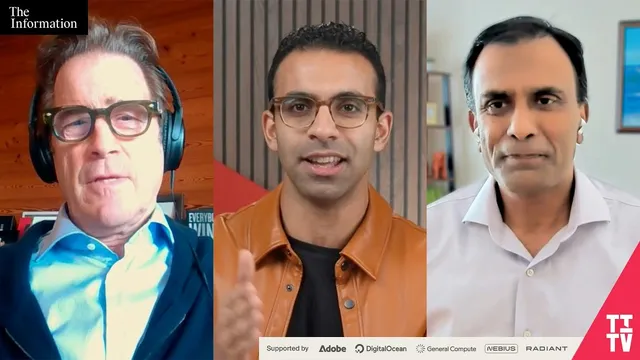
The Information's TITV, hosted by Akash Pasricha, with Vinod Khosla and Kareem Amin.
Transcribed by machine (Whisper) from the episode’s audio, so a word may be off here and there. Where the podcast’s audio and the video part ways, some times are a minute or so off.
welcome everyone to the information's ti tv my name is akash pastrucha it is monday september 21st today on the show we have some big developments on the u.s china ai dialogue our tech and politics reporter Leo Schwartz spoke with U.S. Treasury Secretary Scott Besant directly about it. We'll have more on that in just a minute. We'll then get to a conversation that I had with Vinod Khosla. I spoke with him about some ideas that he has for tax reform in the AI era. I also asked him for his thoughts on the current AI safety regulation debate that is going on. And to close out the show, I'm bringing on the co-founder and CEO of Clay. The company was recently valued a few weeks ago at $7.1 billion. I'm going to talk to him about the AI safety debate going on as well and how it affects enterprise software. It's going to be a great show, so let's get right on into it. President Trump is set to meet with China President Xi Jinping this week and talks between top government officials already started over the weekend in New York. The Information Tech and Politics reporter Leo Schwartz spoke with U.S. Treasury Secretary Scott Besson last night. I want to bring on Leo to share more about that conversation. Leo, welcome back to the show.
It's great to have you here. Thanks for having me. You had a busy weekend, busy Sunday. You were talking with U.S. Treasury Secretary Scott Besson. What did you ask him and what did he tell you? Yes. So yesterday, Scott Besson, along with U.S. Trade Representative Jameson Greer, spoke with a Chinese delegation led by the vice premier on a number of subjects, but AI was top of the agenda. Of course, the biggest debate in Washington has been about a potential slowdown around AI given the pace of model development. Could there be some sort of accord with China that would be safety focused? I asked Besson about this, and he actually said that it had been discussed that China and the U.S. have talked about creating what's called the China-U.S.
AI dialogue, which will be essentially a notification mechanism where if there's some sort of incident that rises to the national security level. Both countries can tip each other off to it. And they also said that they would be meeting again on the subject. Did that surprise you? Has this something like this been on the table for a while? It's surprising to the degree that pretty much every senior Trump official, including Trump himself, has said we are not slowing down AI. We cannot halt development, namely because of this race with China. So the fact that there was anything discussed, I think, is a bit surprising.
Read the whole transcript
At the same time, if you actually take what Besant said at its word, this isn't really a slowdown in any sense. It's basically just saying if there are any sort of incidents, we'll let each other know about them. It's really unclear what would happen after that notification. So is this a slowdown? Probably not, but it does seem like a step in the right direction. Right. And of course, that would depend on the implementation of this type of this is an initial discussion. You know, it would very much vary on whether or not the implementation goes and both parties actually have to pick up the phone and make the call in the first place.
What about export controls and trade and chips? Did that come up at all? So this has been one of the central questions and sticking points between the U.S. and China, namely the export of advanced U.S. chips, NVIDIA chips specifically. As our reporting has showed recently from our terrific reporters in China, there has been a push to emphasize domestic chip production and domestic chips. So I did ask whether expert controls of U.S. chips were discussed at all. And Jameson Greer, who's the trade representative, said that it was not on the agenda. Which, again, is a bit surprising, although that doesn't mean it won't be discussed at the main summit happening this week.
Yeah, I mean, I imagine, just given the size of that industry, maybe that's something that it's like, we can talk about the AI stuff here. Let's leave the chips and the trade for, you know, the presidents to talk about down the line, maybe. Yeah, we'll see. I mean, I think that will be a major point of contention moving forward. So what about President Trump's social media posts over the weekend? This was another flurry of news. You know, he talked about an AI force of some kind. Can you unpack what it is he said, what we know, what we don't know, what your thoughts are on how this would actually be implemented?
Yeah, as you mentioned, it was a busy weekend. I think every weekend is busy now. It already seems like a distant memory. But last Saturday is when Dario Amodei posted his big essay, Pacing the Frontier. So it seems like Saturday is a day for news now. Trump announced this idea of an AI force. I was talking with some sources over the weekend. I do think this took everyone by surprise. So as you may imagine, it's still a bit half-baked. But what it seems like is there will be some new AI czar. It will be modeled after the Space Force, which was a major initiative under Trump's first term. What remains unclear is how it overlaps with all of the offices already dealing with AI.
Of course, you have Casey, which is the small center under the Commerce Department, and you have the National Cyber Director. You have all the intelligence agencies. There are lots of groups already dealing with AI. So what the new remit of this AI force will be remains to be seen, but we'll work hard to try to find that out. Yeah, but I mean, let's just talk about this AI czar. I mean, so David Sacks previously occupied the role of crypto and ai czar do you have any thoughts on i mean look you can make a prediction right here and right now if you want i don't know who who might be a candidate for that but i mean short of that what type of person do you think you might be looking for for that role well there was a good piece in axios this morning that basically said one of the biggest challenges in appointing a position like this is and especially one that's overseeing a large private sector industry is that you have to make sure that they divest from their holdings or at least don't have conflicts of interest so what the Axios be speculated is that maybe it would be a government official who's already essentially gone through that process so someone like Emil Michael who's currently at the
Department of Defense um I don't know maybe Dario Gill at Energy uh there's a number of people Well, Sri Ram Krishnan, of course, was David Sacks as number two and recently left the government, or maybe David Sacks would come back, although I think that that seems unlikely. Yeah, but I mean, to your point, like, this is an imminent issue. And so, you know, it strikes me that they wouldn't want to drag their feet on this is going to take me a month or two or three to divest my holdings and stuff like that. So I think that's that's a good point. Leo, before we let you go, so, I mean, we've talked about the U.S.-China policy.
We've talked about the U.S.'s own view on it. What about that regulatory framework, the voluntary release, the voluntary oversight? We've been waiting for a little more clarity on that. Is there any sign that we're getting clarity on that? Well, I might actually have a light at the end of the tunnel to share, which is there was a FOIA or Freedom of Information Act lawsuit filed by a non-profit and there was a court filing last week that showed that they'd reached some sort of agreement with the federal government to release some of the documents from the framework by October 30th. So we might actually see those forced to be made public. Of course they could be heavily redacted, it could be limited release of what the documents are but it seems like we might finally get those to to see the light of day great well leo i want to thank you for coming on that is leo schwartz our tech and politics reporter here at the information this past friday i had the chance to sit down with binod khosla the founder of khosla ventures binod recently wrote an opinion piece for the information arguing for tax reform in the ai era we also talked about his view on ai safety regulation the role of government and given
that he also just bought the seattle seahawks i also asked him for his view on prediction markets here is that conversation vanod welcome back to ti tv it's great to have you here always happy to be here so vanod you wrote this piece an opinion piece for the information and it had a number of interesting tax proposals for the ai era and there was a lot in there i mean you talked about eliminating preferential capital gains. You talked about closing loopholes that benefit the wealthy, stuff like carry forward tax losses, stepped up basis for inheritances. And the idea here is that these collections should then go to the people whose jobs will inevitably be replaced by AI. And one of the forecasts you made is that more than 60% of human labor will be replaced by AI. And it's a thoughtful piece, and I encourage everyone to read it.
“I should be taxed the same way as if I generated the same income from capital gains.”
Right. But I want to ask you a slightly different question about another facet of government regulation. So we have this dialogue about AI safety, which is currently top of mind for everyone. And I want to put aside for a minute the risks that people think AI could pose. You've made very clear through your writing, I mean, it has a lot of promise, and I think we can all agree with that as well. My question that I'm more interested to hear from you on is how you think AI should be regulated. Who should do the regulating? What are your thoughts? Well, before I go there, And I want to finish the talk we were talking about, which is we levelize capital gains, get rid of breaks that rich people use, like MLPs and step forward bases and a bunch of others.
And we could generate about $400 billion. At peak unemployment during COVID, we were spending about $250 billion a year on unemployment benefits for people. and so we can generate enough money to protect people during this transition but the other thing I think before we get to your safety risks is we haven't shown people why AI is beneficial it's trivially inexpensive to make free primary care available to every person in the country probably for a billion dollars a year or a month or less. Think about it. Free primary care to everybody, which should reduce downstream healthcare costs. Free AI tutors to every child in this country.
Right. And that would reduce education costs. So we can save money by getting the benefits of people, of AI to people in a tangible way where they can see the benefits of AI. And we have to do that, which has not been done very well. So benefits, safety through a fund. And I also talk about how we get to a sovereign fund and token taxes and some other ways. We can have a pretty large corpus of money to help people over the longer term. Getting to the safety issue, I would say the following.
“What's different about AI is previous technologies like nuclear and biotechnology were verifiable when used.”
you've done a lot of exciting things. Perhaps one of the most exciting is you took a controlling stake in the seattle seahawks which i know a lot of people are excited about uh and i want to ask you about um i want to ask you about uh your view on the world of sports we're a tech publication we cover prediction markets pretty closely tell me what is your view on prediction markets now Now that you're firmly in
“If it's handmade in ceramics by a human being, it's going to be worth 10 times as much.”
And, you know, I think I certainly look, I actually I did not play video games at all growing up. I preferred the in-person experiences much more. And so I agree with you that the I mean, live sports, there's nothing to replace it. But, you know, these questions have very much become top of mind for everyone in tech and the sports world broadly. I mean, the NFL has taken a more patient stance to working with predictions markets.
It's already worked with sports gambling companies. Let's be clear, since you want to talk about prediction markets. Prediction markets are nothing. 90% of prediction markets are not about prediction. They're sports gambling by people who, especially younger people. A lot of male, younger males doing gambling on prediction markets. I'm not the one who's going to decide whether that's a good or bad thing. That's up to somebody else. I've never gambled, so I can't be a good judge of that. Right. And tell me, I mean, were you invested in any prediction markets companies? Are you invested in any? I'm not invested in any prediction market companies or any gambling companies.
Right. And tell me, just the societal implications of all this. I mean, it's sports gambling, as you said, in one way of thinking about it. But I mean, I do want to ask you, does it concern you, you know, the extent to which these prediction markets have, in some cases, threatened player safety, some of the societal issues that have come about with it, is that concerning to you? You know, I haven't paid a lot of attention to... markets. So I'm probably not qualified to comment. Things that make it easy to do things like gambling are generally not great for society. Right. Right. Well, Binod, I want to thank you for joining us. It was a great discussion. That is Binod Khosla, the founder of Khosla Ventures here on TITV.
As every tech company in the world moves to sell their AI, Clay is trying to use AI to reinvent sales teams altogether. Earlier this month, the company raised $150 million at a $7.1 billion valuation. I want to bring on Kareem Amin, co-founder and CEO of Clay for a conversation. Kareem, welcome back to the show. It's great to have you here. Thanks. It's great to be here.
“we have almost 18,000 customers and also our enterprise sales motion is growing really quickly as well.”
“we've also developed our own internal router that helps you do that based on what you're trying to optimize.”
Got it. Okay, what about all the AI safety regulation debate that's going on right now?
“we don't fully understand why that's happening. We don't fully understand where it tapers off.”
that it's going to end humanity altogether? What is it that I want the probability to be or what is it that I believe it actually is? Let's go through both scenarios. Anyway. Yeah, yeah. Answer the question. Yeah, answer the question. I think it's, you know, like some of the people who are saying 10%, it was just really hard to know. I don't think about it that often. Right. Well, and last thing I should say, Kareem, something you must be thinking about, Wellington led your latest round, and it's well known that they take stakes ahead of IPOs. What's the update on IPO timing for Clay?
Not anytime soon, but we are always kind of preparing everything so that we have all of our books ready. But it's not on our mind. Great. Kareem, I want to thank you for coming on. That is Kareem Amin, co-founder and CEO of Clay here on TIT. That does it for today's show. A reminder, we are on this stream Monday through Friday at 10 a.m. Pacific, 1 p.m. Eastern. If you can't make it then, episodes are available on theinformation.com, on our YouTube channel, or wherever you get your podcasts. Make sure to follow us on social media, on X, on Instagram, on TikTok, and on LinkedIn. I am already excited for our next show tomorrow.
Have a great rest of your Monday. Bye-bye for now.