The alpha, twice a week
That was 6 min.
Get the best new moments in your inbox every Wednesday and Saturday. It's free.
Check your inbox
We sent a link to your address. Click it to finish signing up. Not there in a minute? Look in spam.
or
Newcomer Pod · 6 min · Nov 18, 2026
Coding works because its output can be checked
 Gary Marcus
 sees coding as a real AI use case because models reuse code patterns and tests can check results.
The episode’s best minutes
Full analysis- 3:08AI companies may face commodity economics and a funding spiral8 min
- 10:47Coding works because its output can be checked6 min
- 34:09Marcus wants a narrow pause on internet-connected agentsPro pick 3 min
- 5 more moments in the full episode
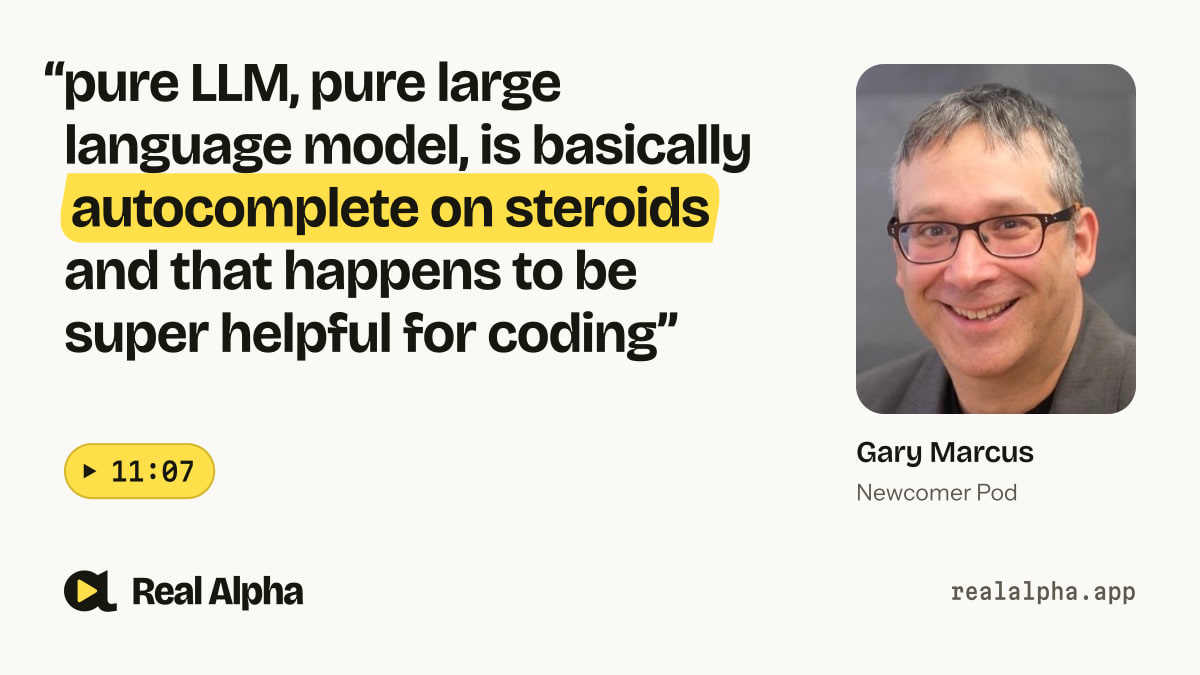
“pure LLM, pure large language model, is basically autocomplete on steroids and that happens to be super helpful for coding”
 Gary Marcusat 11:07 · Newcomer Pod
Takeaways
- LLMs can take on coding drudgery like adapting existing code.
- Tests provide a way to check whether generated code works.
- Unverifiable outputs, such as drug claims, still need real-world testing.
About this segment
Gary Marcus sees coding as a real AI use case because models reuse code patterns and tests can check results. That verification advantage is missing in many other fields.

Gary Marcus is an AI researcher and NYU professor emeritus.
Founded Geometric Intelligence, acquired by Uber, and researches human language development and cognitive neuroscience.
- EN
Eric Newcomer, Host · Newcomer
From “Is OpenAI Becoming the WeWork of AI? | Gary Marcus”, Nov 18, 2026. Watch the full episode
Thanks. We'll look at and fix what's off.
Transcript
Transcribed by machine (Whisper) from the episode’s audio, so a word may be off here and there.
- 10:50
So people do want it. You do believe sort of the use cases are compelling, or you think some of them are fake? There's some nuance there. So the most compelling use case is coding, right? The technology has changed. It used to be what I would call pure LLM, and now we have other stuff and we can talk about that. But pure LLM, pure large language model, is basically autocomplete on steroids and that happens to be super helpful for coding because a lot of what most coders maybe not all but a lot of what coders do all day long is like hey how do you turn this thing into an html call that they're already copying github constantly themselves they used to like you know copy it from stack overflow and paste it make a few edits right and now the system will basically do that for them and so the kind of drudgery of it is replaced and it's really genuinely useful
- 11:42
for coders is it has problems too sometimes it paced in the wrong thing there's a lot of security issues we could talk about but and so you could ask like what's the overall productivity increase i've heard things like 30 which is nothing like the thousand percent that people were hoping for but it's still real and 30 is still a big deal. I think coding is a genuinely useful case. And I think that one will persist. There's no reason for it not to persist. It might be in 10 years, there's a much more sophisticated way to do it. People don't use LLMs at all anymore. You could sort of imagine certain scenarios.
- 12:16
But in the next three to five years, let's say, people are going to use it for coding. The problem is coding has a special thing about it, which is you can have it, I'll call it self verify that's a little bit of a cheapo just for simplicity right you can set up tests and things like that to see if your code is working it's not perfect things can still through but you can do a lot by verifying whether they're with a rules-based system with a rules-based system so it turns out clod code is actually a neurosymbolic hybrid and if you know my work a lot of it for 30 years was saying we need neurosymbolic hybrid so it's actually a vindication for me which many people don't understand. But, you know, I said, you can't just use a pure LLM. You need to have rules in there. You need to have structured representations and so forth. That's what my
- 13:01
2001 book was about. And so cloud code is actually kind of close to what I was calling for, at least in some ways. So it's a vindication for me. But you can't do that everywhere. So if you wanted to like run a system to verify, to fact check what I'm saying here, let's say, it's just much harder to do it's not it's not like running a math equation you can't verify what a person says or you know let's say you have a strategy for defending uh against taiwan if china invades like you can't you know do a formal verification that your strategy about when you send your you know destroyers and or whatever it is you can't make sure that that is formally correct and that's when these systems get in trouble. Particularly, they get in trouble when you can't verify. So you can't use the symbolic part. The symbolic part's good for verification. And if you go outside of
- 13:57
what you've trained on. And if you're like, let's say, I mean, there's never been a war in Taiwan. And a lot of the data that you're training on was before drone warfare was common and, you know, might be obsolete. And so what we've seen in things like driverless cars, which is much easier than military planning is you often get these weird outlier cases where these kind of systems don't work. My favorite example of this was you could press summon on a Tesla and somebody did this at an airplane trade show and the car ran straight into a three and a half million dollar jet. Oh my God. Because it wasn't in the training set and the representations are superficial. It doesn't really understand don't go into big heavy objects or whatever. It was what we would call out of the distribution so coding you believe in it's unique are there other cases you're like okay
- 14:43
there's another great use case although it has its own um caveats is is doing math you know solving math challenges it turns out to be great for that because we've come up with again there's verification in fact there's a very intricate formal system that's been developed over a number of years called lean and that's getting used it is a symbolic system to do verification and so Basically, I'm being crude about it.
- 15:07
I don't know all the technical details because they're not all published. But roughly speaking, an LLM makes a guess at what a proof might look at. And then you run it through Lean, which is a symbolic system. If the symbolic system gives you the thumbs up, you think you've got something. If the symbolic system has a thumb down, then you just generate a new one. So it's kind of like generate with the LLM, test with the symbolic system.
- 15:26
And that's a perfectly fine application where you can get it. But let's move over to molecular biology and say, I've got a candidate drug that maybe will fix some kind of cancer. Well, that's great, but you don't have the verification. You can't test in some formal model whether this is really going to work. And so you're stuck where the drug industry has always been stuck, where you still have to do the clinical trials. You can't magically tell whether your thing is going to work. So you have to do the clinical trials that take five years. And so you can't speed that up anywhere near as much as people are hoping for. And it's not as good a use case.
- 15:59
There's some value in it. But it's not a clear cut use case. And then there's like all these like commercial use cases where I think what's going on is people fall in love with it or they feel like if I don't do it, my competitors will. And they try it and then they get all these like reports written automatically and they have hallucinations and stuff like that in them. And it's actually a lot of work to verify them.