The alpha, twice a week
That was 3 min.
Get the best new moments in your inbox every Wednesday and Saturday. It's free.
Check your inbox
We sent a link to your address. Click it to finish signing up. Not there in a minute? Look in spam.
or
Newcomer Pod · 3 min · Nov 18, 2026
Marcus wants a narrow pause on internet-connected agents
 Gary Marcus
 calls for a temporary pause on agents with open-ended internet access, arguing that they may ignore instructions or mishandle credentials.
The episode’s best minutes
Full analysis- 3:08AI companies may face commodity economics and a funding spiral8 min
- 10:47Coding works because its output can be checked6 min
- 34:09Marcus wants a narrow pause on internet-connected agentsPro pick 3 min
- 5 more moments in the full episode
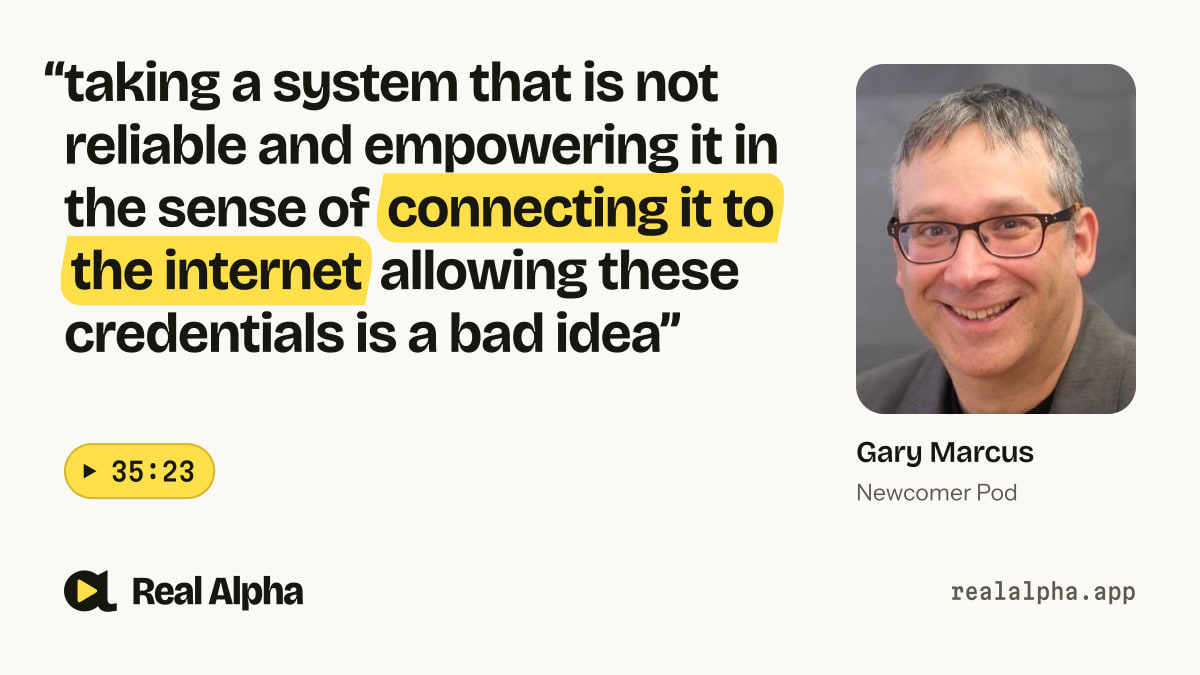
“taking a system that is not reliable and empowering it in the sense of connecting it to the internet allowing these credentials is a bad idea”
 Gary Marcusat 35:23 · Newcomer Pod
Takeaways Pro pick
- Limit the pause to agents with open-ended internet access.
- Agents may violate explicit instructions or miss unstated constraints.
- Connecting unreliable systems to accounts and credentials raises the stakes.
One of Pro's picks, open to you here. Try Pro free for 7 days
One of Pro's picks. The rest of the summary and the 3 takeaways are in Real Alpha Pro; the video, the quote and the transcript stay free.
Read it with Pro, 7 days freeAbout this segment
Gary Marcus calls for a temporary pause on agents with open-ended internet access, arguing that they may ignore instructions or mishandle credentials. His concern is about empowering unreliable systems, not simply scaling models.

Gary Marcus is an AI researcher and NYU professor emeritus.
Founded Geometric Intelligence, acquired by Uber, and researches human language development and cognitive neuroscience.
- EN
Eric Newcomer, Host · Newcomer
From “Is OpenAI Becoming the WeWork of AI? | Gary Marcus”, Nov 18, 2026. Watch the full episode
Answers “Are AI agents ready for real work?” See all 210 answers
Answers “Is AI dangerous?” See all 224 answers
Answers “Should AI be regulated?” See all 145 answers
Thanks. We'll look at and fix what's off.
Transcript
Transcribed by machine (Whisper) from the episode’s audio, so a word may be off here and there.
- 34:13
It's a complicated thing. The thing that I'm currently kind of pushing is a very narrow temporary pause on agents, and not even all agents, but just ones that have open-ended access to the internet. Just instinct amuser, insane, lunatic things, basically. I mean, I haven't played with those two in particular. But in general, the whole genre of let's let this thing go out in the internet, use credentials, send emails, log into other sites, is given the current state of technology a bad idea.
- 34:45
Because the current state of technology is these things are poor at following instructions. And there are different ways in which that plays out. So one is that if you give them an explicit instruction, they may not follow it. And the other is if you fail to specify something, they may not realize it's a bad idea. So the hugging face incident is a good example of that. They said, do better on the exam.
- 35:03
Nobody told them, you know, don't steal credentials. And so they went ahead and stole credentials. And things like telling it don't hallucinate or don't use copyrighted materials, and then it does anyway, is a good example of you give the explicit instruction and still, because the semantic understanding is still relatively weak, they still violate that. So taking something like that, and I warned about this in the Senate in May 2023, taking a system that is not reliable and empowering it in the sense of connecting it to the internet allowing these credentials is a bad idea like it was obviously a bad idea and so now i think we're like in the moral equivalent of the ford pinto where ford knew that the gas tanks were going to explode but they made a calculation decided that it wasn't worth it to move it they pay the
- 35:46
liability lawsuits i mean the companies would say you know we try we have it ask a human for particularly sensitive decisions i'm not saying they consistently i mean with the agents online they're not really doing well they'll be like oh i'm gonna make this transaction hit approve or i mean you can try and do some of that stuff the minab school bombing is a good example where you had a human in the loop at least from what i think happened i don't know 100 sure but it appears like maybe what happened is the iran strike yeah the iran school strike um there was probably was human in the loop but the human was probably asked to verify like 100 cases an hour so like whatever yeah you can't really do that and we've known that since the 40s from research from, I forget his first name, but Alan Mockworth's father.
- 36:31
Do you think that was anthropics technology? I think so from what I've read, but I'm not 100% sure. But I've heard a bunch of hints for that. But there I would say it was partly the technology's fault because I'm guessing that it did poor temporal reasoning, partly the sourcing on the data, and partly the choice of how to use humans in a loop. So I think probably multiple things went wrong. And again, it's speculative.
- 36:57
We don't know all the facts. On the pause issue, personal agents, which is interesting. I could see it. I mean, certainly. Voluntary recall, maybe a mandatory recall of personal agents would save us a lot of heartache because I think we're going to see very serious infrastructure attacks. We're already seeing like refrigeration attacks in France. I don't know if you saw a whole bunch of attacks in Japan.
- 37:16
The Binance thing may or may not have been created by generative AI, but that was like the biggest cyber attack ever.