The alpha, twice a week
That was 3 min.
Get the best new moments in your inbox every Wednesday and Saturday. It's free.
Check your inbox
We sent a link to your address. Click it to finish signing up. Not there in a minute? Look in spam.
or
Big Take · 3 min · Nov 16, 2026
Cognitive tests may not identify what is causing memory loss
 David Cameron
’s family received a mild cognitive impairment label, but the tests did not identify the cause.
In this episode
Full analysis- 13:58A family mutation linked amyloid to Alzheimer’s diseasePro pick 4 min
- 33:02Blood biomarkers could widen access to Alzheimer’s diagnosis3 min
- 29:40Family care accounts for half of dementia’s global costs3 min
- 26:23Alzheimer’s symptoms can appear years after disease buildup3 min
- 40:21APOE testing can reveal risk without a clear next step3 min
- 20:03Cognitive tests may not identify what is causing memory loss3 min
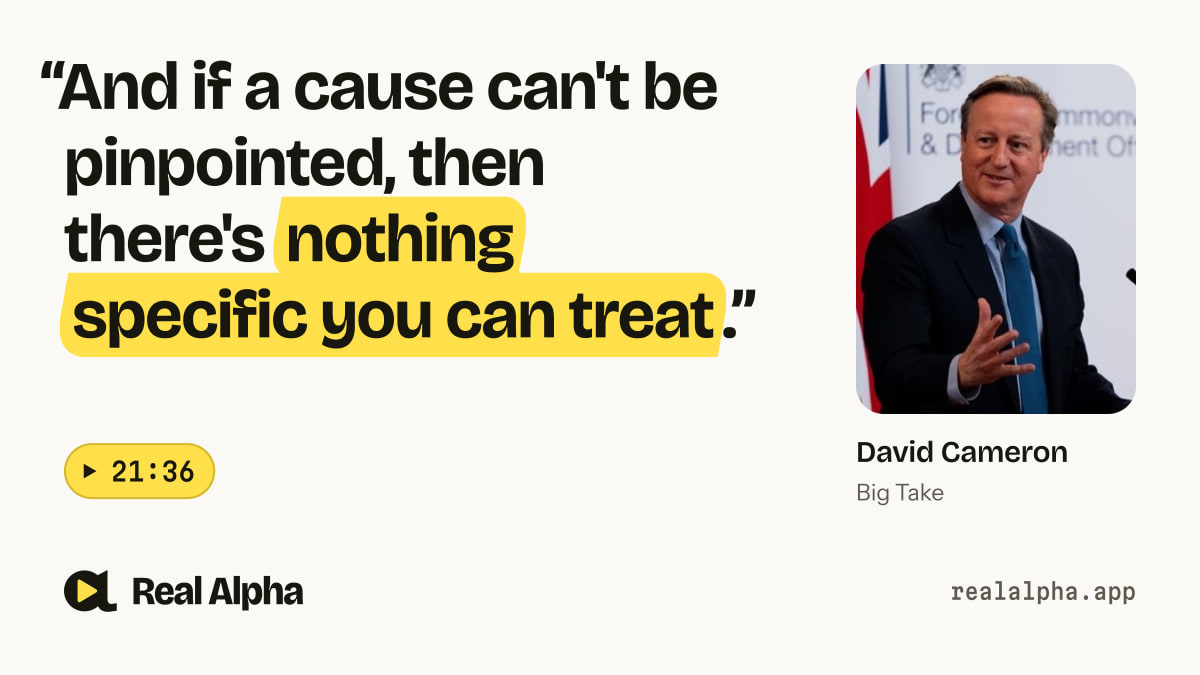
“And if a cause can't be pinpointed, then there's nothing specific you can treat.”
 David Cameronat 21:36 · Big Take
Takeaways
- Cognitive tests indicated impairment without identifying its cause.
- The uncertainty made it harder to explain what was happening.
- It complicated decisions such as taking away their mother’s driving licence.
About this segment
David Cameron’s family received a mild cognitive impairment label, but the tests did not identify the cause. Without that, they had little clarity about treatment or what to tell his mother.

David Cameron, Host
President, Alzheimer’s Research UK
Made dementia research a political priority, helped double investment, and now champions the search for an Alzheimer’s cure.
From “How Close is a Cure for Alzheimer’s? | Ending Alzheimer's”, Nov 16, 2026. Watch the full episode
Thanks. We'll look at and fix what's off.
Transcript
From the transcript Big Take publishes with the episode.
- 20:06
hold in her brain. But back then, we didn't know. My siblings and I started to get worried, so we had her evaluated by her doctor and eventually took her to a clinic to take some tests.
- 20:18
It was very vague. It was a sort of memory tech clinic you'd go to and they'd do all these cognitive tests and you'd come out with a sort of varying degrees of cognitive impairment, as they called it. My sister Tanya again. And really, you know, there was no obvious kind of click into, right, well, we really think she's got full-blown Alzheimer's.
- 20:38
And this is still very much the state of how dementia is broadly diagnosed. It's a long process that involves many steps. For our mother, it involved Tanya taking her to the doctor, our GP, for an initial assessment, and then being referred to a memory clinic. Along the way, each clinician gave her various cognitive tests that included answering very simple questions, like, where are you, what day is it, and so on. Based on those answers, she was eventually given an assessment of mild cognitive impairment. As time went on, the memory slips got worse. She was starting to have no recollection of what she'd done the day before, or that morning, or who she'd seen. I remember once when a really good friend of hers came to see her, and she had no idea who she was. But the test results didn't tell us what was causing the changes
- 21:30
in her brain, if it was Alzheimer's disease, or another form of dementia, like vascular dementia, or something else entirely. And if a cause can't be pinpointed, then there's nothing specific you can treat. Some symptoms, like anxiety or depression, might be managed with medication. But otherwise, you're left a bit helpless. The confusion during the process of diagnosis was hard on us, but obviously particularly hard on Mum. She didn't understand what was going on with her, and it led to a lot of anger.
- 22:09
One of the distinguishing things I remember her saying all the time was, oh, it's terrible. My memory's got really bad. But there hadn't been a sort of formal diagnosis for us to say, well, yes, mum, that's because you've got Alzheimer's. And at that point, we stopped her from driving. And that was something she got very, very angry about and didn't really understand. She didn't really believe. Us that she needed to have the car taken away or her license taken away.
- 22:32
I remember that because I put on one of our WhatsApp groups, thank God you've taken mum's car away. And it was the one with mum on rather than the one without mum on. And I got an absolute roasting when I saw it. This was one of the more challenging moments of my mum's final years, when we knew something was really wrong but didn't know exactly what. And it was difficult not being able to tell her what was going on and not knowing what we could do about it, other than taking away her driver's licence. And that just felt awful, stripping her of her autonomy. There are many families like mine who watch the decline of a loved one occur over many years. only realising that something is really wrong once it's too late to intervene.