The alpha, twice a week
That was 3 min.
Get the best new moments in your inbox every Wednesday and Saturday. It's free.
Check your inbox
We sent a link to your address. Click it to finish signing up. Not there in a minute? Look in spam.
or
Bloomberg Business of Sports · 3 min · Nov 20, 2026
Coker plans super fights and a business distinct from the UFC
 Scott Coker
 says tournament standouts can move into super fights, while the company builds its own business.
In this episode
Full analysis- 26:17Ki MMA will use a global tournament to crown a yearly champion2 min
- 32:33Ki MMA plans to build stars through scouting and tournament exposurePro pick 3 min
- 4:48NBA owners expect $500 million in expansion fees5 min
- 19:30Levin saw Coker as one of two operators who could scale MMA4 min
- 29:55Coker says a ring can give spectators a clearer view than a cage3 min
- 35:18Coker plans super fights and a business distinct from the UFC3 min
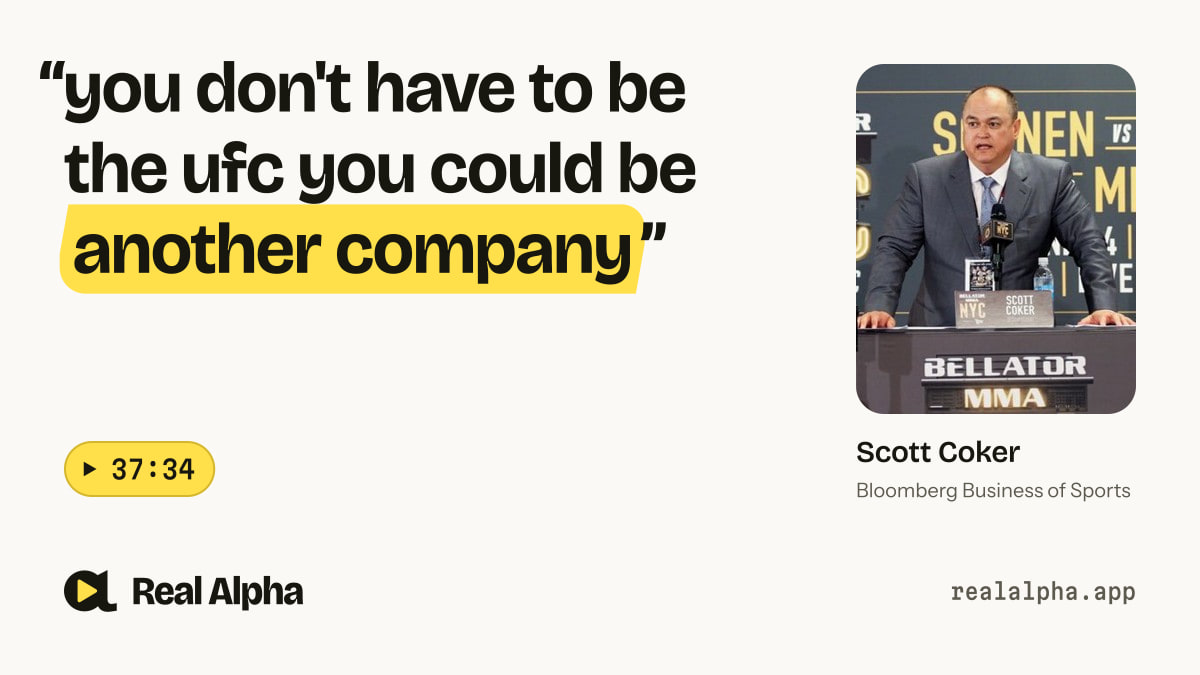
“you don't have to be the ufc you could be another company”
 Scott Cokerat 37:34 · Bloomberg Business of Sports
Takeaways
- Tournament winners and other prospects can move into super fights.
- Coker expects to invest in three or four athletes from a 32-person tournament.
- He sees room for a strong MMA business without matching the UFC.
About this segment
Scott Coker says tournament standouts can move into super fights, while the company builds its own business. He points to TV, sponsorship, live events and international reach as ways to do that.

Co-Founder, Ki MMA
Founded Strikeforce and led Bellator before launching Ki MMA's global tournament-based promotion.
- VP
Vanessa Perdomo, Host
- RW
Randall Williams, Host
From “Ki MMA Co-Founders Peter Levin and Scott Coker | Bloomberg Business of Sports”, Nov 20, 2026. Watch the full episode
Thanks. We'll look at and fix what's off.
Transcript
From the transcript Bloomberg Business of Sports publishes with the episode.
- 35:21
Right. And you have the undisputed one, the winner, and then you have the one that no one expected to see, right? The, the Cinderella story, as we all love to see in, in March madness. So then after, you know, the tournament style and you, you know, you have that going for, let's say a couple of years or how do you see the future? Do you see those stars. Then competing against each other in like big, um, bouts later on, like single fights?
- 35:45
Yes. So, you know, once they get through the tournament, that's when we're going to do the first year. And then the winner, or let's say, like you said, several runner-ups have become, I believe, let's say, very, you know, big stars in the sport, and we feel that they have potential. We're going to put them into the next year. They'll go into super fights because the tournament, let's say in a two-hour TV format, it's, you know, the tournament will be maybe three-quarters of it, but you're going to have slots available for fighters that, uh, you believe, you know, continue, you know, to build the company and build the brand and build themselves and, and continue to, uh, uh, you know, let's say the, basically the art form of, of being a great, you know, martial arts superstar. They, they will have,
- 36:24
we will have room for them as well. So we're going to, we're going to be, uh, in the tournament business and then we're going to be in the star business. So you're going to, you're going to find, I believe, you know, a 32 person tournament, uh, you're going to find three or four athletes that you're going to want to invest in and get behind.
- 36:39
And obviously, Scott, you know, we're talking a lot about just your experience, but you did these, you know, with Strikeforce and Bellator, you built up these businesses into great competitors in the MMA space and to the UFC. When we were talking to Peter, though, he kind of had said, you don't really look at what other people are doing. You're really focused on your own ventures and How true do you think that is in how you operate? And are you looking to become a competitor to the UFC with what you're doing?
- 37:09
You know, I always felt like in Strikeforce or in Bellator, I always told my staff, I said, look, you know, UFC has a great business. They're doing great. But Strikeforce proved you could have a great television property. You could have a great sponsorship program. platform you could have a great live gate you could have an international business and then today's world you could have you know all the digital you know clipping and all the different ways to monetize and you can you can have a great martial arts fight business and you don't have to be the ufc you could be another company and so to me i always felt like look they're gonna have their business and we're gonna have our business and we're gonna be additive to the to the entire, you know, let's say the entire, you know, ecosystem of mixed martial arts combat sports.