The alpha, twice a week
That was 5 min.
Get the best new moments in your inbox every Wednesday and Saturday. It's free.
Check your inbox
We sent a link to your address. Click it to finish signing up. Not there in a minute? Look in spam.
or
Hard Fork · 5 min · Nov 27, 2026
Competitive incentives are making AI math research less transparent
 Terence Tao
 says labs have shifted from academic collaboration to internally generated proofs, with limited peer review and transparency.
The episode’s best minutes
Full analysis- 12:08AI can reach results while missing discoveries along the wayPro pick 5 min
- 17:43Competitive incentives are making AI math research less transparentPro pick 5 min
- 30:07Math may shift from solving problems to interpreting them5 min
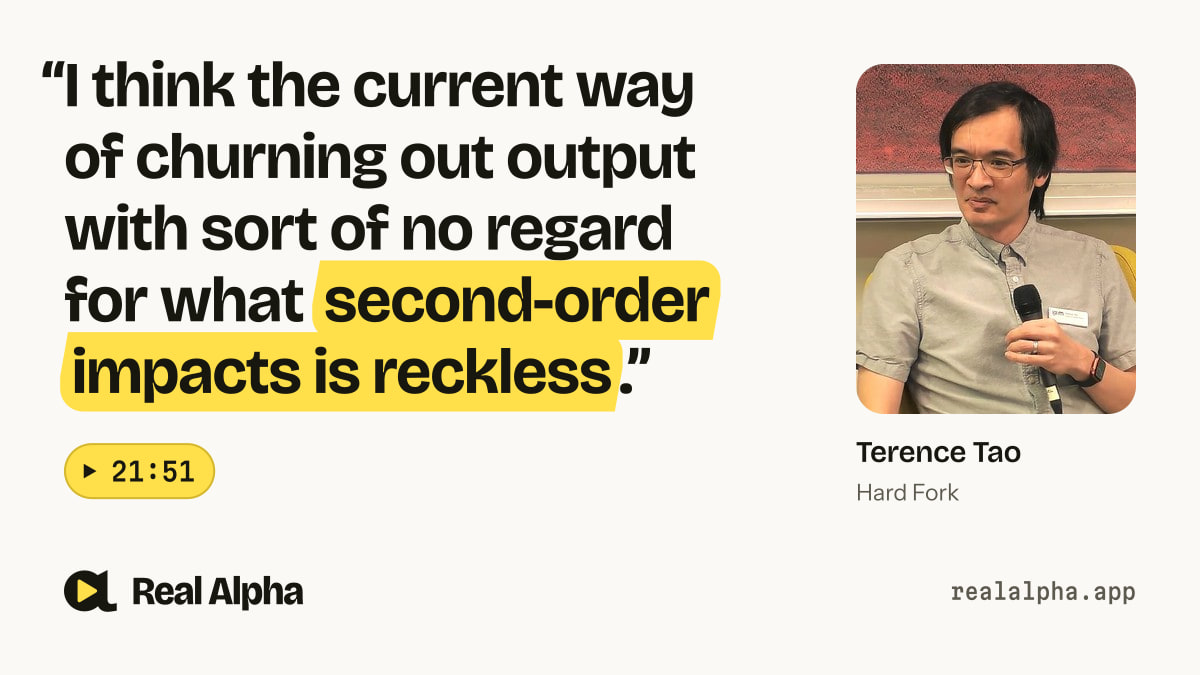
“I think the current way of churning out output with sort of no regard for what second-order impacts is reckless.”
 Terence Taoat 21:51 · Hard Fork
Takeaways Pro pick
- Labs now often produce proofs without academic collaborators.
- Limited disclosure makes it hard to assess how results were produced.
- Tao supports AI but calls the current pace reckless.
One of Pro's picks, open to you here. Try Pro free for 7 days
One of Pro's picks. The rest of the summary and the 3 takeaways are in Real Alpha Pro; the video, the quote and the transcript stay free.
Read it with Pro, 7 days freeAbout this segment
Terence Tao says labs have shifted from academic collaboration to internally generated proofs, with limited peer review and transparency. He sees this as a consequence of competitive incentives, not a reason to reject AI.

Terence Tao is a mathematician, UCLA professor and Fields Medal winner.
Proved the Green–Tao theorem with Ben Green, showing primes contain arbitrarily long arithmetic progressions.
From “Can A.I. Do Math Better Than Us? We Asked Terence Tao.”, Nov 27, 2026. Watch the full episode
Thanks. We'll look at and fix what's off.
Transcript
Transcribed by machine (Whisper) from the episode’s audio, so a word may be off here and there.
- 17:51
Tell me a little bit about what your reaction to that has been and maybe how you'd like to see that change. Yeah, so until like last year, I think these big tech companies were working on a fairly even basis, equal basis with academics because the tools were not strong enough to solve problems on their own. So if they needed academics to maybe supply the problems, evaluate the AI output, and by doing so, the external academic experts would help.
- 18:15
guide the research in productive directions. But yeah, it has changed this year. Now that they have the capability to solve problems on their own, they're finding it just much more convenient on their end to just work completely internally. They're not collaborating with external academics anymore. They're not submitting their results to the traditional publication system to get peer review. These papers that AI generated, there's usually no attempt to polish the output at all. I would just say, we'll leave this to the community to deal with. We've had various advisory groups set up to say, here are the best practices that we would like this research to adhere to. And they are sort of fulfilling some of these a little bit, but what's kind of clear is that for them, these proofs, they're almost generated as a waste
- 19:04
by-product of their training. I mean, their main focus at this point is just getting better and better models. Many of the big tech companies have actually either closed their science divisions or reduced them or reassigned people. And I think because it's a very competitive environment at all the big tech companies, they want to get their model out before their rival does. And one of the best ways to train a model is to give it lots and lots of math problems. And every so often they spit out math proofs, but this wasn't somehow their main objective. And so they're sitting on this pile of toxic waste that they need to deal with. And so they do some minimal cleanup. Initially, they did a very bad job with citing references. A lot of these papers built upon prior work, which often was not mentioned at all in these early papers. They've
- 19:52
done a somewhat better job of citing references, but still there are suspicions. Nothing's been proven, but there are these weird coincidences that there are people who have been working on one of these problems, they use, say, ChatGPT or some other available model to upload some of their work to help them. And then a month or so later, the company releases a big press release, oh, we've solved this problem. And it's the same problem that they've been working on.
- 20:19
Now, that could be a coincidence. It could not be. We don't have much transparency as to what actually happens. These companies are often very reluctant to disclose exactly what they did to produce these proofs, how much compute was used, how much data was used. So it's very different from academic norms. Normally when a scientist writes a paper, you can ask the scientist questions about methodology and you can share the data and we get some transparency, but we're getting a lot less from the tech companies right now. One dynamic that seems interesting to me is that you are something of a hero to a lot of AI researchers. I feel like I first encountered your name sort of from AI researchers, people in the tech world talking about you as the consensus smartest man in the world. You don't have to
- 21:03
respond to that specific compliment. But I think some of your qualms and your hesitations about the way this is going has been taken negatively as a betrayal. I'm wondering if this is something you've observed, too, or if it's something that you have thoughts about, what your reaction has been. Okay. Yeah. So I don't follow Twitter or social media so much. I'm sorry. I feel like I'm bringing a dead animal to you and be like, talk about this for me. Right. I have a lot of friends in the tech industry. By and large, the people, the individuals that I talk to, they actually have, I think, very balanced views about how AI and science should interact. I think many of them are also a little bit concerned that maybe the industry has become too competitive and that this is race to get the most powerful models that is coming at the expense of working cooperatively
- 21:49
with the scientific community. I still believe AI is a wonderful tool and I think used properly, it can benefit a scientist and the public at large. I think the current way of churning out output with sort of no regard for what second-order impacts is reckless. And I think the pace is more fast than is safe. But I'm still positive about AI broadly. I think there are