The alpha, twice a week
That was 5 min.
Get the best new moments in your inbox every Wednesday and Saturday. It's free.
Check your inbox
We sent a link to your address. Click it to finish signing up. Not there in a minute? Look in spam.
or
Hard Fork · 5 min · Nov 27, 2026
Math may shift from solving problems to interpreting them
 Terence Tao
 argues that hiring and research metrics must reward more than paper counts and priority.
The episode’s best minutes
Full analysis- 12:08AI can reach results while missing discoveries along the wayPro pick 5 min
- 17:43Competitive incentives are making AI math research less transparentPro pick 5 min
- 30:07Math may shift from solving problems to interpreting them5 min
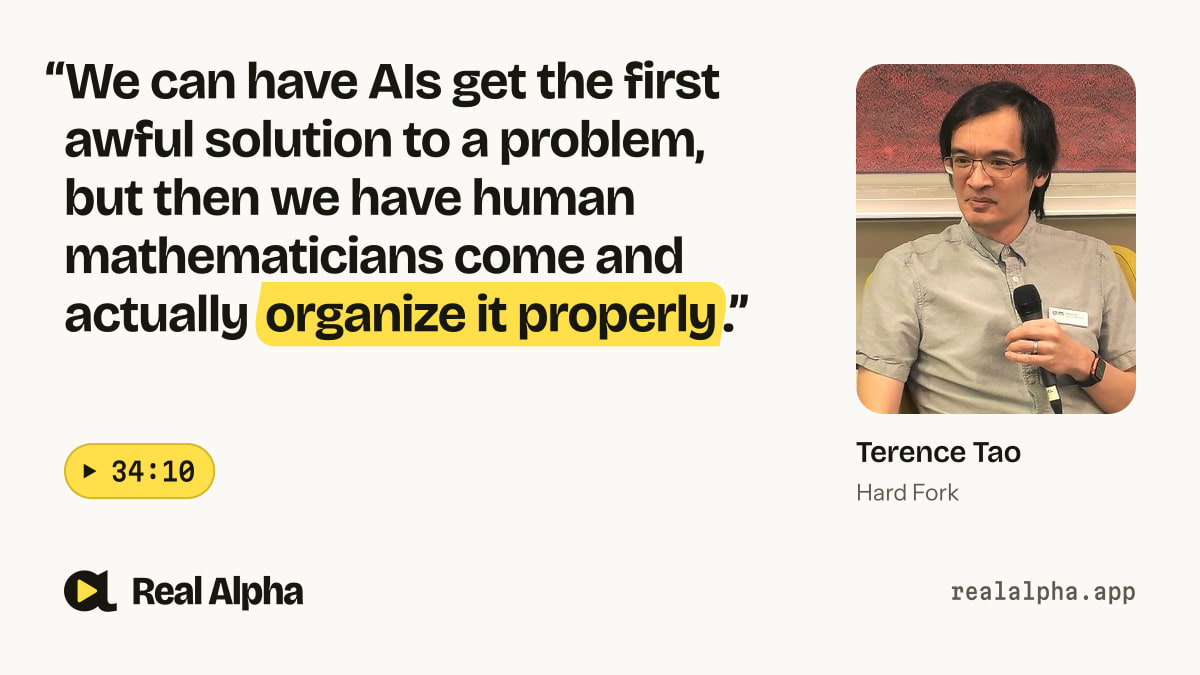
“We can have AIs get the first awful solution to a problem, but then we have human mathematicians come and actually organize it properly.”
 Terence Taoat 34:10 · Hard Fork
Takeaways
- Paper counts and priority can reward the wrong work.
- Great talks, clear writing and outreach deserve more value.
- Humans can turn AI's rough solutions into understandable mathematics.
About this segment
Terence Tao argues that hiring and research metrics must reward more than paper counts and priority. He sees mathematicians organizing and explaining AI results as a valuable role in its own right.

Terence Tao is a mathematician, UCLA professor and Fields Medal winner.
Proved the Green–Tao theorem with Ben Green, showing primes contain arbitrarily long arithmetic progressions.
From “Can A.I. Do Math Better Than Us? We Asked Terence Tao.”, Nov 27, 2026. Watch the full episode
Answers “Which jobs will AI replace, and which are safe?” See all 252 answers
Thanks. We'll look at and fix what's off.
Transcript
Transcribed by machine (Whisper) from the episode’s audio, so a word may be off here and there.
- 30:15
which sounds mostly positive, but obviously it's ambiguous in certain ways. What are the kind of necessary institutional steps? I mean, like, what do we need and what do we need to be paying attention to to ensure we're at least moving to a place where humans are still in charge and following it rather than a place where, as you were saying before, it's just like my LLM, you know, the Caltech LLM versus the UCLA LLM versus the Stanford LLM.
- 30:41
Right. Right. I think a lot of the way we measure progress in science and the way we evaluate candidates for jobs and prizes and grants has to change. So, for example, when we do hiring, we focus quite a bit on publications, how many papers you produce, whether your papers are in top journals, this sort of thing. And one thing we're finding is that AI is actually very good at generating paper products, PDFs that look a lot like papers. And so journals are getting overwhelmed with lots and lots of papers which technically are doing some novel work. They're solving some unsolved problem, but often they're not suggesting new directions of research or they're not citing things properly or they're not explaining things in a way that other people can understand. We just may have to move away from these tangible outputs like papers. We should
- 31:32
reward people for being creative and exciting and getting people wanting to learn more about what you're doing. And one thing about AI-generated work is it's often just not thrilling. If you read page after page of AI-generated math, it is not fun to read at all. And you just do not get excited. I think partly because you don't feel like there's a human on the other end that you can connect to. And this human connection, which was automatic before, is part of why you're motivated to learn more about a subject. I think, for example, we need to value giving great talks, writing well, and just getting the public involved. I think we also have to value the value of outreach more than we have in the past. So we definitely need to change our values, our metrics for what is good research, what is a good mathematician, a good scientist.
- 32:25
There's a lot of chaos this year because we are still using very obsolete metrics for measuring you know, our job hiring and so forth. But I think in a year, we'll get the new equilibrium. But right now, the rules are still being written. Yeah. I mean, if one of the things that's almost obsolete is the idea that there are open problems that might be solved, and some important portion of what math is and what it does is working on those problems, as you say, sort of like seeing the flora and fauna along the way, taking wrong routes and finding interesting things.
- 32:56
is there a way to recreate that experience or to recreate the value of that in a world where you can just take the helicopter right to the mountaintop? Yeah, I believe so. So it comes back to this institutional change. So one thing that we really valued in the past is priority. So if different people are trying to solve the same problem, the first person to solve the problem gets a lot of credit, but then the second and third and fourth people, they get a lot less credit. And this was the way we organized things in the past. If we keep emphasizing priority, then we will inevitably degenerate to who's got the most AI tools. But even in the old days, it wasn't absolute. We had people who wrote textbooks. And often the people who write the textbooks, they're not creating new math, but they're just taking old math and explaining it
- 33:47
really, really well and in a very well-organized way. And the books they produced were very, very valuable, often more so than the initial papers that had the results to begin with. So we already had some mechanism for recognizing derivative work, work that wasn't always solving something new, but repackaging things that were old. So I think if we emphasize that kind of digestion and reinterpretation of work.
- 34:15
Then we can have the best of both worlds. We can have AIs get the first awful solution to a problem, but then we have human mathematicians come and actually organize it properly. It's kind of like how the people who grow food and deliver it to, say, a restaurant are different from the people who prepare the food and actually make a nice meal out of it. So we may become more chefs than sort of raw hunters of mathematics.
- 34:39
Well, that does also make me wonder, I mean, is there going to be a group of mathematicians