The alpha, twice a week
That was 2 min.
Get the best new moments in your inbox every Wednesday and Saturday. It's free.
Check your inbox
We sent a link to your address. Click it to finish signing up. Not there in a minute? Look in spam.
or
Bloomberg Surveillance · 2 min · Nov 11, 2026
Continuing resolutions leave federal spending on autopilot
 David Malpass
 says continuing resolutions avoid new spending choices and leave agencies on autopilot.
In this episode
Full analysis- 22:19The Nvidia allegations go beyond an executive's personal conductPro pick 6 min
- 15:02Texas data centers may have to bring their own powerPro pick 4 min
- 7:29AI borrowing is changing the credit marketPro pick 5 min
- 19:00Oil may stay above $70 even if shipping routes reopen3 min
- 2:09Continuing resolutions leave federal spending on autopilot2 min
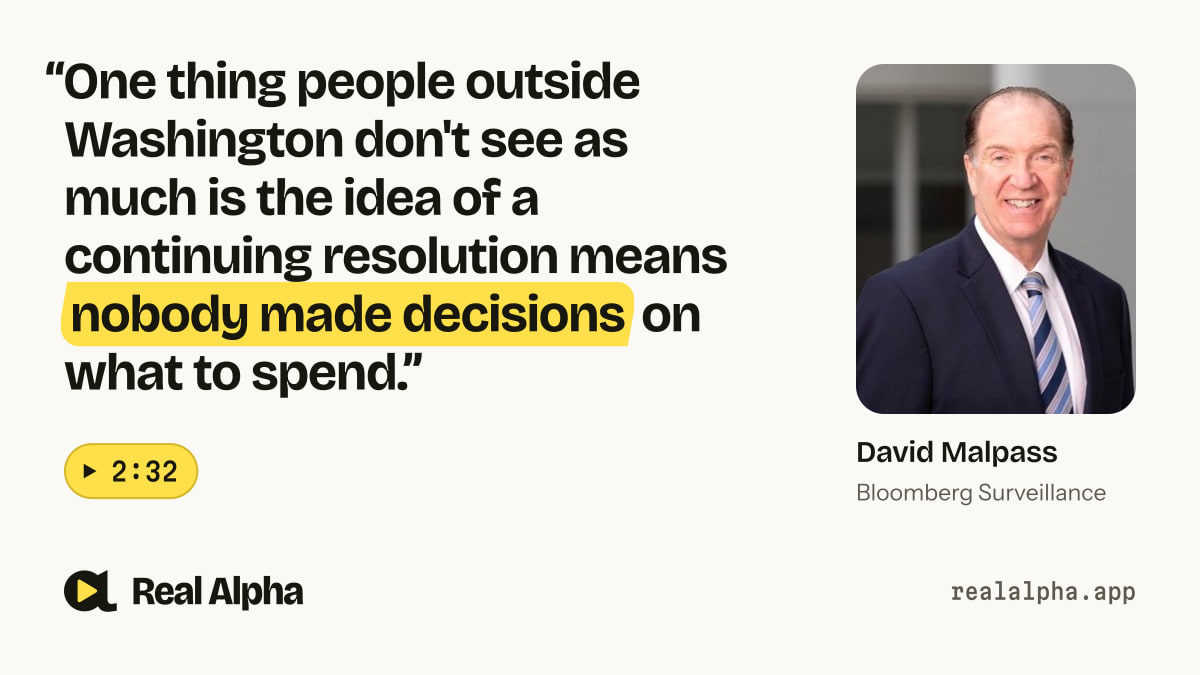
“One thing people outside Washington don't see as much is the idea of a continuing resolution means nobody made decisions on what to spend.”
 David Malpassat 2:32 · Bloomberg Surveillance
Takeaways
- Continuing resolutions delay decisions on government spending.
- Agencies spend time planning without a new spending plan.
- Malpass sees reconciliation as a possible path to permitting reform.
About this segment
David Malpass says continuing resolutions avoid new spending choices and leave agencies on autopilot. He sees reconciliation as a possible route to permitting reform for energy projects.

Former President, World Bank Group
Refocused the World Bank on market-based growth and led U.S. international economic policy as Treasury undersecretary.
- PS
Paul Sweeney, Host
- SF
Scarlet Fu, Host
From “AI Stocks Rebound as Fed Hike Bets Return | Bloomberg Surveillance”, Nov 11, 2026. Watch the full episode
Thanks. We'll look at and fix what's off.
Transcript
From the transcript Bloomberg Surveillance publishes with the episode.
- 2:11
What is your confidence that they will pass a continuing resolution during this lame duck period to keep the government funded until, what, like first quarter of 2027? So that's an issue.
- 2:23
And the Republicans want to have it go all the way through the fiscal year to September. of 27 so that they don't have to come back to the issue over and over again. One thing people outside Washington don't see as much is the idea of a continuing resolution means nobody made decisions on what to spend. They just kept it on autopilot. And so it means that around the government, people are wasting a lot of time over and over again trying to figure out what new spending should be and then just stay on autopilot. So it's unfortunate that they operate that way. Whether they'll get it done here in November and December, we'll have to see.
- 3:04
I imagine they probably will be able to do that. That should be a high priority.
- 3:09
I mean, this rests on the Republicans, right? Because they control the House and Senate right now.
- 3:13
That's right, but they have such a thin majority, you have to get people together. Now I saw the Hegsteth impeachment went down, so that shows you there is some continuity in the Republicans. I think they're realizing that the vote didn't go at what they're trying to do. They want to keep going with what they're trying to do and get a lot done here in November and December. The defense spending bill, which is appropriate, we talked about that today, is also hanging. That's the authorization for new spending.
- 3:48
And it's always done at this point in the year. But they have to bring together majorities in order to do it. And a reconciliation bill would be good if they could do that because that would allow some things that are hard to get a majority for, such as permitting reform. You know, around the country, energy... is really important. In the inflation data yesterday, electricity prices were up. And what the country needs is lots more energy focused on making electricity. But the permitting has been a real problem for that. So maybe they could get that done here by year end.