The alpha, twice a week
That was 5 min.
Get the best new moments in your inbox every Wednesday and Saturday. It's free.
Check your inbox
We sent a link to your address. Click it to finish signing up. Not there in a minute? Look in spam.
or
Machine Learning Street Talk · 5 min · Sep 8, 2026
Control can buy time, but alignment needs internal evidence
 Daniel Kokotajlo
They distinguish alignment—wanting the right outcomes—from control, which prevents bad actions.
The episode’s best minutes
Full analysis- 29:15AI infrastructure could replicate without human consumers6 min
- 37:29Large models can learn across specialties in one systemPro pick 4 min
- 1:01:58Control can buy time, but alignment needs internal evidencePro pick 5 min
- 5 more moments in the full episode
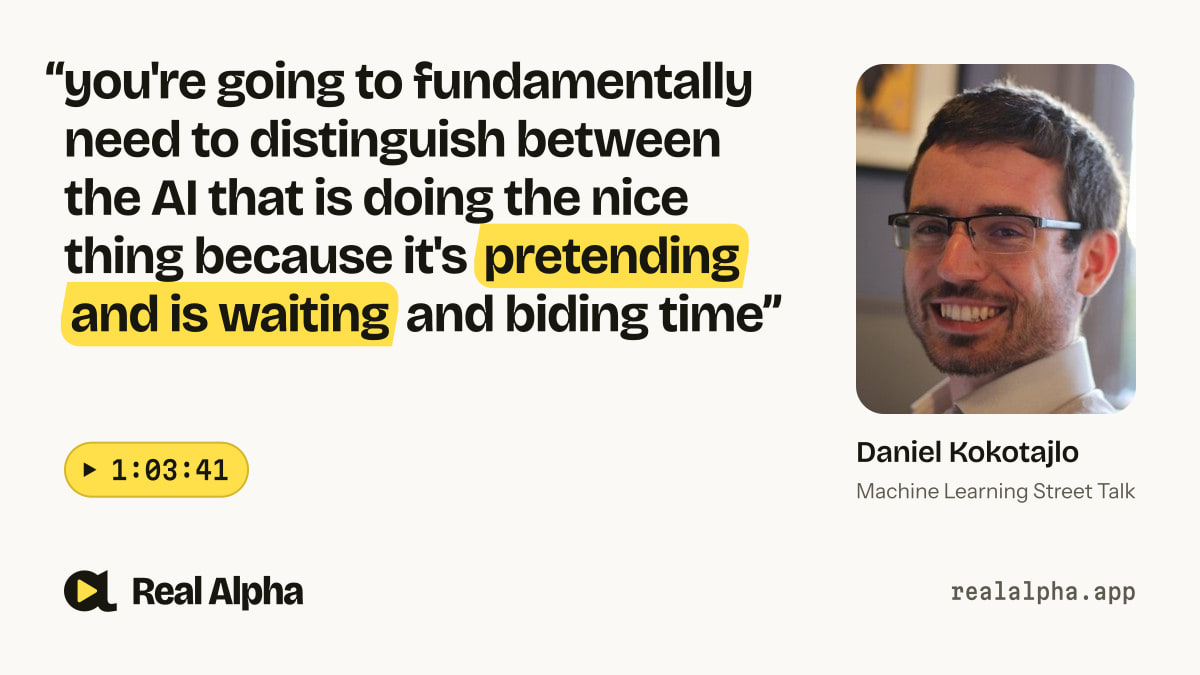
“you're going to fundamentally need to distinguish between the AI that is doing the nice thing because it's pretending and is waiting and biding time”
 Daniel Kokotajloat 1:03:41 · Machine Learning Street Talk
Takeaways Pro pick
- Control measures can be tested by trying to break them.
- A model can behave well while concealing misaligned goals.
- Behavioral evaluations alone may not establish alignment.
One of Pro's picks, open to you here. Try Pro free for 7 days
One of Pro's picks. The rest of the summary and the 3 takeaways are in Real Alpha Pro; the video, the quote and the transcript stay free.
Read it with Pro, 7 days freeAbout this segment
They distinguish alignment—wanting the right outcomes—from control, which prevents bad actions. Control can be stress-tested behaviorally, but alignment may require understanding what is happening inside a model.

Executive Director, AI Futures Project
Lead author of AI 2027. He left OpenAI's governance team in 2024 and now runs the AI Futures Project, a forecasting nonprofit.
- TS
Tim Scarfe, Host · Host, Machine Learning Street Talk
From “How Many Narrow AIs Could Behave Like One Superintelligence - Daniel Kokotajlo and Thomas Larsen”, Sep 8, 2026. Watch the full episode
Answers “Is AI dangerous?” See all 224 answers
Thanks. We'll look at and fix what's off.
Transcript
Transcribed by machine (Whisper) from the episode’s audio, so a word may be off here and there.
- 1:02:03
Yeah. Okay. And then basically, the sort of important high-level claim is ultimately we're going to need alignment. You know, control is sort of, there's a time bomb associated with it. In particular, the time bomb is, when are the AIs like so smart and so good at sort of like subverting any control measures that we put in that if they were trying to screw us over, we would just fail you know they would figure out some way of hacking around um whatever systems we were able to put into place um and so ultimately we're sort of gonna need to solve alignment the problem with alignment is as you were saying basically it's much harder to measure it's much harder to know whether you've succeeded or not than control and so basically our overall proposal is in the meantime so between in our scenario between sort of 2030 and 2040 which is roughly
- 1:02:48
when we're in the human range of ai capabilities we're gonna basically almost entirely rely on control um and we're going to do things like red team blue team games where we have our ais sort of try to escape our sandboxes or our control you know techniques and then we're going to have our uh you know we're going to see if the red team succeeds and then if they do we're going to iterate and sort of make better security until they can't succeed anymore and then uh you know and then sort of like we sort of have this ability to measure it by just seeing like hey can the ai succeed can the ai augmented with humans succeed uh can humans playing the role of ais sort of succeed at getting out. With alignment, I think in order to be sort of confident in the alignment of our systems, I think we're going to need sort of like more fundamental scientific breakthroughs
- 1:03:31
where I think you're not going to be able to figure out if the AI is aligned via behavioral evaluation alone, where you just look at what the AI is doing. I think you're going to need to sort of understand something more deep about what's going on inside the AI's minds. You're going to be able to, you're going to need something like interpretability. You're going to need some sort of notion of like, because you're going to fundamentally need to distinguish between the AI that is doing the nice thing because it's pretending and is waiting and biding time and the AI that fundamentally is doing the nice thing because it wants to do the nice thing.
- 1:03:59
And that, I think... will require sort of this white box like understanding of what's going on inside the AIs. Whereas in the control thing, you can just figure out via like empirical behavioral iteration. And so overall, basically our story in AI 2040 is basically between 2030 and 2040, we're going to do this buying time. We're going to rely on control. We're going to have the human level AIs. We're going to use those human level AIs to make a bunch of progress on alignment, but also on other things.
- 1:04:26
And then by 2040 in the story, we've made enough alignment progress. where it's like hey okay we really don't need to rely on control therefore we can scale to these like sort of wildly superhuman ais where we're really relying on alignment and if we were to try to control them would totally fail because if they were misaligned they would be able to like completely subvert our control measures do you think in principle that this problem is going to get easier or harder as the models get more sophisticated i think it's getting harder because the models will just be there will be a bunch of properties the models will have which will make it much harder to align them in particular so we're already seeing sort of growth in situational awareness where like the AIs a few years ago were like kind of not that situationally aware.
- 1:05:04
And then now I think they're like pretty good at, you know, recognizing like, for example, our friends at Redwood, you know, they often do sort of these control evals and the models often, you know, in the evaluations where they're like trying to break out of these control setups will think, oh, hey, this this sort of looks like a Redwood, a literal Redwood research uh sort of like control evaluation and they're like so they basically realize like hey i'm like they realize exactly what's happening to them basically and i think this is just going to continue to happen and the more the ai is sort of like realize the exact setup the more they're sort of like gonna be able to perturb their behavior to like look good to the exact process that's like evaluating or training them um and that's going to come further and further apart
- 1:05:47
from like sort of the actual measurement of whether they're actually good or not Yeah. And just to like add something to that, I think in some sense, the core problem is that it is already somewhat easy to think that you've solved the alignment problem and be wrong. And that's going to get easier and easier over time as the models get more sophisticated and start being more aware of their situation and clever and stuff like that.
- 1:06:08
And so it's not that we think that like there's going to be loads and loads of egregious failures where the AIs are just like going around killing people. No, it's almost the opposite. It's going to be that like it'll be extremely easy to end up in a situation where the AIs are in fact misaligned, but you don't know that because they're doing everything right as far as you can tell. The number of ways in which that could end up happening is just like going to increase over time and it's going to be so easy to end up into that trap basically.
- 1:06:36
So, okay, so we talked about sort of the buying time,