The alpha, twice a week
That was 3 min.
Get the best new moments in your inbox every Wednesday and Saturday. It's free.
Check your inbox
We sent a link to your address. Click it to finish signing up. Not there in a minute? Look in spam.
or
TBPN · 3 min · Aug 13, 2026
CoreWeave finances shorter enterprise compute contracts
 Brannin McBee
 says its newest loan outlasts the underlying customer contracts, shifting renewal risk to lenders.
In this episode
Full analysis- 7:43Software moats depend on more than code4 min
- 1:21:52Old GPUs and data center capacity still have value4 min
- 1:38:10Flock cut its default data retention to seven days7 min
- 1:52:26Small teams can build domain-specific AI research labs6 min
- 1:17:05CoreWeave finances shorter enterprise compute contracts3 min
- 1:05:25Online training is still an open problem for real-world agents3 min
- 1:31:38Flock requires customers to review audit logs for misuse3 min
- 2:03:34Lab-grown neurons exceed a linear decoder on one task4 min
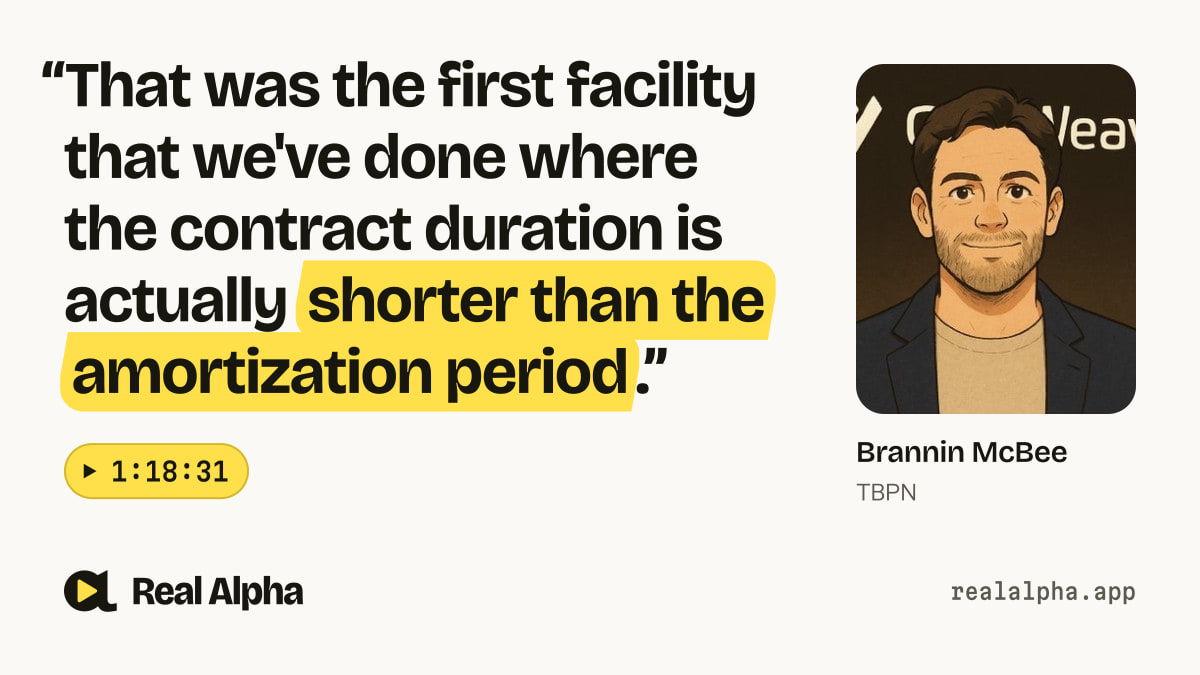
“That was the first facility that we've done where the contract duration is actually shorter than the amortization period.”
 Brannin McBeeat 1:18:31 · TBPN
Takeaways
- The latest facility's contract term is shorter than its loan amortization
- Lenders now take on compute-contract renewal risk
- That financing opens the shorter enterprise-contract market
About this segment
Brannin McBee says its newest loan outlasts the underlying customer contracts, shifting renewal risk to lenders. That financing lets CoreWeave pursue shorter enterprise deals, not just long AI-lab commitments.

Co-founder, CoreWeave
Developed financing strategies and partnerships that helped scale CoreWeave’s AI infrastructure to meet accelerating compute demand.

John Coogan, Host · Co-host, TBPN
Co-founded Soylent and Lucy; OpenAI bought his show TBPN in April 2026.

Jordi Hays, Host · Co-host, TBPN
Founded Branded Native; co-founded fintech Capital, which Rho bought.
From “SaaSpocalypse Revisited, DeepMind's Plan, Polestar Collapse, Aman vs Ryan Walker”, Aug 13, 2026. Watch the full episode
Thanks. We'll look at and fix what's off.
Transcript
From the transcript TBPN publishes with the episode.
- 1:17:14
You guys are spending a lot of time doing demand planning. Demand is obviously off the charts. What are you we we just had Igor on from from River. We were talking with him about this sort of like new skill set that that technology founders need to have around demand planning, right? You have a, let's say, have a NeoLab, you're developing products, it's very hard to gauge how much demand you're going to have for them.
- 1:17:38
The right strategy over the last couple of years was just to assume that demand was near infinite and and sort of plan against that. But for smaller companies that, you know, have smaller balance sheets, it really feels like that is gonna make or break a lot of these companies, especially, you know, NeoLabs that, yeah, that, you know, their margin profiles and and all these other factors are gonna come down to how well they can predict their own, their own demand for their products.
- 1:18:07
Yeah. I completely align with that scenario, but I'll probably take it a step further. Like, what happens after that demand is planned for us? How do you finance it? Right? And for us, that's been just an absolutely critical skill set that we've assembled, team wise over the last six years. And the the latest financing that we did, DDTL five was a term loan b offering. I thought it a fantastic example of that ability to work with demand planning and get the right financing in place for that demand. That was the first facility that we've done where the contract duration is actually shorter than the amortization period. Mhmm.
- 1:18:49
Right? In other words, it asks the investors in that facility to take on renewal risk on the compute versus all of our prior facilities. Investors, were fully covered by the original contract value. Right? If it was a $5,000,000,000 loan, there was $7,000,000,000 worth of revenue sitting behind it. Right now, it's opposite. Like, it it flipped. And what that enables us to do is to spend more time in the, shorter duration contract market because we just proved that it's financeable. And for us, that type of client is predominantly enterprise. Right?
- 1:19:26
The AI lab cohort, the hyperscale cloud cohort, they like to sit in the five to six year range because they know that they need that compute. They need that scale. They need it for that long duration. Enterprise is, at the shorter end of that curve. And as you guys know, historically, we've been really focused on the longer duration contracts, but having this proof point in the market now that we can go finance these shorter duration contracts is is really important to us.
- 1:19:53
So that I I think that goes hand in hand with the demand planning aspect.