The alpha, twice a week
That was 3 min.
Get the best new moments in your inbox every Wednesday and Saturday. It's free.
Check your inbox
We sent a link to your address. Click it to finish signing up. Not there in a minute? Look in spam.
or
Upstarts · 3 min · May 1, 2026
Creative satisfaction can make AI tools worth paying for
 Cristóbal Valenzuela
 compares creative AI to a gym for the mind and says people may pay for the reward of making things.
In this episode
Full analysis- 20:02Runway kept going when investors said generative AI was not a market5 min
- 25:19Build for changing models, not today’s limitations5 min
- 6:11Runway’s founders treated early AI as a creative medium7 min
- 15:29A single editor showed how Runway could fit into TV production2 min
- 38:56Video models could train robots and power real-time characters4 min
- 13:00Creative satisfaction can make AI tools worth paying for3 min
- 30:13Runway gives amateur filmmakers access to the same tools as top directors3 min
- 32:56AI misuse is the creator's responsibility, not the tool's3 min
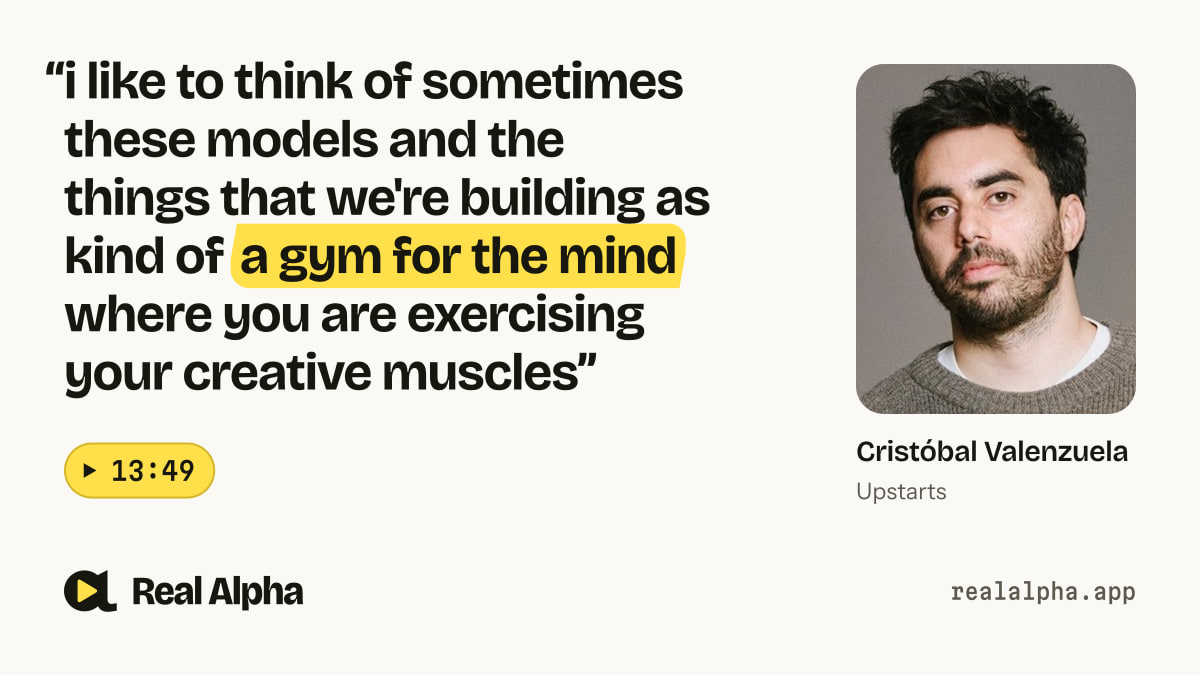
“i like to think of sometimes these models and the things that we're building as kind of a gym for the mind where you are exercising your creative muscles”
 Cristóbal Valenzuelaat 13:49 · Upstarts
Takeaways
- Creative satisfaction can motivate paid use without a business goal.
- Runway users include people with creative ideas but no technical resources.
- Studios and agencies can also make pixels more cheaply and controllably.
About this segment
Cristóbal Valenzuela compares creative AI to a gym for the mind and says people may pay for the reward of making things. That helps explain demand beyond commercial production.

Cristóbal Valenzuela is co-founder and CEO of Runway.
Co-founded Runway, an applied AI research company whose creative suite has more than 30 AI-powered tools.

Alex Konrad, Host · Founder & editor, Upstarts Media
Ran Forbes' Midas List for ten years and co-created its Cloud 100 list; founded Upstarts in 2025.
From “Runway’s Cris Valenzuela: Building The Hollywood-Friendly Video AI That OpenAI Couldn’t”, May 1, 2026. Watch the full episode
Thanks. We'll look at and fix what's off.
Transcript
Transcribed by machine (Whisper) from the episode’s audio, so a word may be off here and there.
- 13:10
There's always this utilitarian kind of point of view about models where people are like, well, why would I ever use this to make a movie if I'm not a filmmaker? Like I'm not trying to sell something. I don't need ads. Right. and i think an underappreciated aspect of of a lot of this technology is the reward it gives you personally to be able to make stuff like this and this is something i would say technology has allowed us to do over time we just sometimes forget about it i compare it to like going to the gym right so if you go to the gym and you exercise a lot of times you're going there not to become an athlete or like to you monetize your like your your performance in some way and get sponsors because you're going to be the best athlete at particular things right you just go there because you feel good it's good for your body you feel um we're all um excited to do it
- 13:57
hopefully more and more right i like to think of sometimes these models and the things that we're building as kind of a gym for the mind where you are exercising your creative muscles and once you exercise that once you practice that enough times you like it and you're willing to spend money on Because there's a reward mechanism that you're activating in your brain that you never had a chance of activating before.
- 14:20
You're able to make things. You're able to creatively concept about things you never thought you could. We have users who are engineers. We have users who work in finance, who you never might have thought of like a runway user. But they are creative. They still have creative ideas. They have creative minds. They're thinking about things. They just don't have the technical experience or the resources to execute some stuff. And when you provide them with the things, it helps them be creative, and they're going to be able to and willing to pay for it. So there's definitely that component of it that it's an answer to how to monetize this. We'll build things that people like to use a lot, and people make countries.
- 15:00
little videos per day. We have people making thousands, even like a week. And of course, on a more utilitarian aspect, well, of course, like this is incredibly useful for studios and agencies and content and gaming studios and everyone who's selling or who's in the business of pixel making. If you're making pixels for a living, this is a completely new way of making pixels with way cheaper and way more controllable methods. And I guess I'm thinking with you guys,