The alpha, twice a week
That was 4 min.
Get the best new moments in your inbox every Wednesday and Saturday. It's free.
Check your inbox
We sent a link to your address. Click it to finish signing up. Not there in a minute? Look in spam.
or
Moonshots · 4 min · Nov 21, 2026
Culture and execution shape which AI labs survive
 Steve Jurvetson
 questions whether OpenAI belongs among the likely long-term winners, weighing culture, talent and execution.
The episode’s best minutes
Full analysis- 2:17Jurvetson backed SpaceX despite his partners’ rejectionPro pick 7 min
- 33:44Culture and execution shape which AI labs survivePro pick 4 min
- 1:43:09Mission, not wealth, is what drives Elon MuskPro pick 4 min
- 5 more moments in the full episode
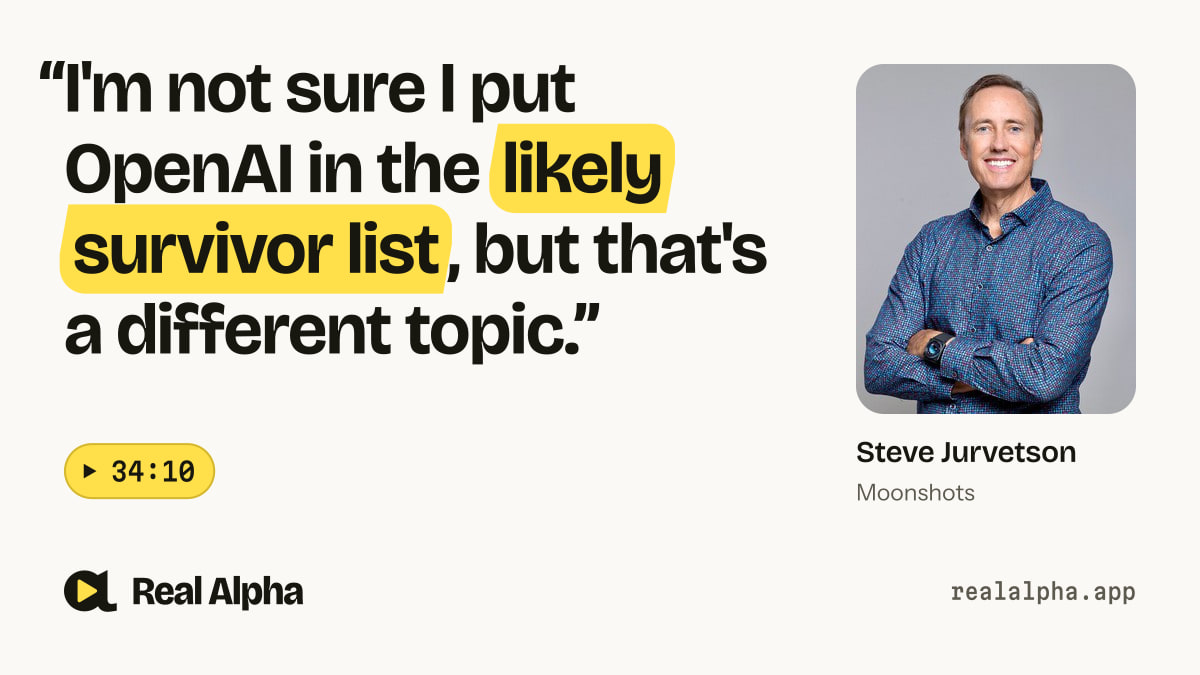
“I'm not sure I put OpenAI in the likely survivor list, but that's a different topic.”
 Steve Jurvetsonat 34:10 · Moonshots
Takeaways Pro pick
- Jurvetson is unsure OpenAI will survive as a leader.
- He sees culture as a force that affects execution and talent.
- Google’s pace and internal silicon strengthen its position.
One of Pro's picks, open to you here. Try Pro free for 7 days
One of Pro's picks. The rest of the summary and the 3 takeaways are in Real Alpha Pro; the video, the quote and the transcript stay free.
Read it with Pro, 7 days freeAbout this segment
Steve Jurvetson questions whether OpenAI belongs among the likely long-term winners, weighing culture, talent and execution. He sees Google’s pace and internal silicon as advantages, with Anthropic currently leading the field.

Steve Jurvetson is a venture capitalist and co-founder of Future Ventures.
Led early investments in SpaceX, Tesla and Planet Labs, backing founders building transformative technology companies.

Peter Diamandis, Host · Founder, XPRIZE
Co-founded Singularity University and founded Zero-G; co-wrote the books Abundance and Bold.

Salim Ismail, Host · Founder, Open ExO
Co-wrote Exponential Organizations; was Singularity University's founding executive director; sold Ångströ to Google.

Dave Blundin, Host · Founder & GP, Link Ventures
Has co-founded 23 companies; founding CEO of Vestmark and chairman of insurance marketplace EverQuote.

Alexander Wissner-Gross, Host · Founder, Reified
Has backed and advised 40+ tech companies, directly and through 021T Capital and Reified; writes The Innermost Loop.
From “Steve Jurvetson: IPO-ing the Singularity, SpaceX Bet VCs Rejected, & Voyager’s 1 Light Day | EP #314”, Nov 21, 2026. Watch the full episode
Answers “What will AI look like in the next few years?” See all 395 answers
Thanks. We'll look at and fix what's off.
Transcript
Transcribed by machine (Whisper) from the episode’s audio, so a word may be off here and there.
- 33:50
Who are you asking? I'm asking you, Steve. I don't like the question because it seems like all the forces are towards every increasing winner take all network effects. I like the idea of 10 or 11, more than three. You do look at any given traditional tech market like search or, you know, mobile phones. You don't tend to have thriving, you know, hundreds of companies. You tend to have one or two that matter.
- 34:17
I'm not sure I put OpenAI in the likely survivor list, but that's a different topic. Yeah. Oh, yeah. That's a hot take, Steve. What happens to OpenAI in your mind? Well, it's just one of, gosh. No one else is listening. It's just the few of us. Let's just say, in the long run, the culture that emanates from a culture of leadership will and inevitably has repercussions. And so I think you want to have an organization that's pulling in the same direction.
- 34:52
I'll take an easier pot shot if you want, which is the best and brightest engineers don't want to join Meta, for example, on average. I mean, there's obvious exceptions because they'll pay inordinate salaries, but then there's back and forth. And Google has managed to recruit back a number of people that were in contention. And one of the reasons is it's not something you just feel great about when you go home at night.
- 35:12
You're like, oh, wait, I just, on my on the core part of the business uh promoted you know an addictive product uh and youth and in sadly if you spend a little time looking at it the largest channel for recruiting of um basically child exploitation um overseas is instagram and policies that they refuse to change that is causing in the way that you can drop in the direct messages uh huge challenges for human trafficking um so you're like that's not a company i like to work for when there's alternatives when there are a handful of others that are in fact ahead clearly and executing better. And so I look at sort of the flywheel of progress and the synergies that happen. So with SpaceX, you have the orbital data center angle and the big investment thesis to come on whether that is in fact the best way to do compute in the future. That's, you know,
- 35:58
a differentiating plank for them. for anthropic you have the current bell of the ball but you have gemini nipping at their heels so i would you know i would put gemini in the top three ahead of open ai um in terms of the pace at which progress is being made um their internal silicon as a point of leverage with the tpus and a whole bunch of other things you like what you know what are the core assets here um and willingness to vertically integrate to make that happen which obviously well and then and then your son you said joined anthropic that's that's quite a vote of confidence there There are two people that I really, really respect from MIT joined Anthropic about a year ago, Shane Longpreay and Tobin South.
- 36:33
They're just awesome. But I'm like, why? Why? It's too late. Like, no, there's one singularity in human history, and this is an ethical place to go and observe and be part of it. And they didn't say some other place was unethical, but it's sort of like, okay, they feel like that place is definitely ethical. That's good enough for me. Did your son see it the same way? yes and had direct experience with at least one of the other labs in that regard on the negative side in terms of you know making business offers that then they didn't abide by interesting there's a really important point peter you and i in the second edition of exo right we said that the future of corporate organizations is the ceo spends a huge amount of time on purpose and culture And you notice in his speech, Dario said he spends like half his time on culture.
- 37:28
That's an amazing comment to make. And I think it's a testament to how important that is for going forward and attracting talent going forward. Well, it's your purpose as a leader now, because, you know, if you're a deep, deep researcher like Dario and you're deep into the technical detail, that skill has a life expectancy of what, another few months?