The alpha, twice a week
That was 7 min.
Get the best new moments in your inbox every Wednesday and Saturday. It's free.
Check your inbox
We sent a link to your address. Click it to finish signing up. Not there in a minute? Look in spam.
or
Moonshots · 7 min · Nov 21, 2026
Jurvetson backed SpaceX despite his partners’ rejection
 Steve Jurvetson
 recounts how his firm initially rejected a SpaceX investment and what deal terms changed two partners’ minds.
The episode’s best minutes
Full analysis- 2:17Jurvetson backed SpaceX despite his partners’ rejectionPro pick 7 min
- 33:44Culture and execution shape which AI labs survivePro pick 4 min
- 1:43:09Mission, not wealth, is what drives Elon MuskPro pick 4 min
- 5 more moments in the full episode
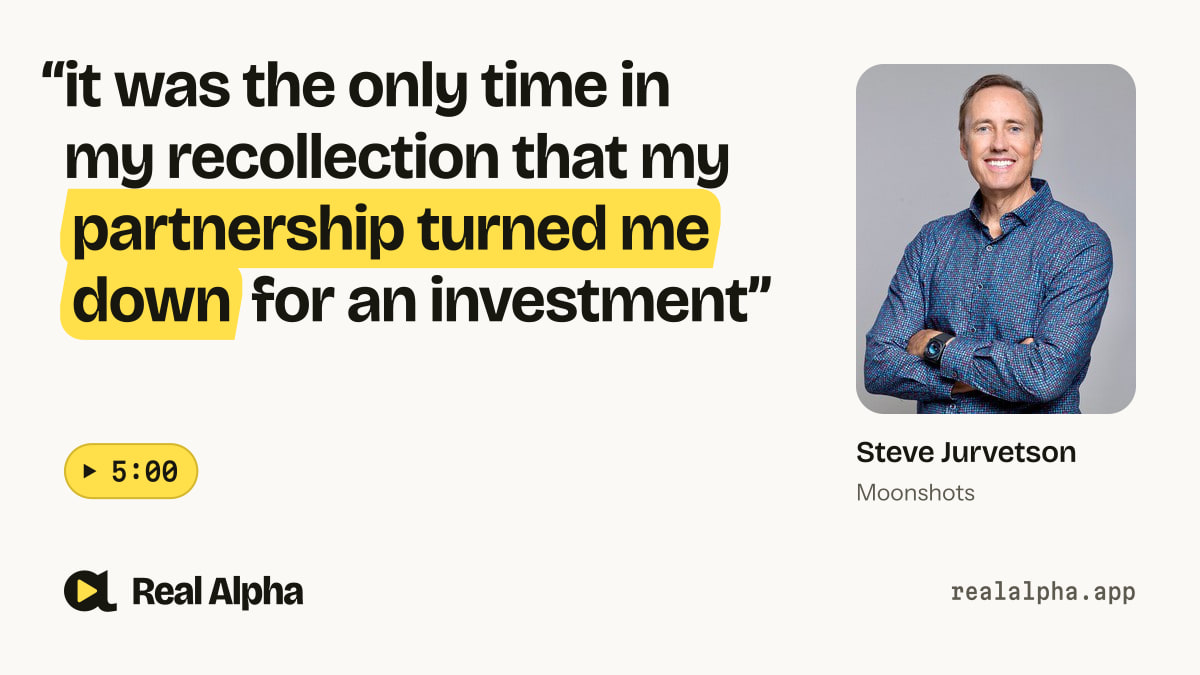
“it was the only time in my recollection that my partnership turned me down for an investment”
 Steve Jurvetsonat 5:00 · Moonshots
Takeaways Pro pick
- SpaceX’s partners initially voted down the investment.
- Deal protections helped move two partners from no to yes.
- Jurvetson invests in unfamiliar ideas adjacent to his experience.
One of Pro's picks, open to you here. Try Pro free for 7 days
One of Pro's picks. The rest of the summary and the 3 takeaways are in Real Alpha Pro; the video, the quote and the transcript stay free.
Read it with Pro, 7 days freeAbout this segment
Steve Jurvetson recounts how his firm initially rejected a SpaceX investment and what deal terms changed two partners’ minds. He says investors should sometimes let personal passion guide them toward unfamiliar opportunities.

Steve Jurvetson is a venture capitalist and co-founder of Future Ventures.
Led early investments in SpaceX, Tesla and Planet Labs, backing founders building transformative technology companies.

Peter Diamandis, Host · Founder, XPRIZE
Co-founded Singularity University and founded Zero-G; co-wrote the books Abundance and Bold.

Salim Ismail, Host · Founder, Open ExO
Co-wrote Exponential Organizations; was Singularity University's founding executive director; sold Ångströ to Google.

Dave Blundin, Host · Founder & GP, Link Ventures
Has co-founded 23 companies; founding CEO of Vestmark and chairman of insurance marketplace EverQuote.

Alexander Wissner-Gross, Host · Founder, Reified
Has backed and advised 40+ tech companies, directly and through 021T Capital and Reified; writes The Innermost Loop.
From “Steve Jurvetson: IPO-ing the Singularity, SpaceX Bet VCs Rejected, & Voyager’s 1 Light Day | EP #314”, Nov 21, 2026. Watch the full episode
Thanks. We'll look at and fix what's off.
Transcript
Transcribed by machine (Whisper) from the episode’s audio, so a word may be off here and there.
- 2:24
memories ever was you telling the story of repeatedly going to elon about the valuation on that if you'd be willing to recount that anecdote it would be really amazing oh no i don't remember it which valuation which company which round well it was when he was running out of money across all three of them and you went to him and you said hey let's i would love to invest in you so he said sure and you said who else are you talking to and he said nobody And he said, great, let's talk about the valuation.
- 2:49
And he said, no. And so you went back to your investment committee and they said, wait. So you waited. And yeah, you had to call him and he still said no and no and no. That one. Do you remember that one? Yeah. So tell me if this is consistent with your memory. Basically, the company never put together a PowerPoint pitch at any point. So they never did it. What you would normally do as an entrepreneur would be like, let's pitch the company.
- 3:10
We had figured out based on Tesla's complete disaster of late 2008, where the Roadster was negative gross margin, the CEO was let go. Elon at the time was interim CEO back when Steve Jobs had that title. And he single-handedly saved that company in December 2008 in the most heroic act I've ever seen an entrepreneur take. But it also meant he was borrowing against everything, borrowing from friends, borrowing against SpaceX.
- 3:35
and we offered to relieve this sort of inter-company debt situation by investing in SpaceX. And little did we know that that company actually needed the money. We thought of it as a profitable enterprise and, you know, all was going to be great. But it turns out it really helped, I think, to get through those particular times until the Falcon 4 success sort of rippled out and everything else. history but uh yeah no it was basically the last rounds price plus a small uptick was was basically where we ended up with spacex so you know it was you know a couple months i'm gonna recount this yeah i'm gonna recount this for you because i remember this it burned into my memory when you talked about this you said he had like three weeks of cash left and you said let's go on let's talk about the valuation he said no i'm not budging on the but you know what the company's worth i know
- 4:28
what the company's worth, what kind of CEO would I be if I dropped on the valuation? And your investment committee said, well, wait, another week goes by, you call him, and he's like, I'm not budging. And with four days to go, and imagine if he just said, if he, you went back to your investment committee and said, what do you want me to do? You won't budge on the valuation. He's completely insane.
- 4:50
And they're like, just fund him. and and it was just unbelievable as in the demonstration of the complete intolerance to risk of any kind yes on his part for sure i don't remember some of those nuances and details but here's what i definitely remember is uh it was the only time in my recollection that my partnership turned me down for an investment so you know go to the partnership present an opportunity to invest in space six for the first time and formally voted down like no absolutely not and it took two full weeks to turn that around. Interestingly, and this will speak to your risk tolerance point of view, by adding structure to the deal in a way that neither I nor Elon thought mattered, but it turned two partners from a no to a yes. And this, what I mean by structure is an anti-dilution
- 5:35
clause, which is like, it's not going to raise a down round. A minimum conversion of IPO, I think was 2x, meaning we'll make at least two times our money at IPO. It's like, we're obviously going to make more. A minimum of 2x liquidation preference if the company gets acquired. He's not going to sell the company right that's a good so elon's like zero chance of that okay and then even the 2x redemption clause put out like five years that if the company stays private forever we could they demand 2x or money back so quite literally two of my partners could not see any scenario where the company was going to be worth more than two to three x our entry price wow 450 million yeah um based on you know launch reliance and comparables in the field like Boeing and Lockheed I'm like that that's not the game here okay well that all that structure elon's like whatever
- 6:16
Sure. Like without even blinking, he's like, fine, because all those outcomes are under his control. Right. You know, people forget that Elon in 2008 was going through a divorce. Tesla's going out of business. SpaceX is going out of business. I mean, he's borrowing money from his friends to keep things going. He's got one he's got cobbling together the parts for one more attempt at Falcon one. And then, boom, you know, actually, that's why I was really surprised when we were meeting Brett Adcock last week that he's.
- 6:46
He's 20x ahead of where Elon was on his 40th birthday. And my AI agent told me that. I'm like, there's no way. There's literally no way. But then you look back at where Elon was on his 40th birthday, and it's like, wow, that's actually not so great. So it shows you what you can get done in a very short period of time, though, if you think, you know, what is he now, like 50, mid-50s? Before, I think.
- 7:07
Before, so 14 years later. He's a pup. Well, infinite longevity. Of course, everyone's a pup. I'm really curious if, you know, given that you had to override your partnership, I know what that dynamic's like. So you put all your credibility on the table. If that fourth Falcon had blown up and the thing all went to hell in a handbasket and then Elon disappeared from the face of the earth, what would that have meant for you professionally?
- 7:32
You know, I didn't think about that. Like Elon, like that literally never occurred to me. Like, wow, this would be a major credibility blow. So what I do remember, and I can quote word for word, is a email that one of the senior partners, I was not as senior then as, you know, towards the end, I think. Your name's on the firm. The company name was DFJ, you know, but I still, let's say I've been there less than Tim or John.
- 7:55
Oh, you're the last name of the firm. One of the partners sent a reply to my first pick. that suggested we take a meeting with SpaceX to consider this investment with any sort of searing, CCing all, adding everyone else in the firm who wasn't on the original thread, make sure everyone sees it. And the exact words were, we should not let our personal passions cloud our investment judgment. And I was like, well, that's a sting because my office is full of meteorites and Apollo artifacts. And I basically decorated the whole office in the space theme. And in retrospect, fact, I think we should let our personal passions invest, you know, influence and guide our investment judgment. Now, I think in his mind, to be fair, to give him the benefit of the doubt, coming off the dot-com boom, there were some VCs who invested in wine.com and golf net and,
- 8:42
you know, basically wine and golf on the internet as if there was such a thing. And then perhaps your personal passions have clouded your investment judgment because you just want to evolve with something that's cool or what have you. But, you know, rockets are inherently cool. There's no getting around that. So you're just gonna have to deal with the fact that rockets are cool. Well, hey, that's what separates you from all the other investors. I mean, I think