The alpha, twice a week
That was 4 min.
Get the best new moments in your inbox every Wednesday and Saturday. It's free.
Check your inbox
We sent a link to your address. Click it to finish signing up. Not there in a minute? Look in spam.
or
Knuckle Up with Nakul · 4 min · May 19, 2026
Customer pain should shape the product before strategy
 Ashwin Sreenivas
 explains why Decagon started with buyer pain and willingness to pay, then worked backward to product and go-to-market.
The episode’s best minutes
Full analysis- 2:13Customer pain should shape the product before strategy4 min
- 13:09Decagon accepts coordination costs to preserve speed4 min
- 40:01Most AI companies need product-minded FDEs3 min
- 5 more moments in the full episode
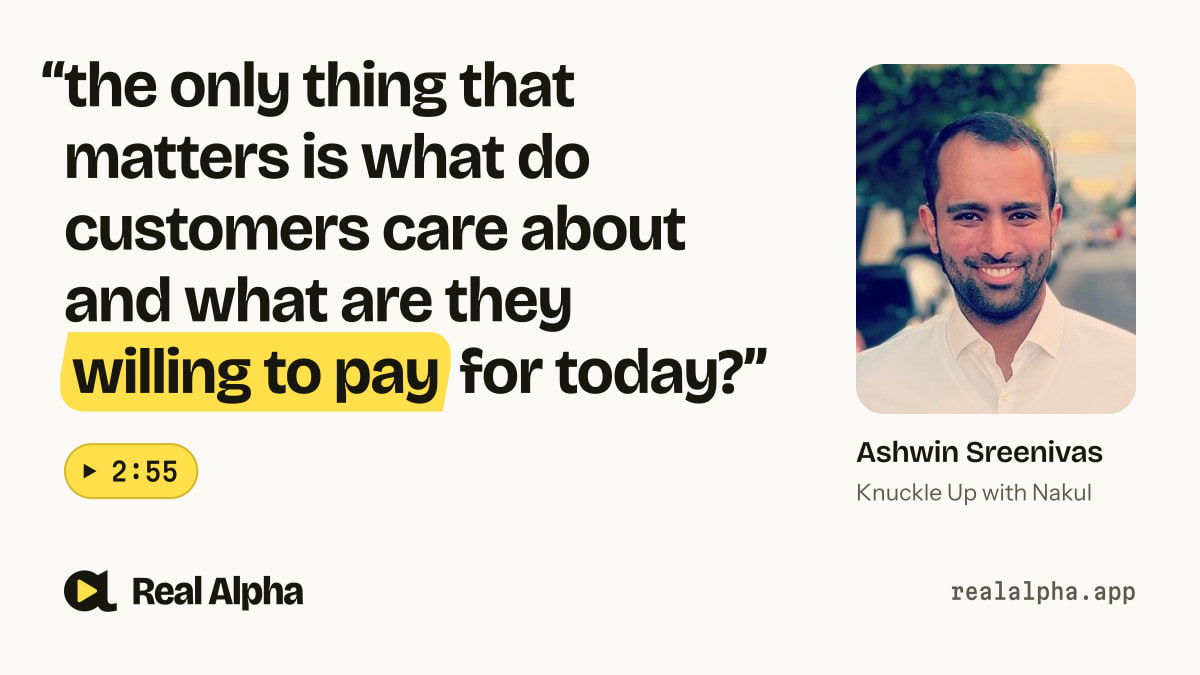
“the only thing that matters is what do customers care about and what are they willing to pay for today?”
 Ashwin Sreenivasat 2:55 · Knuckle Up with Nakul
Takeaways
- Find a shared, specific pain among a defined buyer group.
- Check what customers will pay for now.
- Revisit markets as new technology makes old problems solvable.
About this segment
Ashwin Sreenivas explains why Decagon started with buyer pain and willingness to pay, then worked backward to product and go-to-market. That kept early decisions grounded in real demand.

Ashwin Sreenivas is cofounder and CTO of Decagon.
Co-founded Decagon, the conversational AI platform valued at $4.5B, after building Helia, which Scale AI acquired.

Nakul Mandan, Host · Host, Knuckle Up with Nakul
General partner at Audacious Ventures; his show goes deep with founder CEOs on how they build.
From “The AI founder advice you won’t hear on X | Ashwin Sreenivas (Co-Founder at Decagon)”, May 19, 2026. Watch the full episode
Thanks. We'll look at and fix what's off.
Transcript
Transcribed by machine (Whisper) from the episode’s audio, so a word may be off here and there.
- 2:19
Being able to figure out what is the right three-year strategy at the start. it's really easy to fool yourself into thinking you're doing great, important work. Can you talk about how you and Jesse decided to work on this specific idea for Decagon? How did you go through the idea maze? Yeah, yeah. And first, thanks for having me. I'm really excited to be here. Early on in the company, we decided to explicitly avoid this thing that I think a lot of first-time founders do, which is thinking, okay, you know, what is our 10-year plan?
- 2:48
How are we going to build the right set of modes to build our defensibility? Just because I think in the early days of the company, there is so much that is unknown that doing that well, I think is nearly impossible. So early on in the company, essentially what we did is we said, the only thing that matters is what do customers care about and what are they willing to pay for today? Because everything that comes is downstream of that. So in the early days of the company, all that we did was we said, hey, let's focus on a buyer and the problems that they have. And as an early stage company, the only thing that you're looking for is what is a common, unique pain amongst a specific set of buyers.
- 3:25
And once you figure out the pain that you're trying to address, only then do you say, okay, now this is how I think I can solve this pain. This is the product that results from it. This is the go-to-market motion that results. So in the early days, the only thing that we focused on was who's the buyer that we want to serve and what is the specific pain point that we have. Ultimately, as we started talking to a lot of these buyers and specifically, we were looking at heads of customer success, heads of customer service, VPs of operations, right?
- 3:52
Within fast growing tech companies, the number one issue that they all had was customer support, right? They kept coming back to us again and again saying, hey, we have all these problems, but the number one thing that I'm struggling with is customer support, right? Because number one, it's crucial to the company, right? Because this is the lifeblood of companies today. And two, it's very labor intensive and it's hard to manage.
- 4:14
So that was kind of how we hit on the problem we wanted to solve. Did you not consider the top-down approach at all, like market sizing? A lot of founders come into it from what they've individually felt as a pain point in their last startup. They take a top-down approach of, hey, where is the world headed? This is where I'm excited. It seems like you guys were maniacal about finding customer pain point through that journey.
- 4:37
Yeah. So no top-down approach at all in your journey with Decagon. No, not as much because I'm of the opinion that the markets that you serve honestly determine a lot of the outcome of the company. There are great markets to build companies in in periods of time and there are bad markets to build companies in in periods of time. And I wanted to ensure that I wasn't just going after what was a bad market.
- 5:02
I think Mark and Reeson had a blog post that he wrote about, I think this was in the early 2000s or maybe the late 2000s, where he said, great market means bad founder, market wins. When bad markets mean great founders, market wins. And so we were very focused on making sure that we picked the right market and the right problem within the right market, which was ultimately this view that if you pick the right market, the market will pull the problem and product out of the founding team.
- 5:33
Do you feel actually in today's times, even more so, this bottom-up approach is the only way it works because the world is changing so dramatically that if you're not too opinionated about where the world is going in three years, you're going to get killed by the market shifting sands? I would say, you know, having done a company now both ways, right? One which didn't work out quite as well and one which did. I think this advice holds all across time. I think the difference today is that so many markets are changing so quickly that opportunities that did not exist before are opening up. So I think the big difference today is just that things that were, you know, kind of completely off limits, markets that were completely captured by companies before and markets that just weren't accessible to software
- 6:20
are just opening up. So it's worth kind of re-examining every single market from the ground up and saying, okay, what are the primary pains that the biggest buyer in this market has?