The alpha, twice a week
That was 3 min.
Get the best new moments in your inbox every Wednesday and Saturday. It's free.
Check your inbox
We sent a link to your address. Click it to finish signing up. Not there in a minute? Look in spam.
or
Knuckle Up with Nakul · 3 min · May 19, 2026
Most AI companies need product-minded FDEs
 Ashwin Sreenivas
 separates bespoke implementation work from FDEs who uncover missing product capabilities alongside users.
The episode’s best minutes
Full analysis- 2:13Customer pain should shape the product before strategy4 min
- 13:09Decagon accepts coordination costs to preserve speed4 min
- 40:01Most AI companies need product-minded FDEs3 min
- 5 more moments in the full episode
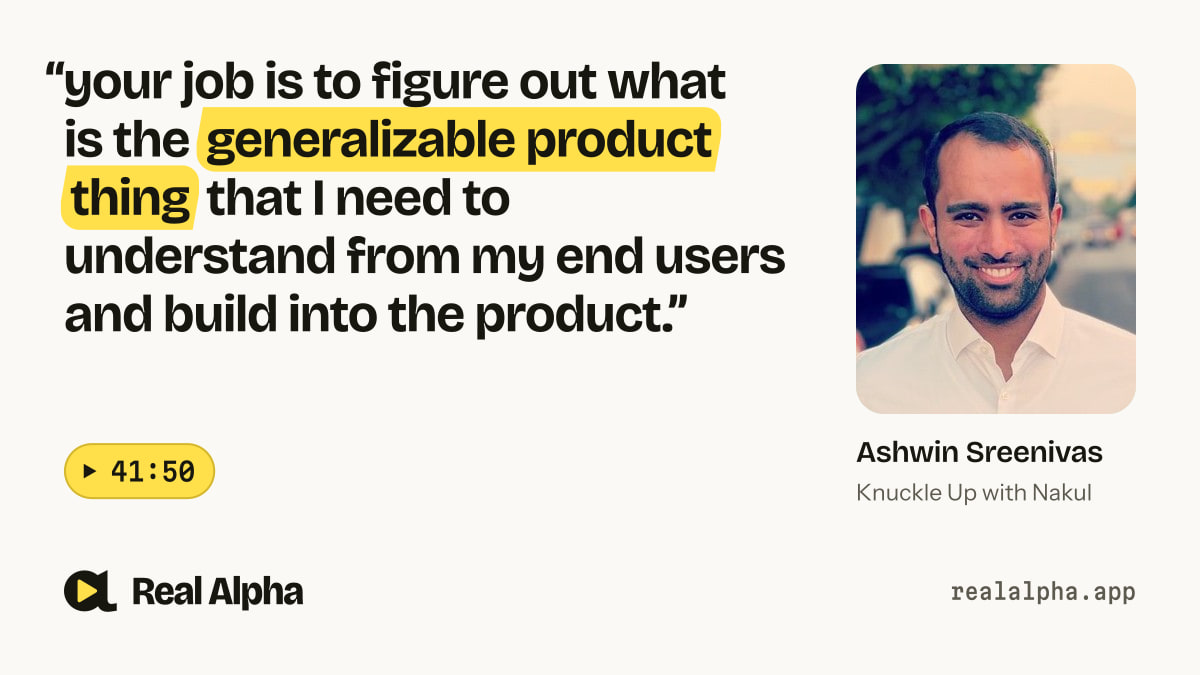
“your job is to figure out what is the generalizable product thing that I need to understand from my end users and build into the product.”
 Ashwin Sreenivasat 41:50 · Knuckle Up with Nakul
Takeaways
- Some FDE work is one-off consulting; some reveals product gaps.
- AI users often discover their workflows while using the product.
- The strongest FDEs empathize, generalize, and build.
About this segment
Ashwin Sreenivas separates bespoke implementation work from FDEs who uncover missing product capabilities alongside users. He says most AI companies need the latter, ideally as product engineers.

Ashwin Sreenivas is cofounder and CTO of Decagon.
Co-founded Decagon, the conversational AI platform valued at $4.5B, after building Helia, which Scale AI acquired.

Nakul Mandan, Host · Host, Knuckle Up with Nakul
General partner at Audacious Ventures; his show goes deep with founder CEOs on how they build.
From “The AI founder advice you won’t hear on X | Ashwin Sreenivas (Co-Founder at Decagon)”, May 19, 2026. Watch the full episode
Thanks. We'll look at and fix what's off.
Transcript
Transcribed by machine (Whisper) from the episode’s audio, so a word may be off here and there.
- 40:07
How has the FDE motion evolved since your Palantir days to where AI is today in the enterprise? I think this is an important point because I think this gets mistaken a lot in this space. There are actually two types of FDE work. And I think when people talk about it on Twitter, they conflate the two. And I think this is dangerous. The reason is the first type of FTE work is what is more typically understood as FTE work, even historically.
- 40:35
This ability to say, I'm going to go in and build the last mile of software and integrations for this end customer because no one else is going to want anything like that ever again. Right. And it is truly bespoke consulting. work. The second type of FTE motion is saying there is a lot of product I haven't built yet and so this is not going to be usable for my customer but this is product stuff that I need to build anyway. Now the reason I think there is a lot of this type of work today, the second type, is because there's a lot of net new product thinking. So for instance if you were starting a CRM company or a sales automation company, there's been 10 years of product thinking on what are the user journeys?
- 41:19
What are the kinds of things that I need to support? What are the kinds of workflows my users expect of me? But with AI tools, all of this is so new that the users themselves don't know what kinds of workflows they need to support until they start using it. So I think the job of the second kind of FTE is honestly just a product engineer that happens to sit next to users and see what the issues they're facing are and build it correctly into the product.
- 41:45
I think confusing the two can be very tricky and dangerous because if you are the second kind of FTE, and this is actually the kind of FTE I think most companies, most AI companies need today, your job is to figure out what is the generalizable product thing that I need to understand from my end users and build into the product. And I think this gets conflated a lot because everyone just calls them FTEs.
- 42:09
Yeah, I 100% agree with you. I'm seeing this across our portfolio also. but then accordingly what's the right background for that kind of an FDE the person who can generalize it is it a product person? Yes it's a really good ideally a really good product engineer that can both empathize with the user understand what the generalizable thing is and build it right because now this engineer can move way faster than before but otherwise an engineer and a product person kind of pairing together.
- 42:35
And then obviously every you touched on this already