The alpha, twice a week
That was 6 min.
Get the best new moments in your inbox every Wednesday and Saturday. It's free.
Check your inbox
We sent a link to your address. Click it to finish signing up. Not there in a minute? Look in spam.
or
No Priors · 6 min · May 1, 2026
Customers should prove value before investing in custom models
 Tuhin Srivastava
 says most inference is customized, and explains why Baseten acquired a post-training research team.
The episode’s best minutes
Full analysis- 18:32Compute supply is tight and contracts require large bets5 min
- 13:04Customers should prove value before investing in custom modelsPro pick 6 min
- 33:42Founders should hire leaders who can own whole problems3 min
- 5 more moments in the full episode
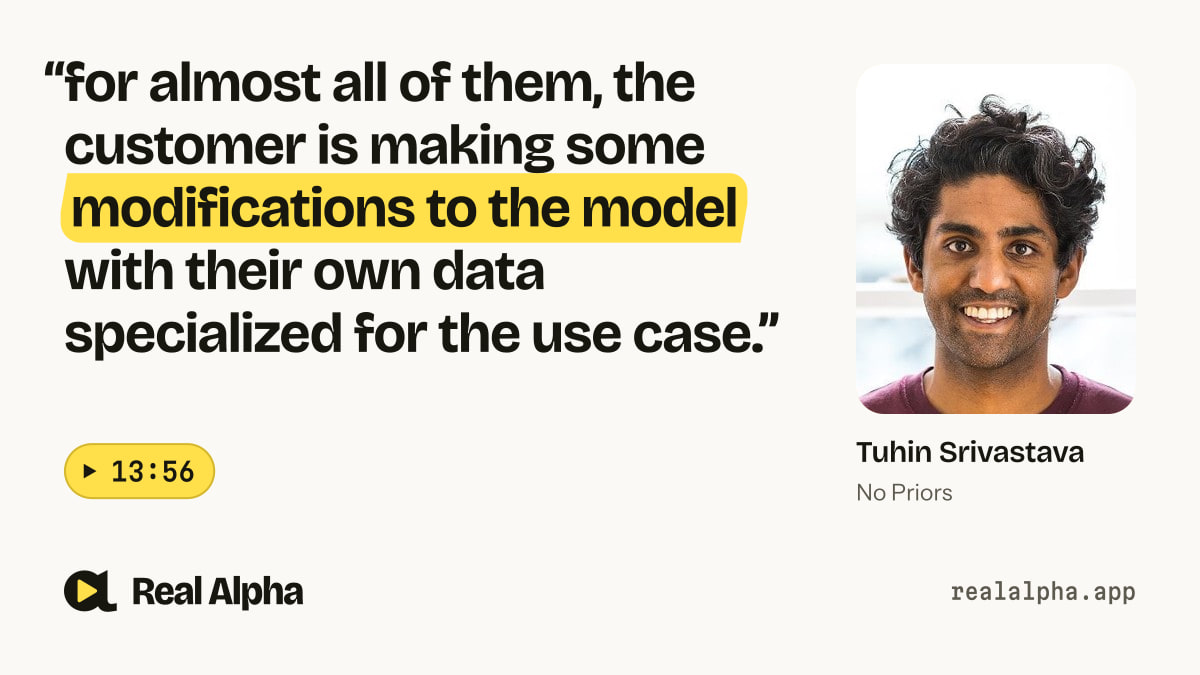
“for almost all of them, the customer is making some modifications to the model with their own data specialized for the use case.”
 Tuhin Srivastavaat 13:56 · No Priors
Takeaways Pro pick
- Most tokens run on dedicated inference.
- Customers modify models for their data and use cases.
- Prove there is value to optimize before post-training.
One of Pro's picks, open to you here. Try Pro free for 7 days
One of Pro's picks. The rest of the summary and the 3 takeaways are in Real Alpha Pro; the video, the quote and the transcript stay free.
Read it with Pro, 7 days freeAbout this segment
Tuhin Srivastava says most inference is customized, and explains why Baseten acquired a post-training research team. His rule: establish value with a strong model first, then optimize for speed, cost, or quality.

Tuhin Srivastava is cofounder and CEO of Baseten.
Co-founded Baseten, an AI inference company powering mission-critical workloads for Writer, Abridge and Bland.


From “Baseten CEO Tuhin Srivastava on Custom Models, and Building the Inference Cloud”, May 1, 2026. Watch the full episode
Thanks. We'll look at and fix what's off.
Transcript
Transcribed by machine (Whisper) from the episode’s audio, so a word may be off here and there.
- 13:09
maybe you can just characterize workload a little bit, like how, of tokens being served on base 10, like how many of them are from custom models of some kind versus like vanilla open-source today? It is all custom. It's basically... Okay, so like 95% plus. 95%, and I think that's really cool, to be honest. I'd say, look, we have two businesses. We have three businesses. We have three businesses right now.
- 13:35
Should we help you count? No, no. So we have like dedicated inference, which is basically custom model inference. Your SLA is your SLA. Then we have shared inference, which is shared inference endpoint, shared SLAs. And then we have a training business. I'd say 95% of the tokens today are on the first business. And almost all of them, there's probably, yeah, for almost all of them, the customer is making some modifications to the model with their own data specialized for the use case.
- 14:09
And I think what's even more important is they might be compiling it in different ways. No one is just running the vanilla open source weights. You might be customizing it for quality, but you also might be customizing it for performance. You made an acquisition of a research team a few months ago. You've mentioned post-training customization. What was the rationale behind the acquisition? What is that team doing today?
- 14:34
Yeah. So the rationale around the acquisition was, you know, we are infrastructure and product people. We are product people and now are really good infrastructure people. And we didn't have much of a research capability ourselves. And what we saw was the market moving heavily and heavily, like that we could. accelerate the market itself with post-training resources, either productized or honestly even just as resources for that market.
- 15:09
So Parz was a company that was a base 10 customer. So there were post-training models and running them on base 10. And I think what they realized was that they would eventually need to become an inference company. And what we realized was like, hey, we really needed that expertise because it represents a way for us to get closer to the customer earlier and be able to support them more. And it just made sense as a, like pairing them together.
- 15:43
And just as I said in the opening statement here, which is, you know, as more and more post-trained models have come up, we've realized that the demand for people to either, for software loops to do post-training or for post-training expertise is very high and we're really really investing um in that um there are also a bunch of australians um you know i like to think that we had a bit of alpha there um but yeah that's been fantastic they're working with all sorts of customers um and it's also very interesting when you when you um start you know And we were doing a lot of research on the performance side and less so on the post-training side.
- 16:29
It's interesting as we've started to do a lot more research on the post-training side, you start to see how linked inference and post-training are. And even when you think about stuff like quantization and when you should do that and how you train the model affects how you need to quantize for inference. and how paired these problems are has become, like, very apparent. And more and more, we're, like, in the post-training inference are kind of both sides of the same problem.
- 16:58
So because inference ideally will beget more post-training, where inference creates data, you do evals, you can now post-train on that reward function that you found with those evals, and hopefully just set up that entire look. Plenty of folks from Ant and OpenAI, Sam, Greg, et cetera, have said in recent months that like inference is super strategic, inference talent is strategic, capacity is strategic. So between that and post-training, these are very difficult to gather like capability.
- 17:31
I imagine that lots of your customers go to you guys for advice on like how to do this progression of moving to custom models. Like, what do you tell people about the lifecycle and when they should invest in that? Yeah, I think it's, hey, go find, go prove to yourself with the best in class model that you have something worth optimizing. And I think, you know, a lot of, you know, if a customer comes to us, was that meme, which was like, it was like two years ago.
- 17:59
It feels like no GPUs, pre-product market fit. It's like no post-training pre-product market fit is what I'd say. So people that you're working with here are very, very at scale first. Yeah, they have a user signal that they know how to optimize. And they've shown that they can, you know, they can serve customer value and that value and that they have something special around that value. And once you have that value, it's like, okay, now how can I do that better, faster and cheaper?
- 18:23
With the idea being that, hey, if you need to be very good at customer support, but you maybe don't need to be that good at coding and a specialized model might be a better fit for that problem and you can do it better, faster, cheaper. What about the capacity side?