The alpha, twice a week
That was 3 min.
Get the best new moments in your inbox every Wednesday and Saturday. It's free.
Check your inbox
We sent a link to your address. Click it to finish signing up. Not there in a minute? Look in spam.
or
Prof G Markets · 3 min · Apr 30, 2026
Dalio sees a return to power-based world order
 Ray Dalio
 says the postwar multilateral system has given way to a power-based order because it lacks enforcement.
In this episode
Full analysis- 13:09Diversification matters more than timing in a stagflationary cycle4 min
- 9:19Dalio sees a riskier U.S. transition as debt demand weakensPro pick 4 min
- 18:59AI cloud leaders are earning returns on rising capex4 min
- 24:27Microsoft is cheaper despite similar growth3 min
- 4:43Dalio sees a return to power-based world order3 min
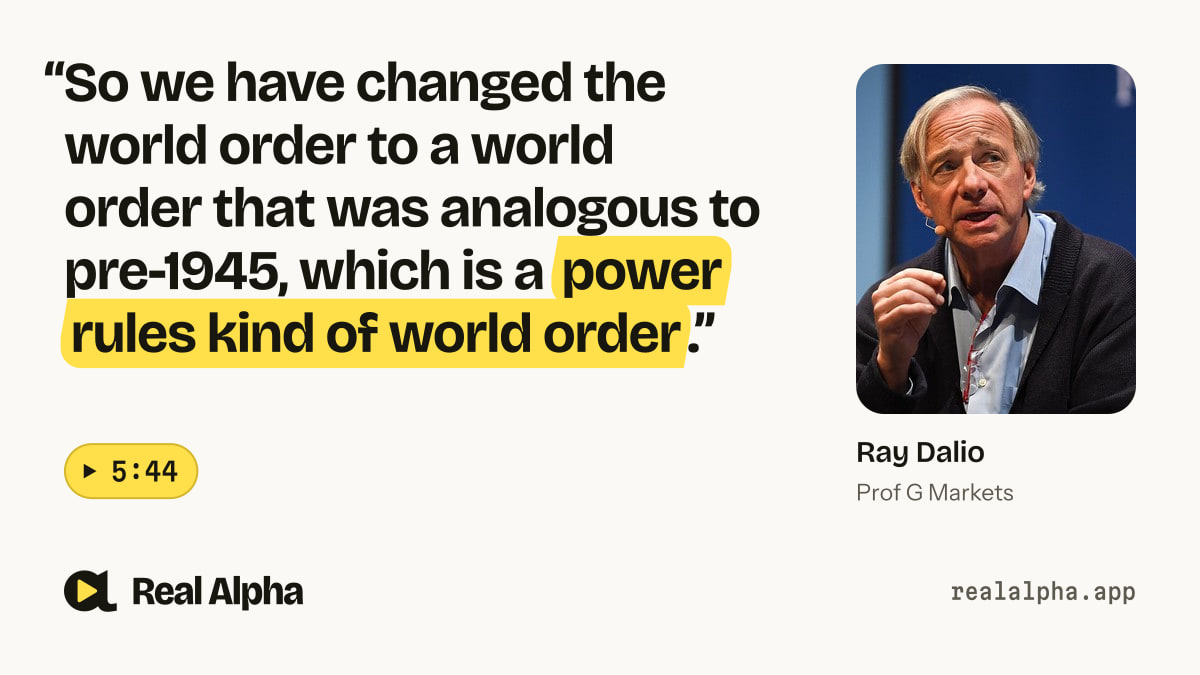
“So we have changed the world order to a world order that was analogous to pre-1945, which is a power rules kind of world order.”
 Ray Dalioat 5:44 · Prof G Markets
Takeaways
- Dalio says postwar institutions lack enforcement in conflicts between major powers.
- He compares the current order to power politics before 1945.
- He places Iran within broader competition involving China and Russia.
About this segment
Ray Dalio says the postwar multilateral system has given way to a power-based order because it lacks enforcement. He frames Iran as one front in wider conflicts involving China, Russia and others.

Founder, Bridgewater Associates
Founded Bridgewater and developed investment approaches like risk parity and All Weather for global institutions.

Ed Elson, Host
From “Ray Dalio: The World Order Has Unraveled”, Apr 30, 2026. Watch the full episode
Thanks. We'll look at and fix what's off.
Transcript
Transcribed by machine (Whisper) from the episode’s audio, so a word may be off here and there.
- 4:54
In other words, how countries deal with each other. And throughout all history, there are great conflicts, wars. And then after the war, there's a new order. The power in the United States, for example, 1945, created a new monetary order, created a new world order, and that was a multilateral world order that was designed almost to some ways replicate the U.S. approach to representative democracy, the creating of the United Nations, multilateral organizations, including, can you imagine, the World Court or the World Bank or the World Trade Organization or the World Health Organization. That's all over.
- 5:41
And it was in some ways naive because you take a vote and there's no enforcement mechanism, of course. That's not going to work in the dominant power. So that's the third. So we have changed the world order to a world order that was analogous to pre-1945, which is a power rules kind of world order. Number four, I told you about the acts of nature. And then, of course, number five is technology. They all have great implications.
- 6:16
Technology can greatly reduce, can greatly improve productivity. And if those productivity creates incomes and so on, it can help greatly. And similarly, productivity, the use of AI and other ways can be used for war or can be used for other purposes. So that is the cycle. So now as we come into it, we see these things happening. They cannot be, should not be looked at individually. In other words, in focusing something like Iran on the war with Iran, we can lose sight of the fact that while it's very important, it's part of a world war.
- 7:00
In other words, there are sides, China, Russia, Iran, and other countries, Korea, North Korea, and the like. And then there are other sides to that and that there are conflicts. And so the implications that this has are very profound. I was just in Asia for about a month meeting with different kinds of different world leaders and so on. And the implications of what is now happening with Iran and the United States and so on are very profound for that world order.
- 7:35
And we can, I'm sure, talk about it. So thank you for letting me get that picture out. And we can now zoom in on whatever you want to talk about.