The alpha, twice a week
That was 8 min.
Get the best new moments in your inbox every Wednesday and Saturday. It's free.
Check your inbox
We sent a link to your address. Click it to finish signing up. Not there in a minute? Look in spam.
or
Sourcery · 8 min · Nov 23, 2026
Dalio sees moderate coalitions as the route out of political conflict
 Ray Dalio
 argues that durable solutions require moderates in both parties to defeat their own extremes.
In this episode
Full analysis- 20:13Bubbles burst when wealthy owners need cash6 min
- 13:28The wealth gap grows when productivity is not broad-basedPro pick 5 min
- 25:55Investment decisions can be built from explicit criteria4 min
- 1:57Dalio’s 1971 market surprise led him to study history4 min
- 5:50Dalio sees moderate coalitions as the route out of political conflict8 min
- 30:05Bridgewater’s Dot system turns meeting reactions into team data4 min
- 34:24Dalio values intellectual humility over academic confidence4 min
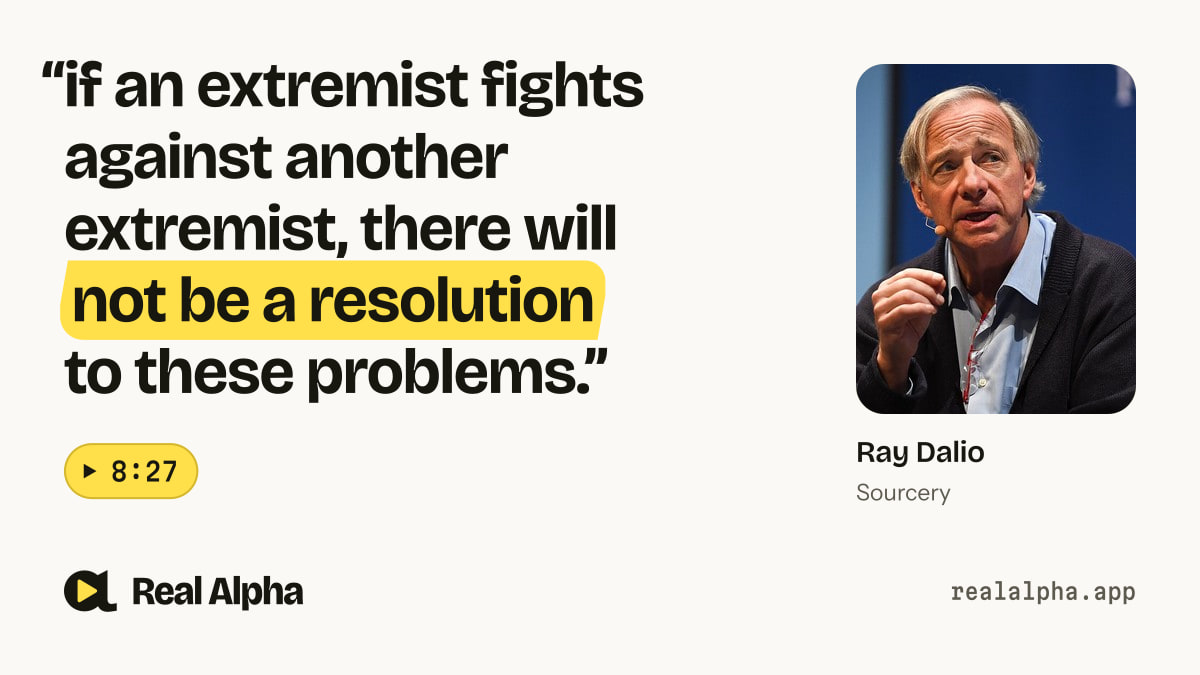
“if an extremist fights against another extremist, there will not be a resolution to these problems.”
 Ray Dalioat 8:27 · Sourcery
Takeaways
- He sees moderates and extremists within both parties.
- Debt and wealth gaps remain regardless of who takes office.
- He says moderates must work across party lines to resolve problems.
About this segment
Ray Dalio argues that durable solutions require moderates in both parties to defeat their own extremes. He expects conflict over debt and other problems to persist without cross-party cooperation.

Ray Dalio is founder of Bridgewater Associates and global macro investor.
Founded Bridgewater and developed investment approaches like risk parity and All Weather for global institutions.

Molly O'Shea, Host · Founder, Sourcery
Ex-Upfront Ventures investor; has interviewed Alex Karp and Palmer Luckey.
From “I Finally Interview Ray Dalio”, Nov 23, 2026. Watch the full episode
Thanks. We'll look at and fix what's off.
Transcript
Transcribed by machine (Whisper) from the episode’s audio, so a word may be off here and there.
- 5:56
To get into a very timely topic, the elections just happened, and this is force number two. So could you explain the mechanics around what might happen with this new change in America? Okay. I think it's important to realize that we're changing those who are dealing with the problem. We're not changing the problems. The problems will still exist. We'll still have a debt problem. Okay. We'll still have a left-right wealth gap, values gaps problem, right? We're still going to have the problems that we're talking about, the, let's say, changing climate, or we're going to have the geopolitical conflict and so on.
- 6:38
So you're changing the people who are going to deal with that. And history has shown that there's only one successful path for democracies. And that is to, that basically you can look at, there's the left and the right. and they're broken up into the extreme left and it's a continuum. There's the extreme left, there's the moderate left, there's the moderate right, and there's the hard right or the extreme right. And in that continuum, there is a fight between the left and the right. And then when there's a winner to that fight, there's also a fight between moderates and the extremists of the same party. Okay, so we're going to see them deal with these issues. And so, and it'll become manifest very quickly in the form of, for example, on the economic, we'll have the debt issue to deal with debt limits and so on december 11th or thereabouts we will the arguments will begin
- 7:51
and we'll be in this uh phase where there's going to be still the old system before the new system place and there'll be a dynamic and that fight will continue. And there'll be changes then which will follow. For example, Elizabeth Warren will be head of probably the Senate Banking Committee and so on. And there are different views. And so the conflicts are going to continue and how they're resolved. There's only one successful way to resolve these things.
- 8:22
And that is if the middle, the moderate Democrats and the moderate Republicans get together and win over the extremists, because if an extremist fights against another extremist, there will not be a resolution to these problems. What one hopes for is that moderates get together and most of the population is going to be in that group, okay? And so extremists could never win this war because there's too many on the other side and there will be that fight.
- 8:58
And so as we look down that path as we're moving down these issues, these important issues, we're most likely going to see great conflict. we're most likely going to see even the definition of the parties essentially we have four parties essentially okay and um and how that conflict will transpire will have enormous implications and of course it has implications on money and technology and everything right as we think about data centers and what sort of support or banking or credit and all of that will have enormous implications and at the same time we have a bubble okay too much capital we can get into the all of that but we have that particular dynamic so um i think as we we'll see it pretty quickly i think this um other conflict over how to deal with things what do you think could be the most
- 9:57
surprising outcome of this i think this is going to end up being a big conflict okay so what's the most surprising the most surprising and hopefully uh contact is that um what we're really seeing is the move to moderates that can work across the lines together okay because when i look at the candidates who flipped these um the states that one wouldn't have thought would have flipped rather than we we call them democrats um but they don't look like socialist democrats okay they're almost uh indistinguishable from republicans let's say they look more like in the middle and so one could say there was a vote for i don't know reasonable people in the middle or and and let's not label them democrats or republicans let's look at what they are like and can they get control to be able to have moderate um thoughtful uh examinations of the
- 11:13
issues because we have problems okay we have a financial problem we have all sorts of problems And the key is whether we together can have smart bipartisan people who can work together to deal with those problems, including getting the people, the population to do the difficult things. For example, you have a debt problem. OK. And the big problem with the debt problem is nobody wants to raise taxes or cut spending. So we will continue on that political. All they know is they want more. OK.
- 11:48
And so on that situation, how do you get control of that group of people to be able to do the thoughtful things that are required in order to have? circumstances work well and build strength again, like building financial strength or building togetherness strength to be able to be productive. How do you resolve these? So the surprise would be if they turned into real moderates who decided we really have to work this way rather than extremists who then are at war with each other. It would be a real surprise. It'd be a good real surprise. Do extremists normally result to the mean?
- 12:30
Is extremism part of the political undertaking of winning? Usually if there's big disagreements and you get beyond reconcilable differences. In other words, if your self-interests are more important than listening to the system, abiding by the system, then the system is in jeopardy. then what do you do? There's a war of sorts. Okay. What kind of civil war? Well, it has to be the resolution of those things till one side wins over the other. That's the nature of how things work.
- 13:04
One side wins over the other and then imposes that. So we have four political parties in a sense, right? And so how the left and the right deal with each other. And then traditionally after one side wins, then there's a fight between the extremists and the moderates of those parties to find out who gets control. And so that's what we're in. Yeah, I want to go to the first force