The alpha, twice a week
That was 4 min.
Get the best new moments in your inbox every Wednesday and Saturday. It's free.
Check your inbox
We sent a link to your address. Click it to finish signing up. Not there in a minute? Look in spam.
or
Balance of Power · 4 min · Nov 6, 2026
Data center opposition is becoming a populist political force
 Patrick McHenry
 links market anxiety about AI infrastructure to voter opposition over how data centers affect local communities.
The episode’s best minutes
Full analysis- 8:56Democrats plan to pair AI safeguards with cost-of-living billsPro pick 5 min
- 30:01Data center opposition is becoming a populist political force4 min
- 34:32Crypto missed its chance to pass market-structure law3 min
- One more moment in the full episode
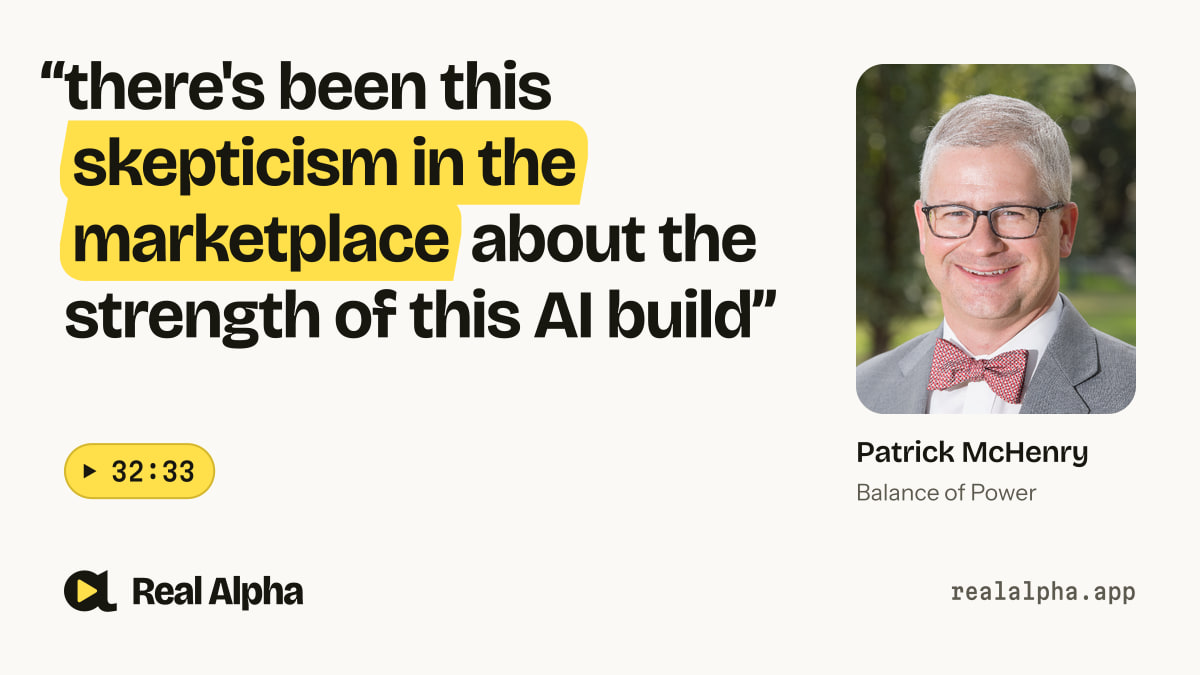
“there's been this skepticism in the marketplace about the strength of this AI build”
 Patrick McHenryat 32:33 · Balance of Power
Takeaways
- Investors are questioning whether AI infrastructure spending can continue.
- Local opposition is shaping data center politics.
- Candidates are responding to concerns about corporate influence.
About this segment
Patrick McHenry links market anxiety about AI infrastructure to voter opposition over how data centers affect local communities. He says the politics reflect a broader populist backlash against perceived corporate and government ties.

Senior advisor, Lazard
Chaired House Financial Services, shaping U.S. policy on crypto, fintech and AI during two decades in Congress.

Joe Mathieu, Host · Washington Correspondent, Bloomberg
Co-anchors Bloomberg’s Balance of Power and covers Washington; founded and hosted SiriusXM’s POTUS political news channel.

Kailey Leinz, Host · Washington Correspondent, Bloomberg
Co-anchors Bloomberg’s Balance of Power, interviewing presidential candidates, administration officials, lawmakers and regulators on policy.
From “Democrats Begin Outlining Priorities | Balance of Power”, Nov 6, 2026. Watch the full episode
Thanks. We'll look at and fix what's off.
Transcript
From the transcript Balance of Power publishes with the episode.
- 30:04
calling it a bloodbath, a generational sell-off in real time. Now that you've had a couple of minutes to let the dust settle here, what are you thinking about the lame duck and just the direction that this country is about to take. Is Wall Street right to be panicking? Oh, sure.
- 30:22
Yes, because you have this assumption about what was going to happen in D.C., which is sort of paralysis. We've seen this in the second half of President's term. What people were not pricing in was a realignment of the House and the Senate to this magnitude, number one.
- 30:37
Number two, the seismic shift in these states. That are very important for AI deployment and which has been the big driver of our economic growth. And in Texas and Georgia, that has been a clearly major statement that the voters made, that they were very anti-data center. But really, that's the physical manifestation of their psychological concern, which is around AI. What does that mean for the AI trade? What does this mean for the whole infrastructure build-out?
- 31:04
There's a lot of questioning about that. And that's before we actually talk about, with the votes in the House and the Senate, what is possible with policy? And now new things are possible with policy than what we'd assumed just at the beginning of the week. Well, we're assuming the worst now.
- 31:21
You know, we had Sam Liccardo on earlier and Kaylee asked a question like, are we reading you guys? Is this the message that you want to be sending? Even Gina Hinojosa, who we listened to in an interview on CNN. Maybe we can bring that up here, CeCe. was making it pretty clear that it's not a moratorium. We're just going to be taking a closer look at these things. And if we're protecting people's electric bills and we're protecting water and the local town wants it, then we're good.
- 31:49
You could see hyperscalers throwing a lot of cash at communities that might not have seen that before. We have that. Listen to what the governor-elect of Texas said about this on CNN.
- 32:00
It is not that I hate data centers. I hate the way they are taking advantage of Texas. Selling our beach to Elon Musk is just something that is almost unimaginable. We can have a strong working relationship with Elon Musk and his companies, but it has. To be on our terms. It has to be on our terms.
- 32:21
Wall Street gets scared when they when they hear that, but you've got bulls out there saying, Hey, you know what? This is an opportunity to like deep seek. This is an opportunity to like liberation day. This is a way to, Jump in at the bottom.
- 32:34
I also think there's been this skepticism in the marketplace about the strength of this AI build and whether or not the tokenomics here match what we've seen with the disclosures from Anthropic about their IPO. And the cadence of spend has been– the trajectory has been enormous on AI. Yeah. And do these things model out if the trajectory is just flattened a little bit on AI spent? Sounds like we don't know. I think this enabled that sell-off in that way. But if you listen very closely, not just to that interview, but what Governor-elect Dana Hoss has said, there's an adeptness to this. She's understanding the zeitgeist of the voter and saying, I get you.
- 33:21
We hear you. We think that these people doing the build-out in your neighborhoods have not been good corporate citizens, number one. And number two, we see a cronyism, the link between our government and them, against you. And that has been potent politics. This is the era of populism for the left and the right. President Trump has ridden this wave over the last 12 years. And now we see this using the same issues and it's been shifted to what appear to be moderate Democrats.