The alpha, twice a week
That was 4 min.
Get the best new moments in your inbox every Wednesday and Saturday. It's free.
Check your inbox
We sent a link to your address. Click it to finish signing up. Not there in a minute? Look in spam.
or
Training Data · 4 min · Jan 14, 2025
Databricks bet on Spark partnerships, even with competitors
 Ion Stoica
 explains why Databricks partnered broadly to make Spark the standard, including a costly Azure build.
The episode’s best minutes
Full analysis- 25:20Databricks bet on Spark partnerships, even with competitors4 min
- 39:28New systems put researchers close to the next problems6 min
- 45:02AI needs software for heterogeneous hardware and autonomy4 min
- 3 more moments in the full episode
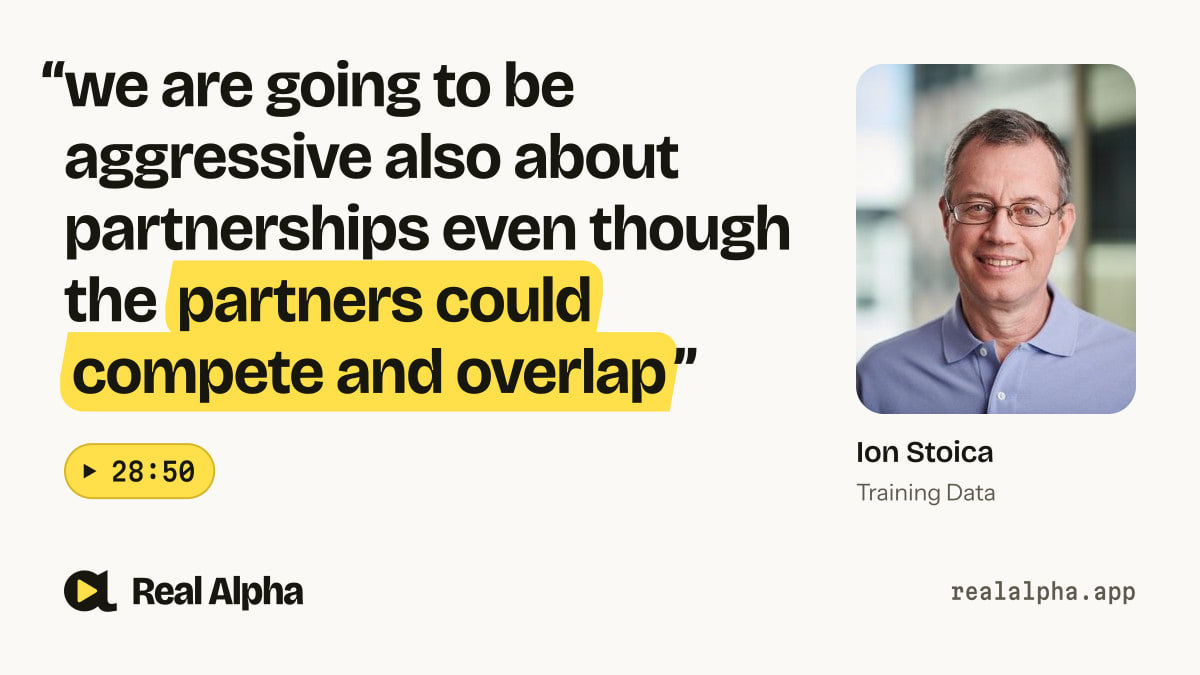
“we are going to be aggressive also about partnerships even though the partners could compete and overlap”
 Ion Stoicaat 28:50 · Training Data
Takeaways
- Make the open-source project win, then be its best place to run.
- Partnerships can grow an ecosystem even when partners may compete.
- Azure Databricks took tens of engineers and about a year to build.
About this segment
Ion Stoica explains why Databricks partnered broadly to make Spark the standard, including a costly Azure build. The strategy worked because the company trusted its product to win as Spark grew.

Ion Stoica is a professor of computer science at UC Berkeley, cofounder of Databricks and Anyscale.
Built Apache Spark and Ray, co-founded Databricks and Anyscale, and helped launch Chatbot Arena for evaluating language models.
- SZ
Stephanie Zhan, Host · Sequoia Capital

Sonya Huang, Host · Partner, Sequoia Capital
Works with OpenAI and Anthropic; co-wrote Sequoia's essay on generative AI.
From “Turning Academic Open Source into Startup Success ft Databricks Founder Ion Stoica”, Jan 14, 2025. Watch the full episode
Thanks. We'll look at and fix what's off.
Transcript
Transcribed by machine (Whisper) from the episode’s audio, so a word may be off here and there.
- 25:23
Look, obviously, the partnership with Microsoft was a great partnership for us. The one thing I want to say, and this is most visible, from day one, we were actually very focused on the partnerships. Our idea was always, you know, like we know we make Spark successful, you know, hopefully de facto standard for data processing. And then we make Databricks the best place to run Spark. So early on, actually, you know, we started, you know, a few months in the life of the company, we had this kind of partnership with Cloud Data.
- 26:08
And then we had with Hortonworks. And this partnership was mainly because we are, you know, to advance Spark, right? Because Spark, it was created in Hadoop ecosystem, right? And these are the Hadoop companies, right? Right. And so we had this partnership, our data stacks and so forth. So this was like in the first year or so, we had all this partnership. Despite the fact that some of these companies, we knew that they could become our competitors.
- 26:41
right because you know just making them is making and helping them um to um to deploy to manage and to sell spark based services right it's like so so in some sense you know uh the microsoft is like It fits our kind of approach of trying to, you know, to strike as much, you know, do partnerships with other, being aggressive, doing partnership with other, you know, organizations in the ecosystem. Even though, again, in some cases, it was not a clear cut whether they are going to compete with us or not.
- 27:32
Just growing the ecosystem and growing Spark, that was the priority. We even had, at some point, a partnership with Snowflake. So it was very... It requires a lot of heavy lifting. left lifting so we always look for a partnership which has which are meaningful right and I think great negotiation you know Ali and so forth did a fantastic job there but at the end of the day we also need to commit to it. It's like it took to build the Azure Databricks. So we are an IWS before that. It took, you know, tens of engineers one year and you are a small company at that point. So it was a huge commitment and a huge bet also from our perspective to do that.
- 28:28
and yeah and we you know I think engineering and everyone executed very well and it was a successful product right and you know Microsoft was great partners you know and yeah this is what happens we are obviously a bit lucky but in general this was our approach we are going to be aggressive also about partnerships even though the partners could compete and overlap because you have to trust yourself that at least when it comes to spark you can build the best products we are you know kind of saying internally well you know if someone else is building a better product for spark then we deserve to lose right so that's kind of always was the confidence that we can build the best products for Spark, and eventually if Spark wins, we are going to win.
- 29:27
Do you think that Databricks would have become the company it is today without that Microsoft partnership? I think so.