Free with a sign-in.
The best 14 min of 60
Turning Academic Open Source into Startup Success ft Databricks Founder Ion Stoica
Ion Stoica says founders should pursue problems that will matter more tomorrow, then build reliable systems that solve them in production.
TDTraining Data · Stephanie Zhan & Sonya Huang
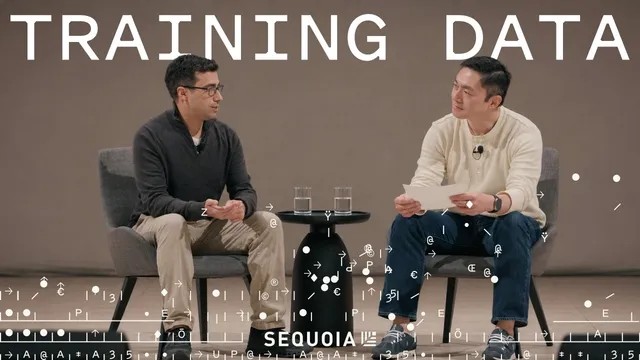
- Ion Stoica is a professor of computer science at UC Berkeley, cofounder of Databricks and Anyscale.
The best minutes
- 25:20Databricks bet on Spark partnerships, even with competitors4 min
- 39:28New systems put researchers close to the next problems6 min
- 45:02AI needs software for heterogeneous hardware and autonomy4 min
Also worth watching
- 20:05Databricks found its first users needed data engineering first5 min
- 49:25AI research has lost its academia-government-industry partnership4 min
- 9:23Enterprise AI buyers want control when they move to deployment4 min
Skip the AI product-positioning discussion and compound-AI explainer, plus the closing rapid-fire questions.
Full analysis · 5 min read
Real Alpha · Nov 11
Ion Stoica says AI products must work beyond demos
- AI demos can show an impressive instance, but products must work across cases, Stoica said.
- His Spark history supports watching users and solving real problems, while infrastructure forecasts remain predictions.
- Budget for data work, deployment control, and reliability before calling a pilot a product.
Free with an account
Read the rest of the analysis
6 sections, the 4 other voices it tests Stoica against, and what it means for you. Every episode we cut gets one.
Check your inbox
We sent a link to your address. Click it to finish signing up. Not there in a minute? Look in spam.
or
Signed up before? The same buttons sign you in. The episode, its moments and the transcript stay free.
Enterprise deployment demands more than a convincing demo
A striking demo shows that an impressive result can happen. Stoica said a product must work across cases, improve accuracy, limit hallucinations, and provide value.
That distinction matters because the buyer’s test changes after a use case proves valuable. Stoica says enterprises then weigh control, security, confidentiality, and where the model runs.
For example, many enterprises fine-tune models on proprietary data rather than pretrain them. Stoica says they may want those models in their own VPC, where they retain more control over sensitive information.
Arvind Krishna discussed matching models to tasks and reserving frontier systems for valuable work on All-In in October 2026. Alex Lieberman gave a rough “like 5” figure for non-engineering agents in production on Latent Space that month, not a firm benchmark.
 Arvind Krishna · All-In · Oct 21Open-weight models could handle most enterprise AI at lower cost
 Alex Lieberman · Latent Space · Oct 21Only 5% of large enterprises run non-engineering agents
Our read
Stoica’s standard is not that every company needs an open model. It is that a successful demo leaves reliability, deployment, and customer control unresolved.
Customers showed Databricks where the work began
Databricks first aimed its hosted Spark product at data scientists and machine-learning workloads. After customers had used it for months, the team found many had barely started machine learning.
They lacked the data for their intended applications. They needed to add product logs, collect information, and clean and curate it before modeling could begin.
For example, Spark’s data-processing strengths let those customers use Databricks for data engineering first. The company then expanded its products as data scientists began building models on better-prepared data.
That sequence argues for examining what blocks adoption before adding features for the original plan. A technically capable model cannot solve a workflow that lacks usable data.
Our read
Databricks followed customer use into a nearer-term need. For founders, stalled usage may reveal prerequisite work, not a lack of interest in the end goal.
Partnerships helped Spark spread without guaranteeing Databricks
Stoica says Databricks wanted Spark to become the standard, then wanted Databricks to be the best place to run it. That meant working with companies that could also compete.
The company partnered with firms across the Hadoop ecosystem, and later with Microsoft. Building Azure Databricks took tens of engineers a year, a large commitment for a small company.
Stoica calls Azure Databricks a successful product and Microsoft a great partner. He also says Databricks could have become the company it became without that partnership, though it maybe would have taken a little longer.
This is a founder’s account of a strategy that benefited his company. The episode does not compare every alternative, but it shows the cost of making ecosystem growth part of the product plan.
Our read
The partnership was a substantial execution commitment, not proof that partnership alone creates advantage. Stoica’s logic depended on Databricks continuing to build the best Spark product.
Adopted systems can reveal the next research problem
Stoica says researchers should choose important problems by watching trends and building systems people use. Adoption can put a team close to new needs as they emerge.
For instance, students of Michael Jordan wanted to compete in the Netflix recommendation challenge using its released data. They asked Stoica’s group for help, and Matei Zaharia built a system that kept the data in memory.
That example explains Spark’s origins. Separately, Stoica’s broader point is that users will apply a system in different ways, exposing problems its builders can then understand directly.
Erik Bernhardsson said Modal’s infrastructure sandbox took years to find a major use on 20VC in November 2026. That is not evidence about Spark, but it illustrates why a useful system’s eventual value may emerge through use.

Our read
Stoica links research advantage to proximity to real problems, not simply to commercial success. The system creates a vantage point from which new questions become visible.
AI demands software that hides growing infrastructure complexity
Stoica expects AI applications to outgrow single processors and nodes while infrastructure becomes distributed and heterogeneous. Different accelerators, chips, and networking systems make the software stack harder to manage.
He says that stack must abstract the complexity for developers. That is his forecast about a software need, not evidence that any particular infrastructure product will win.
He also sees a large gap between human-assisted applications and autonomous ones. Moving to autonomy requires greater reliability, accuracy, and predictability, and he expects more engineering work to make applications easier to build from components.
Aghi Marietti described enterprises moving from one model to many on MTS in October 2026. That points to operational variety, though it does not establish Stoica’s forecast about hardware abstraction.
Our read
Stoica identifies two engineering problems, infrastructure complexity and dependable autonomy. Both are opportunities to investigate, not outcomes the episode proves are already solved.
AI research has lost its three-way partnership
Stoica contrasts the internet era’s collaboration among academia, government, and industry with AI research now divided into company silos. He says universities lack comparable resources and government investment.
He says some larger universities and labs may spend one or two million dollars training models. He contrasts that with OpenAI and Microsoft talking about data centers costing about $100 billion.
The gap matters because Stoica says it will be harder to develop new model architectures when academics cannot compete for resources. He also warns some academics may give up and innovate around the edges, while stressing that new ideas are not impossible.
Stoica favors open-source models and says the playing field needs to be leveled to maximize innovation. His concern is not that academic research has ended, but that fewer teams may be able to explore the same problems.
Our read
Stoica describes a resource imbalance and its possible cost to research. He favors open-source models, but the episode offers no detailed funding proposal.
What it means for you
- Test production cases. For each AI pilot, record success across real cases, errors, and human interventions. Separate an impressive example from repeatable value.
- Find the missing data work. Ask customers who have stalled what data they still need to collect, clean, or curate. Track whether that work blocks the intended use case.
- Cost the ecosystem commitment. Before supporting a partner’s platform, estimate the engineering time required. Define how your own product remains the best place to use it.
- Set an autonomy threshold. Choose reliability and human handoff measures before calling a workflow autonomous. Review them against actual operating cases.
What to watch
- Whether AI pilots become reliable products across varied cases, rather than only successful demonstrations.
- Whether enterprise deployments favor fine-tuning and customer-controlled environments after a use case proves valuable.
- Whether universities retain the resources to explore new model architectures.
Send this to the product and research leaders choosing your next AI workload.
Watch the three minutes where Stoica explains what enterprise deployment demands.
Written by Real Alpha from the episode's transcript and the other moments it links, then checked against the transcript. Quotes are the speaker's exact words.
Minute by minute
- 1:41AI returns Databricks to its roots
Stoica says Databricks has aimed to help customers get value from their data, and Spark began in part to scale machine learning. He sees AI as a return to that focus, but says impressive demos are not products: production requires accuracy, reliability, fewer hallucinations, and valuable use cases.
- 5:47Enterprises want control over models
Stoica says Databricks released an open model to serve enterprise needs for privacy, auditability, and control, including the ability to host models in customers’ own environments and fine-tune them. He points to Mosaic’s data and training infrastructure as an advantage for optimizing models, including for coding assistants.
- 9:13Customer data shapes AI deployment
Stoica says enterprises often want to fine-tune models or use retrieval with their own data, then deploy within their own VPCs to protect security and confidentiality. He says companies may start with proprietary models, but once an application proves its value, control, security, cost, and model choice matter more.
- 17:14Compound AI works like software
Stoica describes compound AI systems as applications made from multiple models, agents, and tools. A system might route math and programming prompts to different models, or use search and calculators; he compares the approach to combining software components.
- 19:27Databricks expanded beyond data science
Stoica says Databricks initially built a hosted Spark product for data scientists, but many customers lacked the data needed for machine learning. They used Spark for data engineering instead, prompting Databricks to serve that need more directly before expanding into further data and AI products.
- 24:57Microsoft partnership accelerated growth
Stoica says Databricks pursued partnerships to make Spark a standard, including with Microsoft, despite the possibility that partners could compete. Building Azure Databricks took tens of engineers a year, he says. He believes the company would have succeeded without the partnership, but taken longer.
- 30:35Commit to a credible path
Stoica says Databricks simplified its strategy to making Spark win and making Databricks the best place to run it. He argues that a small company needs conviction and must commit to a promising path, even when other routes to success might exist.
- 33:45Choose the problem, not just the field
Stoica says problem choice distinguishes researchers who are already strong problem-solvers. He credits Berkeley’s experimental culture, interdisciplinary labs, and close industry ties with helping researchers see important technical needs and take risks in new areas.
- 40:13Building systems reveals new problems
Stoica traces Spark to needs exposed by big-data work: Hadoop was too slow for a Netflix recommendation challenge, and in-memory processing helped address analytics bottlenecks at Conviva. He says that when people use a new system, its builders are well positioned to understand the next problems in that area.
- 45:02AI needs simpler infrastructure and systems
Stoica says AI demand is outgrowing single processors while computing infrastructure grows more distributed and heterogeneous, so software must hide that complexity from developers. He also says moving AI applications from human assistance toward autonomy requires greater reliability, predictability, and accuracy.
- 49:25Research needs broader support
Stoica says collaboration among academia, government, and industry has weakened, leaving universities with fewer resources than large companies. He worries this could limit work on new model architectures and argues that open source and broader access can help innovation, even as scarcity can also spur it.
- 53:42Nvidia and new lab projects
Stoica expects Nvidia’s market share to fall, partly because of concerns about monopolistic behavior, and names Google’s TPUs as a leading competitor. He highlights vLLM and Chatbot Arena as projects from his lab, citing vLLM’s rapid growth and the value of observing how models perform.
- 55:44Distillation can lower inference costs
Stoica expects companies to keep building larger models, while using distillation to reduce the cost of serving them. He says smaller models trained on larger models’ outputs have worked well, and sees that as evidence of the importance of training data.
- 57:06Build for production, not hype
Stoica says he wants AI systems to become more predictable, accurate, verifiable, and easier to debug. His advice to founders is to focus on a real problem rather than hype, understand it, and test whether a valuable version can reach customers in production.
Published Jan 14, 2025.
Transcript · 39 min read
Training Data, hosted by Stephanie Zhan and Sonya Huang, with Ion Stoica.
Transcribed by machine (Whisper) from the episode’s audio, so a word may be off here and there.
in general this was our approach we are going to be aggressive also about partnerships even though the partners could compete and overlap because you have to trust yourself that at least when it comes to spark you can build the best products we are you know kind of saying internally well you know if someone else is building a better product for spark then we deserve to lose right So that's kind of always was the confidence that we can build the best products for Spark. And eventually, if Spark wins, we are going to win. Hi, everyone. Welcome to Training Data. Today, we're excited to welcome Jan Stojka, Professor of Computer Science at UC Berkeley and co-founder of both Databricks and AnyScale.
He has a uniquely exceptional career as a leading professor and founder of companies at truly legendary scale. Today, we dig into questions like Databricks positioning in AI, how research projects like Spark and Ray have led to the founding of Databricks and AnyScale, how he ties his research projects closely to industry from day one, new projects out of his lab like VLLM, MemGPT, LMSys, and Vicuna, and what research fields he's thinking about next. Jan, thank you so much for joining us today. We're really excited to have you on the pod. To kick things off, we'd love to hear a little bit about where Databricks aspires to fit into the overall ecosystem, especially with some of the recent launches. What are you personally most excited about first thanks for having me here so um i think with databricks always we wanted to provide the platform an intent platform which helps our customers get most of the value out of their data and one of the best ways today to get value out of the data it's using this kind of new developments in AI including large language model and and everything else and the one thing is that to note that this was always our vision from day one actually Spark was created one of the main
reason to create it, Matej, when I built it, it was to solve, to speed up classical machine learning algorithms, right, and to scale them up, right, and so in some sense, for us, it's full circle. We started with AI, I use machine learning, it's not classic machine learning, and right now we are back and doing more and more AI because to take advantage and to create value out of the data. So you mentioned that, you know, you were founded around. you know, enabling classical machine learning, how do you see the current AI moment as same and how do you see it as different? And I'm curious, what are the specific things you're doing for this moment in time, like the mosaic acquisition, things like that?
Read the whole transcript
Yeah. So certainly the momentum around AI, it's on a different level today, right? You just look at the investments out there, right? That should tell the, you know, big part of the story. Um, so I think that, um, obviously is like, um, what, what the way we are looking at is that, uh, taking advantage and being successful is AI, um, it's not, it's not easy, right? It's like the AI ecosystem is growing in complexity. It's not just a simple call to a model, right? You need, you have so many techniques now, like rag and raft and, right? to improve the accuracy of your application using AI, right?
Obviously, everyone is excited about AI because it solves so many problems and there are so many, you know, generate so many headlines. But still, it's not what you want. You want a product of AI. A lot of things still we are seeing today are fantastic demos, right? And demos are inspirational. and when people see demos what you know whatever charge gpt solve this kind of problems olympics math problem it's very easy to think that wow doing that is going to do everything right so but going from demo to production it's a like i said it's a big step a demo means that you need to find an instance at least an instance to be really impressive right in production so is like is there exists such instance right but when you go from the demo to the product when you have a product it has to work for all cases right so that's kind of the big gap so that's why where the effort is to improve the accuracy improve reliability of course eliminate hallucinations as much as you can and really also to find where it provides the best value you know because, you know, you can apply AI to 1,000 use cases, but which are the use cases which are going to provide you the biggest value?
I think that's what we are also trying to help our customers with. So to navigate that, how to successfully apply AI to their product, to improve their services, to their business. In that vein, one of the most interesting things that I thought came with the Databricks AI launch which was the new open general purpose LLM created by Databricks, dBricks. What was the reason behind training your own models, open sourcing them? And what do you think are some of the best use cases for that model? Yeah. So I think the main, if you look at like our main market, it's enterprise. enterprise customers they do have a lot of concerns about data privacy confidentiality and obviously they kind of want control is not only that they want auditability right they want to be able to audit what data is used what results have been have been used and what decision have been made with what data the decision have been made and so that's why in in general the enterprises Everything being equal, migrate towards the open source models we can host, you know, on their machines or in their VPC and so forth.
So it's one of the reasons for releasing the D-Bricks is to help our customers. And then the customers say, you know, in many of these cases, they start from this model and then fine tune with their own data and to optimize for their particular use case. Right. So and it's again, so our enterprise customers, they want, you know, open source models. They want kind of control, as much visibility as they can. They want privacy and confidentiality, especially in the, you know, in the recent light of, you know, of the breaches, which are widely published. The other thing is that, you know, the DNA of Databricks was, has been open source.
It's not only Spark, but Delta and MLflow and many others. The other thing I thought was fascinating about DeepRx is its excellent programming abilities. What do you think has made it such a capable code model, especially even compared to something like CodeLama 70B? Look, I think it's about, obviously, it's about data and how you train it. And it's one thing, I think, you know, one of the major databricks advantage is Mosaic, right? We have also the entire infrastructure for training. We have not only about the data, but the entire infrastructure of training and fine-tuning. And that makes it much easier and most cost-effective to optimize models for different use cases.
And obviously, the co-pilot programmability is one of the very important use cases in these enterprises. Because software engineers are still very expensive. Yes, interesting. So making the people you have, and it's not only about that. It's like hiring top software engineering is very difficult, right? If you are a large company, like maybe, I don't know, 4G or something like that. And so making those people productive, it's extremely important and critical for their business. You mentioned Mosaic as a key part of the strategy. I guess, what do you think are your most important chess pieces in this kind of AI battleground?
I imagine Mosaic is one of them.
“As an enterprise, I will prefer more control.”
Yeah, open source being, you know, on par, or all else being equal for the core use cases? So you have a lot of use cases, you know, it's again, it's the open source plus the data. And right now the application are more complex. It's not just a call to a large language model. You have this kind of, you know, it's what it called, you know, you compose, you have, you know, application which build from many components and that's what it's called compound AI. And so actually it turns out that, you know, if you can, you know, you can build an applications for doing, you know, recommendation or things like that or, you know, for programming for a particular copilot for a particular tool, you can actually do better than even something like OpenAI on the latest ChatGPT because you have more data. And the other things about, you know, Databricks, which I think there are also announcements about that, is that with a kind of Unity catalog and things like that you have access and you know also about the structure of the data which helps you tremendously to improve the accuracy of your applications right so it's not only the model
right it's everything else you have around it and the quality of the data you you feed it in so i think that's uh it's it's it's a data stupid like you'd say right like at the end of the day It sounds like control and security are two primary areas of things that enterprises really care about that you've noticed. And Databricks, obviously, has a tremendous advantage with having access to data as well to help these companies use models. Control and security for the customers. Exactly. What about some other factors have you noticed that they also care about? about is how much does cost matter how much does diversity of other models matter i think um obviously cost is important and um it's like this right first of all you know you want to you know it's the initially the important thing is about the value yeah right can you provide the value right it's like so that's the first thing and at that stage cost is not as important right Right. And in here, actually, in some of these early stages where people also try to use the most powerful model like OpenAI and things like that.
But once you cross that and you have a use case, which you conclude that is good, add value to your business. Now you want to scale it up. Right. And now you are talking about having more control and more security and all of these things, protect confidentiality of the data, privacy of your users and so forth. And now basically people consider how they are going to deploy it. And this is where having multiple choices and having, like you said, more control, security, it matters. and where open source models and platforms like Databricks are very valuable, right? And again, it's also all the other components which are together in Databricks, like I mentioned, like Unity Catalog and everything else to increase the value of your applications.
Yeah, super interesting. I'd love to talk to you about compound AI systems. I think you guys probably coined or popularized the term And it seems like that's a lot of what the industry is latching on to now. Maybe for our audience, can you explain what is a compound AI system and what our enterprise is thinking about when they're building these? Yeah. So a compound AI system, it basically consists of multiple components, multiple calls to light-language models or agents. And it's very much you can think about when you write a program, you have multiple components you have different function procedures to do different things and then you then put them together to create the program the same is very similar here right you can use maybe one model to parse the data to extract the data you can use and then you can use for instance depending of the prompt, you may use a model, you know, if the prompt is about mass problems, right? It's like you can use one model. If the prompt is about maybe about programming, you may use a different model, right? And then you may use, for instance, about formatting the result, right? That's another one you may use it for instance now more and more you are talking about agents and with agents you
have to you know you call external services or functions like search or you can use a calculator and things like that so now you have different models you can do a better job and they are small models actually to take the prompt and convert it to a function call right so that's kind of what it is but the way to think about is like this the conceptual is like you write a program has different components and make it easier to develop and deploy and manage the same thing you want to apply to AI applications. So like a collection of smaller components that work together where some of the parts is greater than the one monolith that you're replacing.
I'd love to dive a little bit into the Databricks story quickly, which I think is an incredible legendary journey over the last decade, but with a lot of nuances that I think maybe many folks don't yet understand. From today, it looks like you were building the right company at the right place at the right time. But the actual nuance is that Databricks was originally started originally for data scientists. It happened to cater well to machine learning workloads because of all the work that you were doing in data. And over time, you made the right strategic decisions to actually really grow with the AI market.
Can you share a little bit of some of the learnings and journey
“in order to do machine learning you need data like we discussed early on”
partnership. I think that was the stuff of legends. And I think still probably one of the only case studies of a successful, like truly transformative partnership. Maybe walk us through what that partnership was. Was it a bet the company moment at the time? Do you think Databricks would have become what it became if you hadn't struck that partnership? Maybe just talk about that.
“we are going to be aggressive also about partnerships even though the partners could compete and overlap”
It maybe would have taken a little bit longer, but yeah, I think so, right? We would have still have a good, very good offering on Azure, like we have with GCP.
It would have taken a bit longer, but I don't see any fundamental change in dynamics, right? Because one of the advantages of Databricks, of course, is once Spark won't, and we could provide the best product for Spark, we are in a very strong position. And compared with other clouds, remember that one of our advantage, like everyone else's advantage, like Confluent and so forth, is that you can provide a service on multiple clouds, right? And multiple clouds is, you know, multi-cloud has been, you know, more and more very strategic for, especially for large enterprises. We do not want necessarily to be locked in or to want the one choice.
I love the confidence and conviction that you have in Spark and your own execution abilities internally, but that married with the practicality and aggressiveness of winning as a business and pursuing the right partnerships and doing whatever it takes to win. Yeah, yeah. I mean, you try to simplify things. That's what I was saying. Initially, when I said, look, we have to make Spark win. You know, there are many, I remember, we look at all these combinations, it's like Spark Queens, the product fails, right? Spark loses, but we have a product which is successful or both fail. No, that's not very interesting or both are successful, right?
And we convince ourselves that, you know, we need to bet on Spark to win because that's the most likely way also for the product to win. Again, for better or worse, right? But sometimes, you know, there could be many ways to success, right? And in retrospect, you cannot go back and, you know, and try other alternatives. Maybe there are better alternatives at that point. But it's important to commit to one sink, which hopefully it's a reasonably good solution, a good pass forward, right? Again, there are many, many passes to the peak, right? The most important is to commit to one, which leads to the peak, right?
It's like not the shortest one, not the easiest one. It may not be, but it has to be one to get there. And to the highest peak. And that's why I said, okay, spark has to win, right? Right. And we have to build, you know, the best need to be the best place for Spark. And then we are saying, you know, to be the best place for data and AI, we need to eventually we knew and we assume that if you are to be hugely successful, you are going to, you know, to go beyond Spark. Yeah. Right. It's like that's why the name of the company, Databricks, is not Spark Labs or something like that. Yeah, yeah. Interesting.
So that's kind of, you try to simplify it. Once you do that, then you start to execute. Okay, so you want to make Ray successful as an open source. So you want everyone to use it. So that's why you do Cloudera and try Horton, and so forth to do this partnership. Because at that time, there are other solutions. You know, people knew that Hadoop MapReduce, you know, these times have passed, so to speak. So they are talking about new systems. There are like TES, which actually Hortonworks has this project and so forth. So that was very important. And then it was also for data science. It was kind of when we bet it's like it's a niche and, you know, and we saw that we can build the best product for it.
So, you know, so that's kind of. And you need to have ultimately confidence in what you bet on, right? You have to bet, right? Because you are a small company, right? If you don't bet, how you are going to win, right? Everyone, right? And then you need to have some level of conviction, right, to do it. And, yeah. I'd love to kind of pull on that thread and switch gears a little bit into tying a lot of the entrepreneurial path that you have with a lot of the academic and research background that were the roots for the beginnings of these companies. You have a very unique career as both a leading professor and a founder of multiple unicorn and decacorn companies.
I don't think there's anyone who comes close to pursuing both disciplines at the scale of success that you have. Maybe specifically, you know, Ray with any scales, Ray 2. AnyScale, Spark 2 Databricks. Take us into your head, what is the process in which these research fields start to ruminate in your mind? When do you kind of continue to give them resources to develop? And then when do you know that it's the time to then start a company to pursue that in a better, more open and fast way? That's a good but hard question. So I think that And by the way, I like to preface, you know, to say that, to start with saying that it's obviously also a lot of luck involved and, you know, being in a place like Berkeley and having fantastic students and colleagues around you, you couldn't do without that, right?
It's like, it's their merit probably more than mine. so um but one thing i think is that i've been always trying to focus um it's on the problem yeah right and actually when um even to my students i'm telling them is like the most one of the most important things you need to do is to figure out what problems you are going to work on yeah right because it's like everyone which comes to berkeley or this top schools, they are one thing they have in common, they are good problem solvers, right? They have good grades, good scores, you know, write papers, paper is about solving a problem. So therefore, if all of them are good problem solvers, the differentiator is a problem you are working on, right?
Yes. So you start with that. And also, I think it's like, especially at Berkeley, you get exposed of kind of not only new ideas, but willingness to take risks and get into new areas. In some sense, and this is what I like about Berkeley, if you look traditionally, Berkeley, among top schools, they are the first to open new areas is like, of course, the RISC processor, it was with Stanford as well, but databases, networking, sensor networks, even in open source with the Unix BSD, you know, TCP IP, right, part of the SCIB. So they are always kind of more, you know, a little bit trying to experiment.
So I think that's kind of, you know, that's kind of culture. I really resonated with it. And then the other thing that happened with Berkeley, we have these labs, which are like five-year labs, which basically each lab has kind of a vision. And, you know, it's a group of faculty coming together, which believe in that vision and with their students and try to make it happen over, you know, five years. And this, you know, has a lot of great, you know, impact, you know, like all the way it started. This tradition started 40, 50 years ago with Dave Patterson, Randy Katz and others. And they built, you know, risk rate, redundant area of inexpensive disk.
Now network of forestation is commodity. You know, this is everyone is building now this huge cluster of commodity machines, servers. and again and many more so there are this kind of elements and these labs are it's a very strong relation with industry right connections they are funded since I came when I came actually this was one change happened before these labs were also supported by government in particular DARPA but it was at the point in which that kind of at least that particular DARPA funding dried yeah So kind of when I came to Berkeley, there was this kind of now we need to go and remember, you know, getting more money from industry.
I remember from Google, first time we got, and it was unheard by then because you were asking for $500,000 per year, right, for four years. But, you know, we got, and this is what we got. So now you have also this kind of very tight connection with the industry. It's a very good environment to see the problems, right? To understand the problems, right? And then you can see that. And you try to think about also about, obviously, about trends, right? Because trends are important, right? You have to be aligned with the secular trends, right? You need to bet on the right trends because these are things you cannot change, right?
Or it's very hard to change. So you are not aligned. And it's not good. And these trends, actually, there are multiple trends.
“the best position to understand the new problems in that area because people are going to use your system in different ways”
“go from having the human in the loop to being autonomous is a huge gap”
“And that, when it comes to AI today, that kind of partnership is broken.”
I'd love to switch gears into some rapid fire questions, if you're ready for it. Sure, go ahead. Will anyone take meaningful market share from NVIDIA over the next five years? I think they, it will be, they will be at the minimum because they are going to, it's probably that it's, because NVIDIA will not like to be accused about monopolistic behavior. So their market share has to decrease under some percentage, whatever, 70, 80%. So that one will be one of the reasons. But I think that if I have to name one company to, of course, there are clouds and for strategic reasons, they are going to push their agenda to build their chips.
Like still probably the biggest competitor right now in terms of the market share, it's Google with TPUs. Yeah. Probably that will continue for a while. What's one project or a student in your lab right now that you'd want to highlight? you know i'm going to cheat here because i think that both vllm and childbot arena has been tremendous it's like i'm not talking about skypilot because skypilot is like they started a company um so i'm not talking about but i think vllm has been amazing it's like it's one year old project and i haven't i've never seen such a rapid growth and of course it's also part of the ai AI is kind of compressing the time so there is something about that. And I think the other one is chatbot arena because it just is fascinating to see the development in the space and to see how these different models, where they are strong, where they are weaker and I think that having a front seat at that to see that kind of development in the of the ecosystem and in the space it's fascinating do you think the foundation models will commoditize the foundation model whether they are like a gpt-4 or a clod do you think do you think there's a market to be made and you know uh providing these models over time or do you think it commoditizes i think people will continue to
to build larger and larger models. I think when it comes to serving, it looks like model distillation works quite well. By the way, The list where you train a smaller model on the outputs from the bigger model has been a lot of success with that. By the way, this in some way, it says that it shows how important the data, right, for training a model, right? Going back early on in our conversation, right? Because you have higher quality data from the big model and you use that to train the small model and it's working very well. So I think using multiple distillation models to reduce the cost of inference is going to be a way forward.
But yes, I think for advancing and pushing the frontier, so to speak, right? Pun intended. You are still going to see a lot of, you know, a lot of effort on bigger and bigger models. What are you most excited to see in the world of AI in one, five, and ten years? What I'm most excited about AI. Yeah. Look, there is no question it's transformational, right? I think that it will change a lot of things, everything maybe. I think the most excited I am about it, it's about how do you make these AI, more systems, more predictable, accurate, verifiable? how you can debug these systems. All of this is kind of in realm of software engineering-like techniques. This is what I think is exciting.
What advice do you have for founders building in AI? It's the same thing. Focus on the problem. Don't focus on the hype. Hype is emotional. It's not reliable. Just look at the facts. And look at the problem. try to understand the problem and try to be truthful to yourself. It's, it's, it's about, if you build an application, it's about production. It's not about the demo, right? It's beyond the demo. Of course, the demo are important. Don't get me wrong. I'm very important, but the production is the way the mindset you have to have. And, um, yeah, and it's, it's a dangerous thing is that so much hype and you think you can solve everything and you can do everything probably in certain number of years. But now just focus on exactly what problems you are going to solve. Convince yourself it's a good problem. Convince yourself that you can solve it, or at least you have, you can have an MVP, right? You can solve a smaller version of that problem, which is still very valuable for your customers. That's what I will say. Nothing, no silver bullet. Amazing. Thank you so much, Sian, for joining us today. I've loved hearing a lot about your own thinking and reasoning behind your own journey. A lot of the thought process behind finding the right problem to solve,
building the right systems to actually be in a position to understand the best problems, and then applying that even to many of the bold decisions that you've had to make in founding multiple companies from research into commercialization and the incredible success of Databricks today. Thank you. Thank you for having me. Thank you.