The alpha, twice a week
That was 5 min.
Get the best new moments in your inbox every Wednesday and Saturday. It's free.
Check your inbox
We sent a link to your address. Click it to finish signing up. Not there in a minute? Look in spam.
or
The Information's TITV · 5 min · Nov 5, 2026
DigitalOcean monetizes software on top of its infrastructure
Paddy Srinivasan says DigitalOcean’s growth comes from software services as well as GPU capacity, generating more revenue per megawatt.
The episode’s best minutes
Full analysis- 2:01Power and permitting delays give hyperscalers an edge6 min
- 9:11Smaller banks limit what AI agents can access6 min
- 20:33DigitalOcean monetizes software on top of its infrastructurePro pick 5 min
- 2 more moments in the full episode
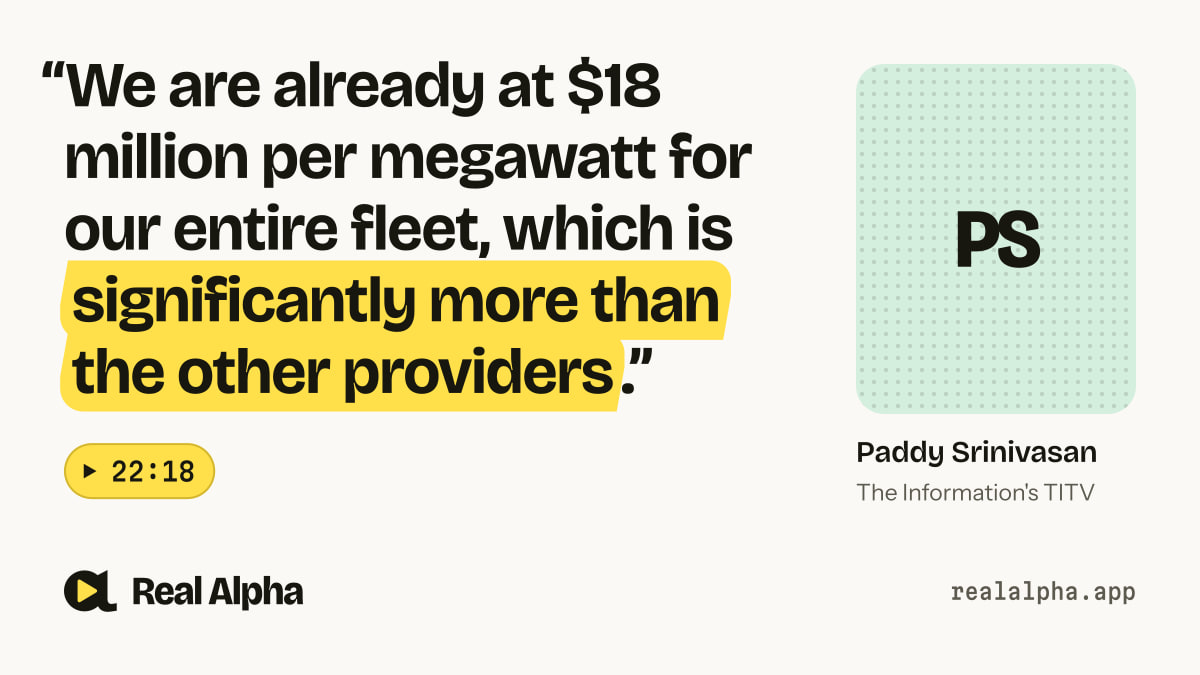
“We are already at $18 million per megawatt for our entire fleet, which is significantly more than the other providers.”
Takeaways Pro pick
- DigitalOcean guided to more than 60% growth next year.
- It sells data, compute, agent sandbox and token services.
- Its announced 2027 capacity is mostly on existing campuses.
One of Pro's picks, open to you here. Try Pro free for 7 days
One of Pro's picks. The rest of the summary and the 3 takeaways are in Real Alpha Pro; the video, the quote and the transcript stay free.
Read it with Pro, 7 days freeAbout this segment
Paddy Srinivasan says DigitalOcean’s growth comes from software services as well as GPU capacity, generating more revenue per megawatt. That model could help it stand apart as compute supply and prices change.

Akash Pasricha, Host · Host, TITV
Led The Information's Pro subscription and co-wrote its flagship newsletter, The Briefing.
From “Microsoft’s $5 Billion Data Center Delay, DigitalOcean CEO on AI Infrastructure Boom”, Nov 5, 2026. Watch the full episode
Answers “How do AI companies make money?” See all 122 answers
Thanks. We'll look at and fix what's off.
Transcript
Transcribed by machine (Whisper) from the episode’s audio, so a word may be off here and there.
- 20:36
So I want to drill into that 60% forecast you guys gave because it's almost double the growth rate that you guided to for this current fiscal year. And, you know, look, these types of growth rates for these cloud firms that are coming up, we've seen these extraordinary growth rates. but you also have a software business as well. And so as you look at... that 60% growth rate, how much of it is coming from the cloud side of the business and how much of it is coming from the software growth? Yeah, it is a really interesting question.
- 21:10
It is becoming increasingly hard to distinguish between just AI and cloud. And let me explain what I mean by that. For a very new NeoCloud, there's only one vector of growth, which is you add more GPU capacity and you rent that GPU capacity with a markup. So that is one business model in today's AI world. And the market is starting to question that business model because the cost of borrowing to put this gear on the ground is growing by the week, with interest rates being at the levels that they are in. And number two is there's a huge pushback on data center projects, at least in this country, right? We are very different in the sense that we have two sides of the equation. We have P times Q is our total yield on the megawatts we energize. Q, of course, is real capacity, but P is the price and the yield we can get on the capacity we are
- 22:09
bringing online. Since we are a software-enabled infrastructure platform, we have multiple ways of monetizing the hardware that we buy and energize. So we have a rich software platform. We are already at $18 million per megawatt for our entire fleet, which is significantly more than the other providers. And I'm talking about the entire fleet, not just one customer or one data center. So that's a very, very important distinction for us because we monetize software and not just raw hardware. And help me understand. So $18 billion per megawatt. So when you say yield per megawatt, at the end of the day, that's what you're taking home is higher than what the other NeoClouds might be offering? Or is it higher pricing? Just break down that metric for us? Yeah, it is not higher pricing. We make $18 million per megawatt on a blended basis
- 23:09
for all of our hardware. And the reason for that, the reason why we command a premium is not because our prices are high, our prices are very competitive, but we have multiple ways of monetizing it, Akash. So we, of course, we can sell GPUs, but we don't do that very often. We sell services, software services on top of that so that we can monetize our hardware in different ways. Like we sell data services, we sell compute agent sandbox services on top of our infrastructure. We sell tokens on top of our GPU infrastructure. So all these are software enabled infrastructure plays where we can get a premium on top of others who are just renting their hardware. And so maybe this sort of relates to that, but then what gives you confidence once once the compute prices start to stabilize in this supply and demand environment,
- 24:07
what gives you confidence that you will still be able to command the same demand once these dynamics equalize? Yeah, so I'm very confident because what we are monetizing is software and not just hardware. So the need for more sophisticated software is increasing by the day because most companies are moving into productionizing agentic systems. And agents need memory. Agents need data services. Agents need complex orchestration.
- 24:36
Agents need secure operating environments called sandboxes. So there is a significant amount of software value addition that we provide, which is not easily copyable. So as the supply demand imbalance kind of reaches an equilibrium over the next 18, 24 months, we'll see if it reaches there in the next couple of years. With many data center projects getting into scrutiny, I think we will probably be in this supply-demand imbalance for longer than we want to.
- 25:11
But regardless, we feel confident because we are a software company and we are monetizing a software platform, not just reselling hardware.