Free with a sign-in.
The best 17 min of 32
Microsoft’s $5 Billion Data Center Delay, DigitalOcean CEO on AI Infrastructure Boom
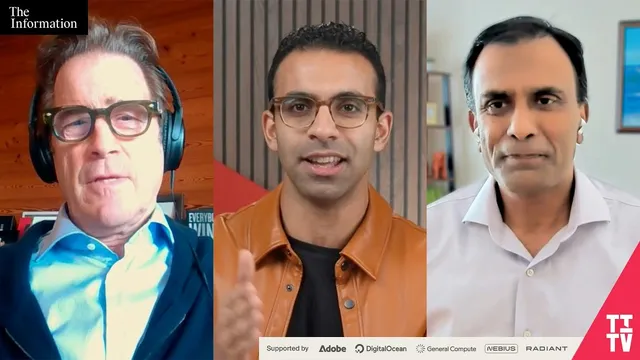
Aaron Holmes, Yueqi Yang and Paddy Srinivasan trace AI growth through data-center delays, agent-banking risks and software-led cloud economics.
 The Information's TITV · Akash Pasricha
The best minutes
- 2:01Power and permitting delays give hyperscalers an edge6 min
- 9:11Smaller banks limit what AI agents can access6 min
- 20:33DigitalOcean monetizes software on top of its infrastructurePro pick 5 min
Also worth watching
- 26:29AI demand may expand from office agents to physical devices4 min
- 15:03Brokerages are applying limited trading controls to AI agents3 min
Skip the sponsored DigitalOcean opening on the stock reaction and customer mix, plus the brief show intro and outro.
Full analysis · 6 min read
Real Alpha · Nov 21
Aaron Holmes says Microsoft deferred about $5 billion in capex
- Microsoft deferred about $5 billion in planned quarterly spending, much of it apparently tied to IREN's delayed Texas campus.
- Holmes said IREN was at least one delayed supplier, while power and permitting problems also affect other builds.
- That makes delivered, energized capacity more useful than announced GPU supply, but DigitalOcean's yield metric needs more detail.
Free with an account
Read the rest of the analysis
6 sections, the 7 other voices it tests Holmes against, and what it means for you. Every episode we cut gets one.
Check your inbox
We sent a link to your address. Click it to finish signing up. Not there in a minute? Look in spam.
or
Signed up before? The same buttons sign you in. The episode, its moments and the transcript stay free.
Microsoft's capex miss tracks capacity timing, not demand
The host opened with Microsoft's about $5 billion cut to planned quarterly capex after a third party delayed GPU access. Holmes identified IREN as at least one supplier, and said he thought it accounted for most of the amount. That distinction matters because he did not know IREN's exact share.
Holmes described an IREN deal worth about $10 billion over around five years. Microsoft generally starts paying only when capacity is online and it has become a tenant, he said. That leaves the quarter's miss as a timing signal, not proof Microsoft abandoned the capacity need.
Holmes said Microsoft had more GPU rental demand than it could meet. It also wanted GPUs for Copilot and model training. So the deferred spend sits beside reported scarcity, rather than demonstrating weaker demand.
Our read
The clearest evidence is a capex timing miss tied to capacity not yet delivered. It does not establish that Microsoft cut long-run demand, or that IREN caused all $5 billion.
Power delays increase neoclouds' financing exposure
Holmes said he did not know IREN's precise delay cause. Across the sector, he pointed to construction and power connection problems. Nscale's UK project shows the timetable risk. Microsoft withdrew after Nscale learned power might not connect until at least 2030.
Power connection is therefore part of usable capacity, not a detail after a site is built. Holmes said more permitting difficulty after the midterms may advantage hyperscalers with existing sites and power access.
Microsoft can draw on software cash flow, while smaller providers have borrowed to build capacity they plan to lease. Delayed revenue therefore lands against financing costs. For example, Apoorv Agrawal on Sourcery in November estimated a possible 10 to 15 gigawatt U.S. shortfall. That was against next year's forecast.
Heath Terry on Bloomberg Surveillance in November said compute costs were up 40% year over year. Tae Kim on TBPN in November said, on the margin, he thought neocloud financing had become more difficult. These comparisons fit a constrained supply and funding picture, but don't show a particular provider will fail.
 Apoorv Agrawal · Sourcery · Nov 20Compute shortages favor hyperscalers and threaten smaller clouds
- HTHeath Terry · Bloomberg Surveillance · Nov 20AI returns are strong, but infrastructure supply is the constraint
- TKTae Kim · TBPN · Nov 13Neo-cloud financing faces more pressure than hyperscalers
Our read
Together, these moments support a structural advantage for operators with power access and funding headroom. They do not quantify the effect on Microsoft's margins or establish that any single project will fail.
DigitalOcean sells services alongside GPU capacity
Akash introduced this as a partner segment. Srinivasan was making the company's case, not giving an independent audit. He cited 680,000 paying customers, with no customer larger than high single digits in concentration. That reduces reliance on one large buyer, but says little about project delivery.
He framed DigitalOcean as a cloud platform with GPUs, databases, storage and data services. He said its blended fleet produced $18 million per megawatt, not the $18 billion the host first repeated. He said the figure covered the entire fleet and attributed yield to software services, tokens, data services and agent sandboxes.
He did not name peers or explain the measurement period in this exchange. That makes it an interesting management metric, but not a directly comparable unit-economics measure. He gave 60% plus growth guidance for next year at a billion plus scale. He also said DigitalOcean was operating-income profitable and cash-flow positive.
Mike Volpi on a16z Podcast in November said tightly coupled GPU clusters favor firms designing the whole system together. That is a hardware-design point, not evidence for DigitalOcean's software yield.

Our read
The software-platform thesis is plausible, but the $18 million figure is not self-explanatory. Without a measurement period, denominator details or named peer comparison, readers cannot treat it as a direct benchmark.
Existing campuses reduce, but do not remove, delivery risk
To answer the same bottleneck, Srinivasan said DigitalOcean selects established data-center partners and mostly uses already built campuses. He said most announced capacity coming online in 2027 would be on campuses already energized and permitted.
For example, he described adding a data hall or adjacent building rather than breaking ground on a gigawatt-scale site. That reduces exposure to greenfield permitting, but not construction, equipment or partner execution risk.
Jim Zelter on Bloomberg Surveillance in November said annual additions might land at 20 to 25 gigawatts. Earlier projections were 50 gigawatts a year, he said. That comparison places DigitalOcean's approach within a slower buildout, not outside it.
Srinivasan gave no project-by-project schedule or partner-specific power commitments in this conversation. Existing energized sites are an execution hedge, not a delivery guarantee.
Our read
Choosing energized sites addresses a bottleneck that delayed Microsoft and other providers. It shifts the question from greenfield permitting to execution and partner delivery, risks the interview does not quantify.
Banks cap agents' access without resolving trust
Yueqi Yang reported a split between large banks blocking third-party agents and smaller providers offering bounded access. Jamie Dimon at JPMorgan said it would block them. Wells Fargo and Bank of America changed terms saying customers who share logins are responsible for agent actions.
Smaller banks work with fintech providers on prepaid cards, transaction limits and isolated accounts. For example, Lead Bank works with Stripe on single-use virtual cards with spending limits. Column works with Natural on wallets held as sub-ledgered accounts under users' names.
These controls limit the money an agent can reach, without proving the agent will behave reliably. Some banks and fintechs argue that blocking may fail when agents can access email or texts and retrieve verification codes. They say scoped access can provide an auditable, separate account instead.
Krish Subramanian on MTS in November said adapting human authorization practices to agents was flawed to some degree. He argued agent authorization must move beyond shared API keys, while cautious limits remain reasonable for now. Yang said regulators had offered little guidance on bank access for agents.

Our read
Capped cards and isolated accounts contain exposure, but leave identity, liability and regulatory questions open. A spending limit is a control, not a reason to assume an agent can be trusted.
Task routing may temper model intensity, not agent demand
Srinivasan said knowledge-worker workflows are increasingly becoming agentic. He pointed to marketing and sales agents, and said legal and ad-production use cases were already starting to appear. He also described physical intelligence, including surveillance devices, humanoids and drones, as an emerging next wave. He offered no usage figures for either category.
At the same time, he said not every task needs the latest frontier model. His example was a bot searching for an iPhone Duo. He asked whether it needed Fable 5.1 or could use an open-weight model.
Hayden Field on Decoder in November said businesses were building internal benchmarks to route tasks to the cheapest model that works. That supports a model-mix question for budgets, not a claim that total compute demand falls.
Srinivasan said cybersecurity may require frontier models. When asked about the host's proposed 50% share of token use, he said he did not know the exact number. Any expectation that software services offset cheaper GPU tasks is our inference, not a quantified result in this interview.

Our read
The episode supports a split model of AI demand, not an assumption that every workflow consumes frontier compute. Workload counts, model mix and paid software services need separate tracking.
What it means for you
- Map power milestones. For each AI capacity plan, record site energization, interconnection dates, construction milestones and who bears delay risk. The IREN and Nscale examples show that a lease commitment is not usable capacity.
- Separate capex from demand. Track spending against when capacity becomes online and billable, not only when contracts are announced. Microsoft's roughly $5 billion delay followed a supplier's missed access date.
- Verify per-megawatt yield. Ask management for the metric's time period, capacity denominator, service mix and comparable peers. DigitalOcean's $18 million figure lacks those details in this conversation.
- Scope agent access. Set per-agent funds, payment limits, audit trails and a named liability owner before connecting financial accounts. The described bank controls do not resolve regulators' unclear guidance.
What to watch
- Whether IREN's Texas campus reaches usable capacity and when Microsoft resumes the deferred spending. Holmes gave no revised completion date.
- Whether DigitalOcean's announced 2027 capacity reaches its target on existing energized and permitted campuses.
- Whether regulators provide guidance for banks allowing third-party agents to access accounts. Yang said guidance remained unclear.
Send this to the infrastructure lead and finance chief weighing AI capacity commitments.
Watch the minute where Holmes explains Microsoft's roughly $5 billion capex delay
Written by Real Alpha from the episode's transcript and the other moments it links, then checked against the transcript. Quotes are the speaker's exact words.
Minute by minute
A Pro write-up, open to you here. Try Pro free for 7 days
A Pro write-up. The minute by minute is in Real Alpha Pro; the episode, its moments and the transcript stay free.
Read it with Pro, 7 days free- 2:01Microsoft's IREN capacity is delayed
Holmes says Microsoft disclosed about $5 billion in planned capex it had not spent in the September quarter after a third-party provider delayed access to GPUs. He identifies IREN's Texas data-center campus as at least one source of the delay and says IREN accounts for most of the spending in question.
- 2:51Power delays favor established clouds
Holmes says data centers are struggling to finish construction and connect to power. He cites an Nscale campus near London that Microsoft left after power access was projected to take until at least 2030, and says permitting, power access and smaller providers' debt burdens could give established hyperscalers an advantage.
- 8:33Banks limit third-party agents
Yang says major banks worry about agents misusing customers' money and who would be liable. She says JPMorgan Chase's Jamie Dimon said the bank would block third-party agents, while Wells Fargo and Bank of America updated terms to make customers responsible for agents' actions.
- 11:31Smaller banks cap agent access
Yang says smaller banks work with fintech providers to give agents access through limited-use tools. Lead Bank works with Stripe on single-use virtual cards with spending limits; Column works with Natural on agent wallets held as sub-ledgered accounts, which Yang says are FDIC-insured bank accounts.
- 14:04Scoped access may beat blocking
Yang says some banks and fintechs argue that agents may reach email or text messages and obtain bank verification codes, making a full block difficult. They favor isolated accounts and auditable access; brokerages are also allowing agents to trade within limited accounts. Yang says regulators have yet to provide much guidance.
- 18:36DigitalOcean says it differs from neoclouds
Srinivasan says DigitalOcean is an established cloud platform, not a GPU-only neocloud. He cites 680,000 paying customers, no customer representing more than high single digits of revenue, and guidance for 60% plus growth next year at more than $1 billion, while profitable and cash-flow positive.
- 21:06Software adds value to each megawatt
Srinivasan says DigitalOcean monetizes more than raw GPU capacity, including databases, data services, storage, agent sandboxes and tokens. He puts revenue across its entire fleet at $18 million per megawatt and says the figure reflects multiple software services, not higher prices.
- 24:03Agent software drives cloud demand
Srinivasan says production agent systems need memory, data services, orchestration and secure sandboxes, which he argues are harder to copy than hardware rental. He expects data-center scrutiny to prolong the supply-demand imbalance, but says DigitalOcean's software platform gives it confidence beyond that imbalance.
- 25:16DigitalOcean favors existing campuses
Srinivasan says the company chooses experienced data-center partners and mostly adds capacity at campuses that are already built, powered and permitted. He says much of the capacity announced for 2027 will be in existing campuses, rather than new projects that require breaking ground and local approvals.
- 26:29AI use cases will spread beyond coding
Srinivasan expects agents to expand into knowledge-work tasks such as marketing, sales, legal work and media production, as well as physical devices like drones and humanoids. He says tasks will be routed to suitable models, with frontier models reserved for demanding work such as cybersecurity; he did not confirm a specific share of token use for cybersecurity.
Published Nov 5, 2026.
Transcript · 21 min read
The Information's TITV, hosted by Akash Pasricha, with Aaron Holmes, Yueqi Yang and Paddy Srinivasan.
Transcribed by machine (Whisper) from the episode’s audio, so a word may be off here and there.
welcome everyone to the information's ti tv my name is akash pastricha it is thursday november 5th today on the show we'll have an update for you on microsoft's capex spending and how that is looking on the ground we'll then unpack how smaller banks are embracing ai agents and we're going to close out the show with our partner digital ocean we'll discuss the company's neocloud ambitions in the difficult data center regulatory environment and its recent quarterly results it's going to be a great show so let's get right on into it microsoft delayed about five billion dollars in planned capital spending because data center capacity it expected to rent from cloud provider Iron wasn't ready on time. For more on this, I want to bring on Microsoft reporter Aaron Holmes. Aaron, welcome to the show. It's great to have you back. Happy to be here. Okay, so what's
“the general consensus so far is that that is potentially going to give the big hyperscalers”
Great. Well, Aaron, I want to thank you for coming on. That is Aaron Holmes, our Microsoft reporter here at The Information. Big banks may not be thrilled about allowing AI agents just yet, given the risks that are involved with them, but my colleague Yueqi Yang has new reporting that smaller banks are embracing these tools. I want to bring on Yueqi to share more of her reporting. Welcome to the show, Yueqi. It's great to have you back. Hey, Akash. Thanks for having me. So I want to start with the risks here. um when you've been talking to uh your banking sources about these agents I mean, on one hand, there's using agents in your own course of work, you know, as an employee at a bank.
Read the whole transcript
On the other hand, there's customers using agents for some of their banking products.
“rather than just trying to block it, which you might actually fail, you should provide a controlled, scoped access for agents.”
“the stock brokerages and crypto exchanges too are early movers because historically, there's always been pragmatic trading of stocks and crypto.”
That is Yueqi Yang, our crypto reporter here at The Information. Our next segment is with our partner, DigitalOcean. The Democrats' midterm victories are putting fresh attention on the future of data center development. DigitalOcean is a neocloud with several data center projects planned for next year. The company also reported quarterly results this week. Here to discuss it all is Patti Srinivasan, CEO of DigitalOcean. Patti, welcome back to the show. It's great to have you here.
Thank you, Akash. Wonderful to be here. so patty i want to start with the big picture here i mean look uh neocloud stocks uh they've gotten hit pretty hard over the last couple weeks you first had the debt concerns you had the election um you reported earnings and the earnings were admittedly they were quite strong but if you look at the the stock price for the company in the last week it's down about 17 so look i'm sure you're meeting with tons of investors right now what is the message that you are sharing with them right now on the ground yeah it is uh it is interesting uh we had our best quarter in over 10 years and it's interesting to be uh bucketized in this concept of neo clouds we are not neo but we are a real cloud um and we've been doing this for a while we've been public for five years and the differentiation on um on our platform is that we are very different from a customer segmentation or target customer perspective, we don't have the usual concentration of NeoClouds. We have 680,000 paying customers, and no customer is bigger than high single digits in terms of concentration for us. So that's very different. Number two is we don't just sell GPUs.
We sell a whole cloud platform. We sell a platform for agents to execute. We, of course, have a very robust leading token factory and we have a core cloud platform with databases and data services and storage and the whole breadth of a rich cloud platform. And the third thing is we're doing this in the public market. We just guided to 60% plus growth for next year at our scale at a billion plus while being profitable, operating income profitable and cashflow positive. So we're doing it in a very, very different way. And as I said on the earnings call, we are different by design. Right.
“We are already at $18 million per megawatt for our entire fleet, which is significantly more than the other providers.”
Will that scrutiny that comes maybe in an increased form because of the election results, will that scrutiny affect your data center ambitions at all? You talked about the facilities that are coming online for your own business on the earnings call. Yeah, exactly. So we are very, very careful, Akash, in terms of the data center partners that we work with.
We try to work with tier one data center providers that have been doing this for dozens of years. And we are very careful in selecting campuses for the most part that are already built. So most of the data center capacity that we have announced coming online in 2027 are already in campuses that are already energized and permitted and tariff. So we are adding a data hall or we are adding an adjacent building in an existing data center campus. We are not in this, oh, let's bring on a gigawatt of new facility where we have to break ground and work with the local county and things like that. So we typically work with data center providers who are really top-notch and who have been doing this development for a number of years and we try to stay away from the hot spots of extreme data center scrutiny in the country today.
Right.
“And then the second big bucket that I'm starting to see emerge is the physical intelligence and agents that will enable physical devices”
That does it for today's show. A reminder, we are on this stream Monday through Friday at 10 a.m. Pacific, 1 p.m. Eastern. If you can't make it then, episodes are available on theinformation.com, on our YouTube channel, or wherever you get your podcasts. Make sure to follow us on social media, on X, on Instagram, on TikTok, and on LinkedIn. I am already excited for our next show tomorrow. Have a great rest of your Thursday. Bye-bye for now. You