The alpha, twice a week
That was 6 min.
Get the best new moments in your inbox every Wednesday and Saturday. It's free.
Check your inbox
We sent a link to your address. Click it to finish signing up. Not there in a minute? Look in spam.
or
TBPN · 6 min · Oct 2, 2026
Dorm Room Fund fills the friends-and-family funding gap
 Molly Fowler
 explains how Dorm Room Fund backs founders with small early checks and helps them raise institutional rounds.
In this episode
Full analysis- 1:28:47A single government site could replace thousands of clunky onesPro pick 5 min
- 2:06:13Larry Ellison is comfortable making high-stakes bets4 min
- 2:27:38Greg Castle keeps his venture funds deliberately small3 min
- 1:46:12Dorm Room Fund fills the friends-and-family funding gap6 min
- 1:57:18Ellison accumulated a 40% stake in Oracle4 min
- 2:11:48Game-video data can help train robots before physical deployment3 min
- 2:34:58Anorak is looking at chemicals, steel and supply-chain inputs3 min
- 36:05Self-driving could make Tesla’s car business surprise to the upside7 min
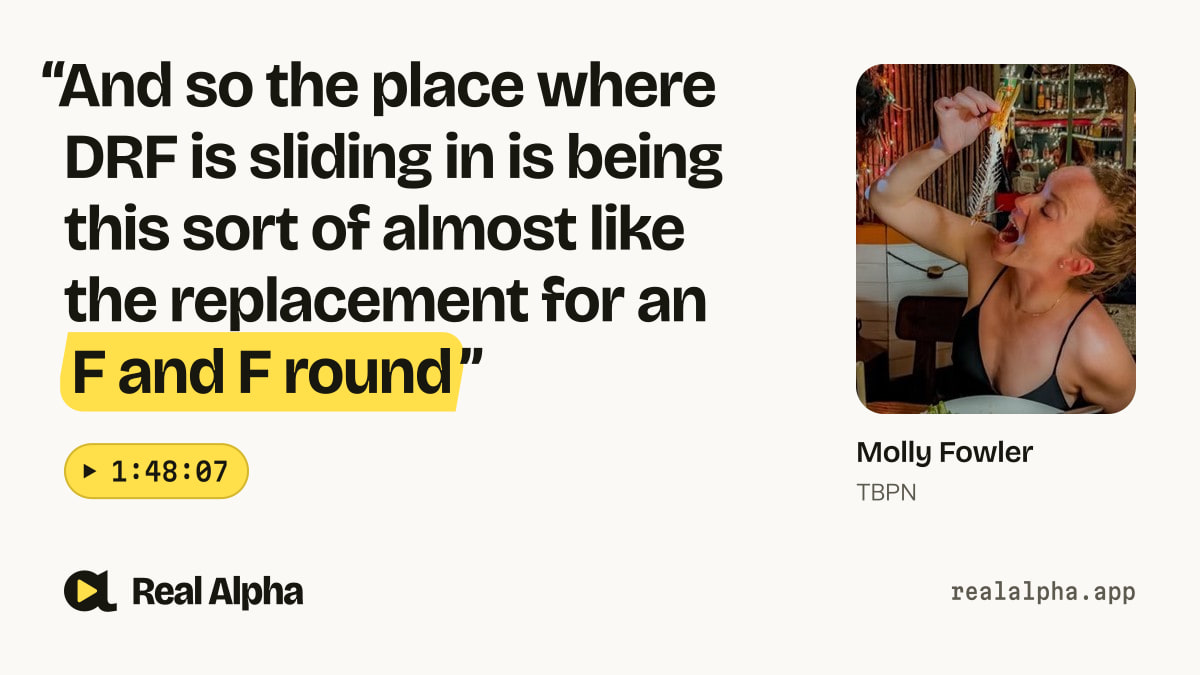
“And so the place where DRF is sliding in is being this sort of almost like the replacement for an F and F round”
 Molly Fowlerat 1:48:07 · TBPN
Takeaways
- Typical first checks are below $1 million.
- The fund expects to back 75–80 companies over three years.
- Alumni remain eligible for checks after they leave school.
About this segment
Molly Fowler explains how Dorm Room Fund backs founders with small early checks and helps them raise institutional rounds. Its new $50 million fund plans to invest in about 75–80 companies.

Partner, Dorm Room Fund
Built Dorm Room Fund into an independent venture firm backing student founders and developing generations of young investors.

John Coogan, Host · Co-host, TBPN
Co-founded Soylent and Lucy; OpenAI bought his show TBPN in April 2026.

Jordi Hays, Host · Co-host, TBPN
Founded Branded Native; co-founded fintech Capital, which Rho bought.
From “BYOCompute, Pope Destroys False Idol, Ben Affleck's White Pill”, Oct 2, 2026. Watch the full episode
Thanks. We'll look at and fix what's off.
Transcript
From the transcript TBPN publishes with the episode.
- 1:46:18
What are you what are... I mean, do you have any data on like entry prices? Because it feels like you you might be the the the... Well, you're kind of like final early stage fund that can actually reliably get in like sub Yep. 10,000,000 potentially because you're not like even even, you know, there's gotta be founders today on college campuses that are compelling enough that they could go raise, you know, a full seed round if they're No.
- 1:46:43
If you're if you're in college and you do 50 k on 500 k, you can build a business for like a full year. Like Yeah. That's a Yeah. That that's a lot of money in in Yeah. The college world.
- 1:46:55
Yeah. And so you guys, I'm sure, like actively avoid not being predatory. Yeah. And and that's on the the... That's the job of the individual investors. But if somebody's gonna give good pricing to somebody, would be one of their peers that then opens up this network that you guys have.
- 1:47:12
Yeah. I mean I think... So I think a couple things are happening. One is that, you know, every time there's one of these big technology changes like we're seeing obviously today in the last couple of years, it really has the effect of leveling the playing field for first time builders. Right? So... And the other thing that it does is that it drops the price of how much it costs to really start a software business. And so, you know, we're in this really interesting era where, you know, Jordi you're right. There's a ton more capital on campus than used to be. You know, when we started doing this back in the old days, everybody thought we were insane.
- 1:47:45
Now everybody's like, oh shit. I have to, you know, get my own campus program going. And so great founders can raise really quickly. I think what is what is different about today's market and I think puts dorm room fund in a really strong position is that founders are increasingly dilution sensitive. Right? And so there are a lot of these legacy solutions that look like seven, ten, 12% dilution with the first big check. And I think founders are quickly realizing that, you know, to John's point, you can build really fast, cheap. And so the place where DRF is sliding in is being this sort of almost like the replacement for an F and F round, like a friends and family, and recognizing that like not everybody has a bunch of like rich aunties and uncles who can back them up. Right? And so, dorm room fun can be that first infusion of capital to get them just to the point where they get that magic moment of like sparkles of product market fit.
- 1:48:38
And then, we can help them go out with our giant community and help them raise an even more kick ass institutional round.
- 1:48:45
Yeah. Mhmm. Yeah. I remember back when I was in college, like the concept of a a friends and family round was so absurd to me because I was like Yeah. Friends and family that are gonna like Yeah. Individually invest like Thousands of money. As a car. Yeah. Oh, yeah. No. Like a new... Instead of buying a new car, why don't you invest... A wild at my idea. Yeah. No way. Yeah. And I I think that's... Yeah.
- 1:49:10
That's such such an unlock too. It's it's also... Yeah. There's there's a lot of reasons that that it it can make more sense to do that. As much as you wanna give the people in your world access to to to what you're working on, sometimes it's better to just work with something more institutional.
- 1:49:27
Yeah. Well, and I think there's also plenty of space for... I mean, there's there's been a lot of examples where dorm room funds been the first institutional check for a founder. Right? And we might catalyze around where they bring in a few friends and family alongside us. Right? So I don't think it's an either or, but I think what it is is recognizing that like, you don't necessarily have to go to the traditional accelerator programs or something like that as you're just getting started and that there's a more capital efficient way to do it, I think, the early days.
- 1:49:56
What is... Last question for now. What does the 50,000,000 mean? How how do you how do you think about like allocating it across different different students, not, you know, on the on the investment team, but then also founders, things like that?
- 1:50:13
Yeah. Definitely. So we... Our check size is is, you know, usually sub million for the first time around. We're probably gonna end up investing in, I guess, probably like 75 or 80 companies over the next, you know, in the sort of three year period. And the way we think about spreading that around is one, the student opportunities that are sourced to us. Right? So we have regional teams all across The US. They they cover all the top entrepreneurial ecosystems. And so each each of those four teams will be deploying capital over the next two years.
- 1:50:47
We've already been in... We've already been deploying out of fund two since about July of last year. We also then have the bucket of dorm room fund alumni. Right? So if you've been part of the DRF crew, like like Ben Horowitz and like some others, no matter when you build, you're eligible for a dorm room fund check. And Mhmm. And those have been superstar hitters for us. So that's how we got into... Know, you we're lucky enough to get into cursor. We got into dandy really early because Tony and...
- 1:51:16
Thank you. Tony and and Mike were both on the team when they were in undergrad. And so, you know, that's a really big win for us. And then, you know, we're lucky to have been able to get some really fantastic institutional partners with us in terms of LPs. And so now, we're in a really great position to not just help our founders with that first amount of capital, but actually be along for the ride a little bit longer.
- 1:51:39
Awesome. Amazing. Thank you so much. Such a great product and platform and great to finally meet.