The alpha, twice a week
That was 5 min.
Get the best new moments in your inbox every Wednesday and Saturday. It's free.
Check your inbox
We sent a link to your address. Click it to finish signing up. Not there in a minute? Look in spam.
or
The Information's TITV · 5 min · Nov 6, 2026
Dropbox is extending its content infrastructure to AI developers
Ashraf Alkarmi says Tigris brings developer customers and agent-focused storage, while Dropbox plans APIs for permissions and file processing.
In this episode
Full analysis- 2:29Data center delays could put Nvidia sales at riskPro pick 5 min
- 35:36Codex features can be temporary scaffolding for model limitsPro pick 4 min
- 52:14Models still struggle to keep context out of their output3 min
- 9:15Kedrosky puts 2028 data-center capex exposure at 12 to 16 percent3 min
- 17:22Lyft is scaling Waymo through a Nashville depot and rider demand2 min
- 20:47Dropbox is extending its content infrastructure to AI developers5 min
- 26:24Dropbox is testing paid AI packs after a free rollout3 min
- 1:00:10EveryAgent passes token costs through without a markup2 min
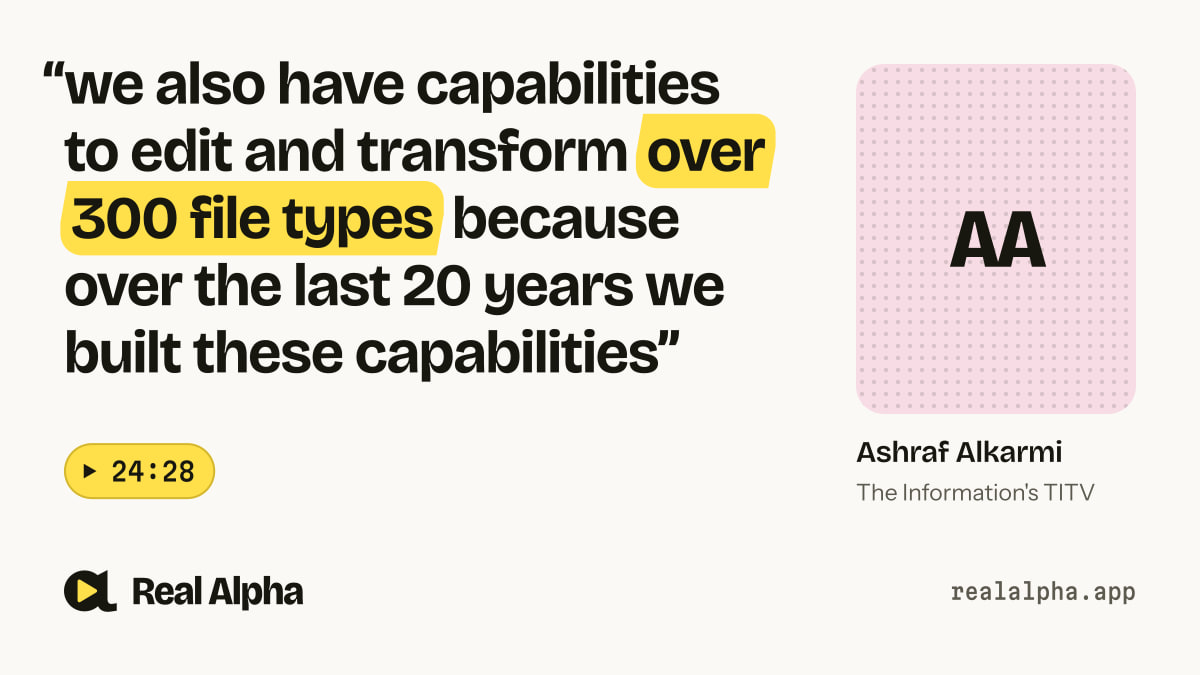
“we also have capabilities to edit and transform over 300 file types because over the last 20 years we built these capabilities”
Takeaways
- Tigris already serves thousands of AI and developer customers.
- Forking and snapshotting target agent workflows near GPUs.
- Dropbox plans APIs for governance and 300-plus file types.
About this segment
Ashraf Alkarmi says Tigris brings developer customers and agent-focused storage, while Dropbox plans APIs for permissions and file processing. That turns Dropbox infrastructure into a developer-facing product.
Co-CEO, Dropbox
Extended Dropbox's storage to AI developers and brought AI tools into customers' files and workflows.

Akash Pasricha, Host · Host, TITV
Led The Information's Pro subscription and co-wrote its flagship newsletter, The Briefing.
From “Nvidia's Data Center Threat, AI Stock Rebound, OpenAI's Codex Strategy”, Nov 6, 2026. Watch the full episode
Thanks. We'll look at and fix what's off.
Transcript
Transcribed by machine (Whisper) from the episode’s audio, so a word may be off here and there.
- 20:50
and you know i was looking at the uh descriptions uh of the company it's it's more of a developer storage company and you obviously are more consumer storage. The first thing that came to mind is you couldn't have just built this in-house? Why did you have to buy it? So let's start with a little bit of context. So Dropbox is almost celebrating our 20-year anniversary in a couple of months, and that's a huge milestone.
- 21:15
For the last 20 years, we've built a lot of incredible infrastructure, and that happened to be an amazing product for people. So basically, you have the ability to have a trusted content foundation. You're able to not just store things, but securely share them, apply permissions. And what we found as we started rolling out our own AI capabilities, that we have a structural advantage. People don't want to just use AI. They want to use AI where their content is. They want to be able to use AI in a trusted, safe way. You want to be able to apply permissions and sharing. You don't typically work in a siloed environment. You work with people.
- 21:55
And so what we've solved for people over the last two decades, we realized there's an opportunity to solve it for agents as well. And as we started thinking more about it, we realized that what we've built over the last 20 years has an insane potential to enable other developers and AI companies to build on top of. And so as we started looking at this, we found Tigris to be an incredible match for us.
- 22:20
And I'll explain why. Number one, they have actual thousands of customers who are developers, both AI builders and large known AI companies like Foul AI, for example. And so not only do they have traction, they have a lot of experience building for AI developers. And this is a company that built their product from day one for agentic use cases. So they have capabilities like forking and snapshotting.
- 22:48
I'll give you what it translates to in simple terms. If you build agentic or AI workflows, you're going to get better speed, better latency, and you're going to be able to do things much faster and closer to your GPUs. So essentially, they've built their product from the ground up in a way that is really compelling. And what we could do with them, the match here, is we can help with taking this to more customers.
- 23:16
and we can also help bring the exabyte scale efficient infrastructure we built in our own data centers to that company. So the match was really great and it accelerates significantly the opportunity. So are you talking to like the replets and the lovables of the world about trying to make Tigris or I guess, you know, whatever you call it, DGX, is it DGX, Dropbox Cloud? Is that what you're calling it?
- 23:44
Yeah, so we're- Are you talking about them making it the de facto developer storage tool? I mean, is that the distribution strategy here? Yeah, the strategy is twofold. One is to enable a developer motion that people can come in, pick up an object storage API designed for agentic use cases. We're starting with object storage, but we're not stopping there. The things we built over the last 20 years will also be added as APIs.
- 24:10
So I'm going to give you examples. when you store content you need to apply typically if you're building a product capabilities on top so who has access to that content can you share it is it secure so there's a lot of governance on top of that content that we have today in Dropbox that we'll add a set of APIs we also have capabilities to edit and transform over 300 file types because over the last 20 years we built these capabilities so how to process the content so now it does not only can just drop in stuff it can actually govern it it can process it and so these are capabilities that we want to add so part one of the motion is to enable developers in a self-serve fashion to come in and pick up these apis and use them And part two is going after companies that are building at-scale AI solutions and need to store things.
- 25:05
You and I both know that more agents means more content. And so we have a lot of... So you are talking to all these AI coding companies about trying to make this the de facto tool, sounds like. Yeah, as an API, yes. And not just AI coding. We're talking about companies that, you know, you think of a Haygen, you think of Hicksfield. There's a lot of companies that store a lot of content and need to process it.
- 25:36
So there's a lot of different audience for this. Again, from self-serve AI developers all the way to companies that have established products. Yes. Right.