The alpha, twice a week
That was 3 min.
Get the best new moments in your inbox every Wednesday and Saturday. It's free.
Check your inbox
We sent a link to your address. Click it to finish signing up. Not there in a minute? Look in spam.
or
The Information's TITV · 3 min · Nov 6, 2026
Kedrosky puts 2028 data-center capex exposure at 12 to 16 percent
 Paul Kedrosky
 says external financing now covers 55% of data-center spending, squeezing hyperscaler cash flow.
In this episode
Full analysis- 2:29Data center delays could put Nvidia sales at riskPro pick 5 min
- 35:36Codex features can be temporary scaffolding for model limitsPro pick 4 min
- 52:14Models still struggle to keep context out of their output3 min
- 9:15Kedrosky puts 2028 data-center capex exposure at 12 to 16 percent3 min
- 17:22Lyft is scaling Waymo through a Nashville depot and rider demand2 min
- 20:47Dropbox is extending its content infrastructure to AI developers5 min
- 26:24Dropbox is testing paid AI packs after a free rollout3 min
- 1:00:10EveryAgent passes token costs through without a markup2 min
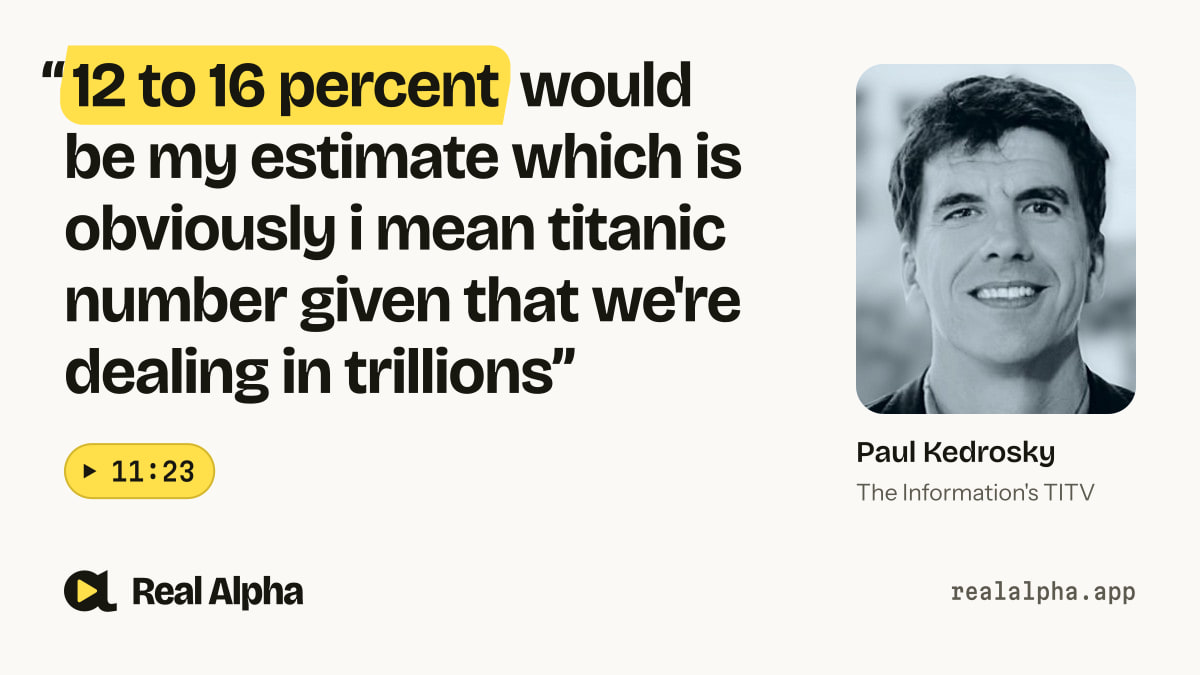
“12 to 16 percent would be my estimate which is obviously i mean titanic number given that we're dealing in trillions”
 Paul Kedroskyat 11:23 · The Information's TITV
Takeaways
- External financing now funds about 55% of data-center spending.
- Hyperscalers face more claims on cash flow as debt joins capex.
- Kedrosky estimates 12–16% of 2028 capex could be at risk.
About this segment
Paul Kedrosky says external financing now covers 55% of data-center spending, squeezing hyperscaler cash flow. He estimates 12–16% of capex could be exposed by 2028.

General partner, SK Ventures
Invests in science-driven startups and founded HSBC James Capel’s technology equity research practice.

Akash Pasricha, Host · Host, TITV
Led The Information's Pro subscription and co-wrote its flagship newsletter, The Briefing.
From “Nvidia's Data Center Threat, AI Stock Rebound, OpenAI's Codex Strategy”, Nov 6, 2026. Watch the full episode
Answers “What will AI look like in the next few years?” See all 395 answers
Thanks. We'll look at and fix what's off.
Transcript
Transcribed by machine (Whisper) from the episode’s audio, so a word may be off here and there.
- 9:19
So you also, you put out this other note talking about how S&P 500's earnings growth ex-MAG7 for the first time since 2022 outpaced the MAG7. This, of course, keeps in mind that NVIDIA hasn't yet reported. Why do you think that is? What's the story here? Well, it's the intense cyclicality of the build-out that in the early years was relatively straightforward forward to fund it all from cash flow. And so funding it from cash flow was tremendous because I didn't have this overhang of debt obligations, which in turn was eating incrementally to my cash flows alongside of this, what I was spending on data centers. So now I have an extra, I'm feeding an extra hungry animal and the extra hungry animal is the, is external financing of, which is now something like 50 plus percent, 55 percent of the funding of data centers. So that's
- 10:12
the problem. So increasingly we have a lot of mouths to feed with respect to cash flows that are flowing out of these large and heretofore very profitable hyperscalers and so that's beginning to cut into and we're seeing this with negative cash flows almost across the board in the hyperscalers and so it's really remarkable to see for the first time since the build-out really began not only do many of them have negative cash flows but for the first time the rest of the s&p is outperforming them in terms of earnings growth okay and um because you follow the data so closely i mean you you mentioned the estimates around NVIDIA uh sales how that could be affected have you seen anything around how capex growth could be affected we had somebody on the show uh earlier this week talking about i mean the next year's capex probably unaffected maybe the
- 10:58
year after something like maybe 10 15 percent at risk here uh yeah does that match what you're seeing or what are you expecting no it's on that order of things and i think you know bloomberg intelligence had a report out i think it was goldman had a report out yesterday and again all of this is belated because this was all kind of baked in the cake after the midterms but nevertheless at least they showed up to the party and began doing the numbers and so um yeah on the order of something probably nothing obviously this year but looking out next year into 2028 on the order of sort of 12 to 16 percent would be my estimate which is obviously i mean titanic number given that we're dealing in trillions okay and last question for you paul i mean if you just look at the the story that these big tech companies tell broadly i mean they have been able to get
- 11:41
away with this narrative that we will lose you know we'll burn cash or we'll invest for the long term this is the game we're playing and and you know we'll see the results uh three years out let's say i mean in a world where they cannot tell that story anymore uh because like you're saying the estimates might come down what do you think is like the new uh is this like a year of efficiency story that we start to hear again uh come through in the next year what do you think is the the broader narrative they start to all adopt on premises and everything gets pushed on premises because they're getting huge pressure from their customers to do ai on premises so you start seeing these hybridized cloud models and saying you know it doesn't have to happen just in our cloud it can happen on your premises so we got to talk about you know confidential data
- 12:26
and secure computing and blah blah blah all this geekery but the bottom line is it's a response to this pressure that they need to find corporations need to find efficiency gains and large language models will try and do it by saying hey we can do that hybrid or on premises and so that's going to be like the litany for the next 12 months. Great. Well, Paul, I want to thank you for