The alpha, twice a week
That was 8 min.
Get the best new moments in your inbox every Wednesday and Saturday. It's free.
Check your inbox
We sent a link to your address. Click it to finish signing up. Not there in a minute? Look in spam.
or
TBPN · 8 min · Oct 28, 2026
Drug trials, not discovery, are pharma's growing bottleneck
 Ben Liu
 says AI is making drug discovery cheaper, but proving a drug works in people remains costly.
The episode’s best minutes
Full analysis- 56:47Gurman traced iPhone Duo crack reports to a hinge defect4 min
- 1:42:14Drug trials, not discovery, are pharma's growing bottleneck8 min
- 1:36:08Sidewalk robots need city-specific navigation data2 min
- 5 more moments in the full episode
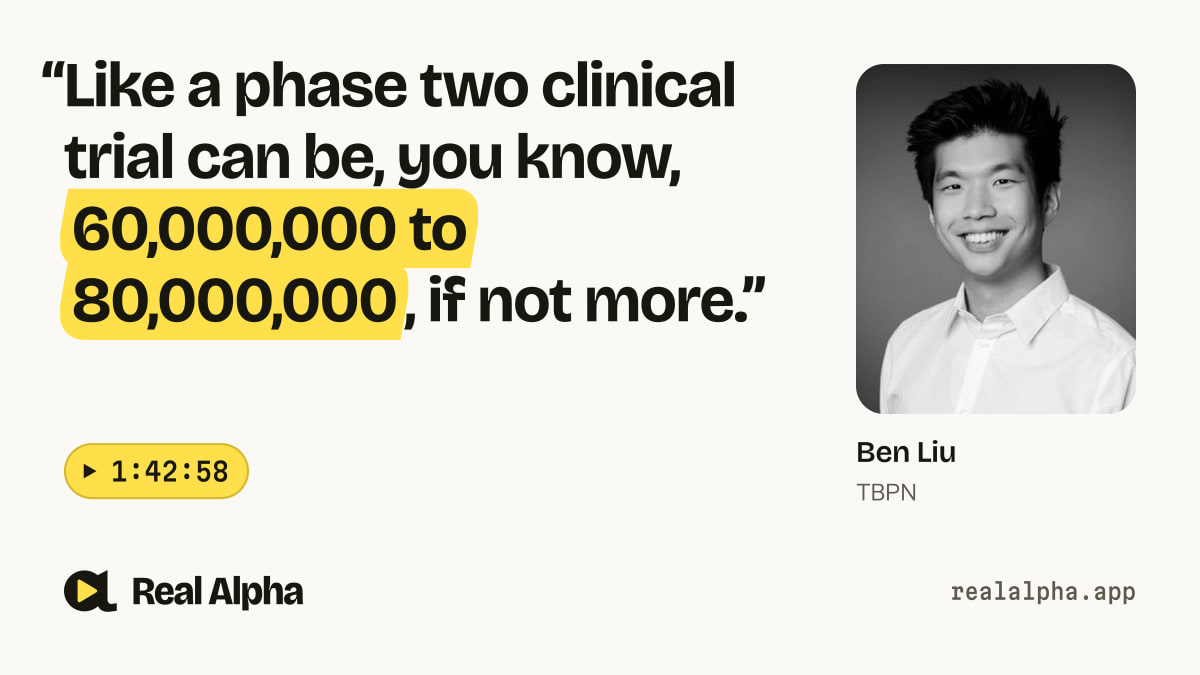
“Like a phase two clinical trial can be, you know, 60,000,000 to 80,000,000, if not more.”
 Ben Liuat 1:42:58 · TBPN
Takeaways
- A phase two trial can cost $60 million to $80 million or more.
- Formation Bio funds drug assets, not whole companies.
- More shots can improve the odds and reduce reliance on equity raises.
About this segment
Ben Liu says AI is making drug discovery cheaper, but proving a drug works in people remains costly. Formation Bio funds individual drug assets and shares development capabilities so more candidates can reach clinical proof.

Co-founder & CEO, Formation Bio
Built Formation Bio to use AI and pharma expertise to speed clinical development and bring treatments to patients.

John Coogan, Host · Co-host, TBPN
Co-founded Soylent and Lucy; OpenAI bought his show TBPN in April 2026.

Jordi Hays, Host · Co-host, TBPN
Founded Branded Native; co-founded fintech Capital, which Rho bought.
From “Pro and Tell, The Gurmanator Joins, New Google Models, Open Weight Demand, Joe's Monkeys”, Oct 28, 2026. Watch the full episode
Answers “Will AI cure diseases?” See all 11 answers
Thanks. We'll look at and fix what's off.
Transcript
From the transcript TBPN publishes with the episode.
- 1:42:18
Yeah. What were the pre... Like, talk about costs around drug discovery pre AI, and then where you think it'll go with new advancements and models Because continued it feels like a $600,000,000 fund, I imagine you're gonna distribute it across a bunch of entrepreneurs and teams that are focused on that discovery. But then each one of those individual drugs, if they're promising and they start going through trials, could still cost hundreds of millions of dollars to actually take Yeah. It
- 1:42:50
all That's actually the fundamental bottleneck. Right? So you had this like kind of drug abundance in discovery. But once you hit the clinic, you know, a clinical trial can cost a few $100,000,000. Like a phase two clinical trial can be, you know, 60,000,000 to 80,000,000, if not more. And so what's going to happen is if we don't develop more capabilities around the drug development period, we're not going be able to translate all these discoveries into new medicines. And as you alluded to, you're kind of looking at like all these great discovery companies and, and, you know, getting a drug from, you know, a discovered idea to 90 is now costing just a few million dollars. And that's probably going go down over time. Right? You know, with all this automation and, you know, the the the great work that, you know, folks like Anthropic and, you know, you got ISO CHI.
- 1:43:40
Like, is getting increasingly commoditized. But what is pretty rare is, like, the ability to prove that it works in a human. So and that capacity hasn't changed.
- 1:43:49
So historically, what was the origin of the capital for this particular phase? Obviously a lot of drug discovery candidate selection might happen in the in academia. And then Yeah. Once you're post phase two, phase three, you're probably working with a big biotech, maybe got acquired. But is this the sweet spot for companies that might go public, might be traded as sort of like risk on biotech public markets investors historically, and you're able to That's right.
- 1:44:20
Okay. That's right. So either you have to go public or you're raised from a traditional like TradBio VC. Right?
- 1:44:26
Like a flagship pioneering or something. Or, you know, an Atlas or, you know, a lot of kind of great funds kind of finance these drug, you know, Arch Capital. Yep. You know, think what separates our fund is we're not investing in companies, but individual drug assets. Okay. And so these are drugs that we put into Inuco. Yep. And we not only provide like the 60 or 80,000,000 needed, but all the capital, but also the capabilities. So think about like the ability to run trials cheaper and faster, best in class human drug pickers. So our R and D head was the R and D head at Biogen. Developed the first, you know, genetic medicine for ALS, the first, or a drug for SMA, the first disease modifying drug for Alzheimer's. And we have a guy who also discovered, had a neuroscience at Roche.
- 1:45:14
So folks really experienced in drug development, but also the AI systems allow you to, like, look at every single drug in the world, match the right drug to the right disease, design the right study, and then be more efficient in getting the drugs ultimately to a clinical balance option. Maybe kind of share a little bit more about how I got started. Know, I trained as a computational biologist, so I think like many, you're really excited about how all the genomic, proteomic, transcriptomic data mixed with machine learning AI can transform discovery. When I was a graduate student, we had the discovery of few candidate drugs in Alzheimer's and Parkinson's, and just bearing that you believe, we went to some pharma execs and said, hey. We discovered these drugs.
- 1:45:50
Aren't you guys excited? And they said, know, start to burst your bubble. And this is, like, ten years ago. There's already more good drugs discovered than we could afford to develop. When a single clinical trial in Alzheimer's across all the phases can cost like hundreds of millions of dollars, actually it's 500,000,000 per per shot, we just can't afford to prosecute everything we we discover. And now with AI, that's probably going to 10, if not a 100 X, right? Yeah. And so if we can't like ultimately solve this throughput, we're not going to get more medicines to patients. And so this fund is dedicated for, you know, let's say a biotech and discover five, 10 drugs. As soon as they have a lead asset, traditionally, all the capital needs to go to that lead asset.
- 1:46:27
That second, third, fourth month not getting love. And so we're saying, hey. We can provide the capital Yeah. But also all the capabilities to enable that company to take more shots. And if it wins, we kinda share upside. It could be upfront royalties, milestones, and even equity. And so it's kinda a win win for for for the industry. Yeah. But it's maybe the counterintuitive thing. I don't think people appreciate that, like, you know, drug discovery has not been necessarily the bottleneck for a pretty long time. Yeah. And it's only going to get more and more acute as you have drug discovery abundance. And and ultimately, it's like how can you get them into clinical proof of concept?
- 1:47:05
And that's what the market values too, right? Because if you have an abundance of discovered drug assets, you really don't see value until you demonstrate human clinical proof of concept. And that's where, maybe the heuristic to think about this, like a discovered drug isn't worth much. Mhmm. Once it has clinical proof of concept, so in human trials in the disease post phase two, the heuristic is one x peak sales.
- 1:47:27
So you can sell drug for... You know, if it's a $5,000,000,000 a year drug for 5,000,000,000. Once it's over phase three, past phase three, it's two to three x peak sales. Makes sense. And so, know, and this is interesting. Like, we kinda ask the question, like, why hasn't there been a big pharma company really in our industry created since the nineteen eighties? Yeah. And one of the big challenges, if you're a venture... And that's kind of the Amgen's Vertex If kind of of the you're like venture backed company, it takes you like three to five years to get in the clinic, and then two to four years to run a phase one and phase two.
- 1:47:57
Phase two is only worth 30% of the time on average. And let's say you're fortunate enough after you spend 60,000,000 to run a phase two, and it works, and a pharma company offers you $5,000,000,000 to take the chips off the table. You could, you know, not sell, run a phase three. There's a 40% chance it goes to zero, a 60% chance the phase three works, and then you can sell for two to three x peak sales. Risk adjusted, the rational thing is to sell.
- 1:48:21
So we're structured as a company, as a hub and spoke, so we can sell in new co without selling the whole company. But if you can only take three shots and you hit a winner, you should probably sell. Right? Because if the expected value is 30%, you know, it's more likely your MOVE and IRR is gonna be diminished if you kind of run those two shots versus just sell off the first shot. So as a consequence, our industry usually has biotechs get acquired before they can become the next, you know, Roche or Novartis.
- 1:48:47
Same exact thing in consumer packaged goods, honestly. Oh, yeah. Like there there has been like a new Yeah. Yeah. Yeah. Yeah. Yeah.
- 1:48:53
There's no They new Campbell. Yeah. Yeah. Buy the protein company, they buy the supplement company, They buy the cereal company, but there's no one that's... And there's been super ambitious founders that have gone after it, but all of them That's with right. Point solutions. Yeah.
- 1:49:08
And and that and to to your point, like, second thing that's important is you take enough shots. Right? Because if you can only take three shots, you should sell for the reasons we discussed. But if you can begin to take more than 10 shots Yeah. Your expected value is three out of 10. Now we have AI systems, and humans have dumbed that at three out of 10, but it's better to underwrite considerably Sure. And and kind of exceed on the upside. Once you run 10 shots, you you expect three out of 10. Yeah.
- 1:49:30
So what the fund allows us to is take more shots, number one. And we can increase the throughput of also the industry, but it also allows us to raise capital and then always have to raise equity. Yeah. So it lowers our cost of capital over time. Yeah. And, you know, like,.