The alpha, twice a week
That was 4 min.
Get the best new moments in your inbox every Wednesday and Saturday. It's free.
Check your inbox
We sent a link to your address. Click it to finish signing up. Not there in a minute? Look in spam.
or
Bloomberg Law · 4 min · Nov 9, 2026
Earlier school-funding cases do not match Colorado's policy
 Caroline Mala Corbin
 says earlier rulings barred states from excluding religious schools simply because they were religious.
In this episode
Full analysis- 15:19Religious schools seek a broader exemption than race law allows5 min
- 27:24A Democratic win could shift the court back toward the middle5 min
- 39:02Kroger’s CEO should have led the merger defense3 min
- 9:47The court gives little weight to the dignity harm of exclusion6 min
- 5:55Earlier school-funding cases do not match Colorado's policy4 min
- 34:43The grocery merger faced major regulatory warning signs4 min
- 42:17A breakup fee can help fund a new competitor3 min
- 24:28A lame-duck Senate may not secure a Supreme Court successor3 min
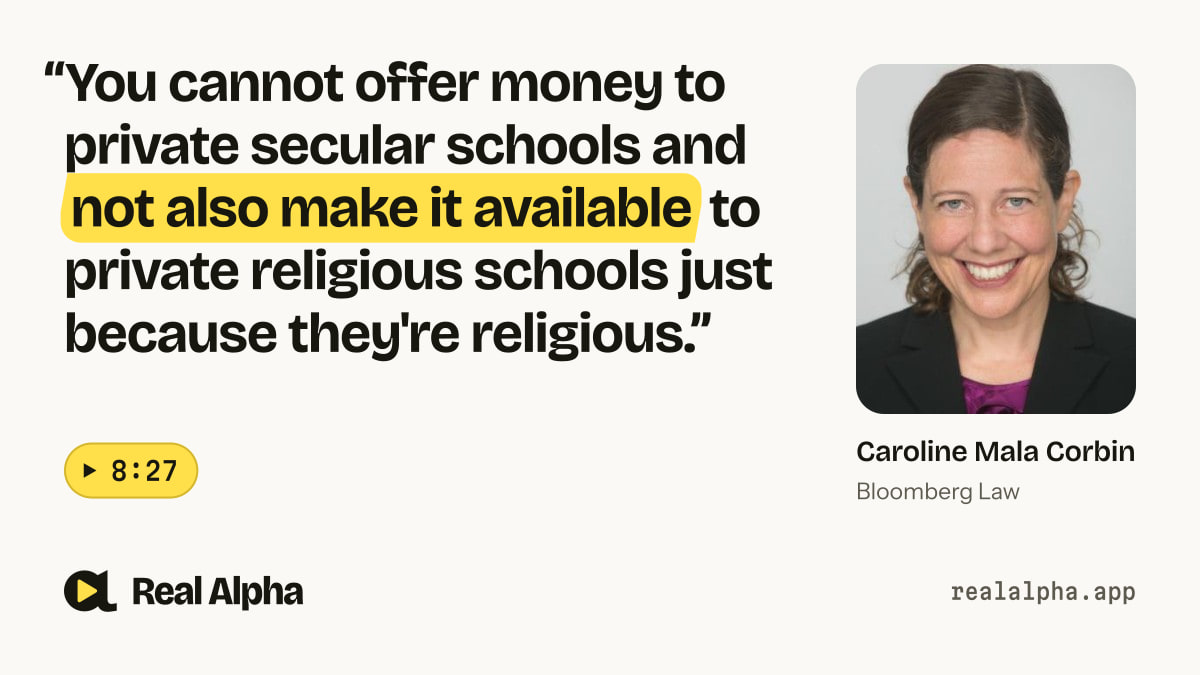
“You cannot offer money to private secular schools and not also make it available to private religious schools just because they're religious.”
 Caroline Mala Corbinat 8:27 · Bloomberg Law
Takeaways
- The earlier cases involved explicit exclusion of religious schools.
- Colorado lets religious schools join its preschool program.
- Funding is conditioned on following the same admission rules.
About this segment
Caroline Mala Corbin says earlier rulings barred states from excluding religious schools simply because they were religious. Colorado, she argues, welcomes them but conditions funding on nondiscrimination.

Professor, University of Miami Law School
Focuses scholarship on First Amendment speech and religion clauses, especially their intersection with equality issues.
- JG
June Grasso, Host
From “SCOTUS Leans Toward Catholic Schools at Expense of LGBTQ Rights | Bloomberg Law”, Nov 9, 2026. Watch the full episode
Thanks. We'll look at and fix what's off.
Transcript
From the transcript Bloomberg Law publishes with the episode.
- 5:58
The district court and a unanimous Tenth Circuit panel rejected the Catholic schools here. Why did the Supreme Court even take this case?
- 6:09
I am surprised that the Supreme Court took this case because it is a poor case on the existing law. Under the existing law, there is a rule that says if the state's law is neutral and generally applicable, in other words, if the state law is not targeting religion in any way, then it's not a free exercise problem. And this very much seems like a law that is not singling religion out for disfavor because it's basically saying you can get the money if you meet our requirements, whether you're religious or secular, and you can't get the money if you don't meet our requirements, if you're religious or secular. And so there is no discrimination against religion such that, the law would fail this requirement that it be neutral and generally applicable. And the existing law does not argue otherwise.
- 7:10
But during the oral arguments, the conservatives suggested over and over that this case falls in line with the three other cases where they found that state efforts to block religious schools from getting public dollars violates the free exercise clause.
- 7:28
Some people may be familiar with a series of cases where the Supreme Court has been insisting that the government fund religious schools. And so you might think, isn't this part and parcel of that? Is this a quartet of cases rather than a trio? This is different from the prior cases because the prior cases, what the government was saying was, We have money. We have grant money. It's either for schools or it's for playground resurfacing. And we are explicitly excluding religious schools because of the Establishment Clause, which the court pretends doesn't exist. But again, that was the reason offered is we are worried about establishment. The government's not supposed to fund churches or we want to promote separation of church and state. So even though we have this program of benefits, we are gonna exclude religious organizations.
- 8:26
And the Supreme Court has said, you cannot do that. You cannot offer money to private secular schools and not also make it available to private religious schools just because they're religious. And that was sort of the holding in a series of cases. So again, the existing rule right now is that if the government is going to offer money to private schools, it cannot exclude private religious schools just because they're religious. And Colorado hasn't done this. That's not at all what it's doing. It has absolutely said, are you a private religious school that wants to offer pre-K education? Come on down. You're welcome to government money.
- 9:14
You can still teach religion however you want. The only thing that we are requiring is that you're not allowed to discriminate against who's allowed to come. So this is not the same situation as the prior cases. Again, in the prior cases, the state law explicitly said no religious schools because they're religious. This case is like the religious schools are welcome. We just don't want to spend our taxpayers' money on schools that are going to discriminate against some of the people of Colorado.