The alpha, twice a week
That was 7 min.
Get the best new moments in your inbox every Wednesday and Saturday. It's free.
Check your inbox
We sent a link to your address. Click it to finish signing up. Not there in a minute? Look in spam.
or
Wall Street Week · 7 min · Nov 21, 2026
Employers are using plan design to contain health-cost increases
 Pat Tomlinson
Employers expect steep increases in health costs and are responding with narrower networks and higher employee contributions.
The episode’s best minutes
Full analysis- 15:59Gaming is splitting between dominant publishers and lean indies3 min
- 28:18Employers are using plan design to contain health-cost increasesPro pick 7 min
- 39:23AI makes cybersecurity a governance problem as well as a technical onePro pick 7 min
- 3 more moments in the full episode
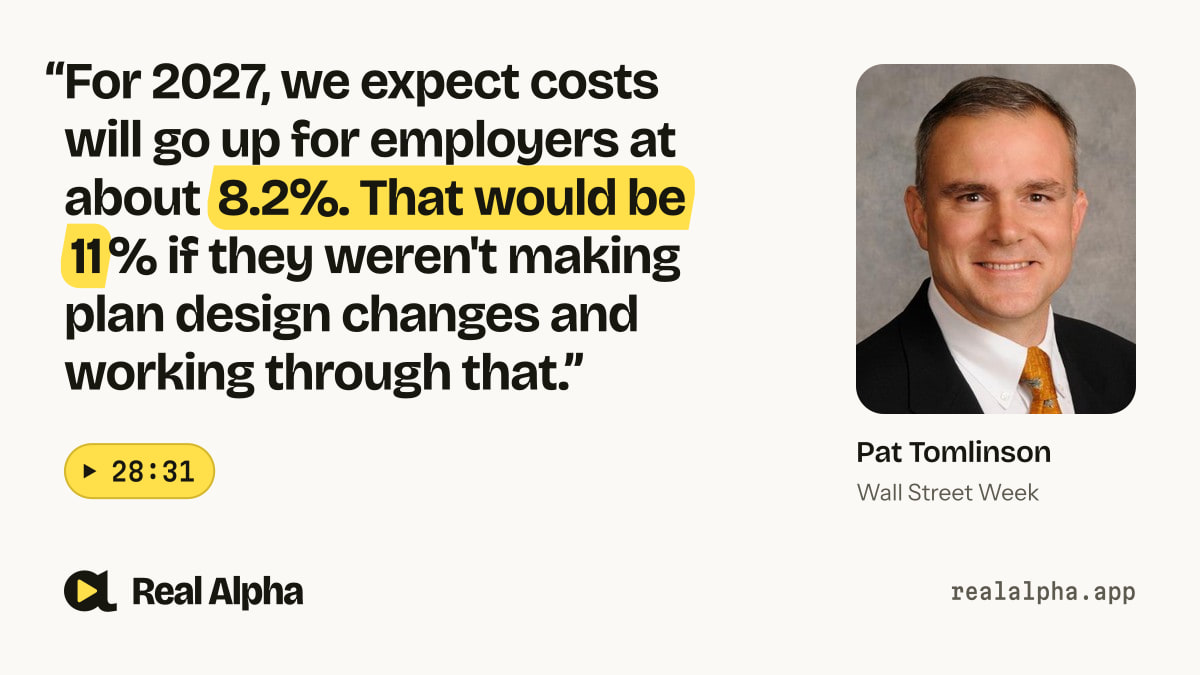
“For 2027, we expect costs will go up for employers at about 8.2%. That would be 11% if they weren't making plan design changes and working through that.”
 Pat Tomlinsonat 28:31 · Wall Street Week
Takeaways Pro pick
- Employers expect 8.2% cost increases in 2027, or 11% without plan changes.
- Narrower networks can steer employees to high-quality, lower-cost providers.
- Health coverage remains an important tool for attracting and retaining employees.
One of Pro's picks, open to you here. Try Pro free for 7 days
One of Pro's picks. The rest of the summary and the 3 takeaways are in Real Alpha Pro; the video, the quote and the transcript stay free.
Read it with Pro, 7 days freeAbout this segment
Employers expect steep increases in health costs and are responding with narrower networks and higher employee contributions. Those choices can ease budgets but put pressure on workers and small businesses.

President & CEO, Marsh People and Investments, Marsh
Leads Marsh People and Investments and Marsh US and Canada, after joining the company in 2014.
- DW
David Westin, Host
From “Gaming Blockbuster, Healthcare Costs, Cybersecurity Meets AIGaming Blockbuster, Healthcare...”, Nov 21, 2026. Watch the full episode
Thanks. We'll look at and fix what's off.
Transcript
From the transcript Wall Street Week publishes with the episode.
- 28:20
and he sees things getting only worse. Healthcare costs are on everybody's mind these days, particularly employers. Give us a sense of what's happening with them. So healthcare costs are going up for employers, right? I think we can all see that.
- 28:34
For 2027, we expect costs will go up for employers at about 8.2%. That would be 11% if they weren't making plan design changes and working through that. And it's not only the size of the cost that really is the impact to them. I think it's also a bit more of the uncertainty of the cost. It's coming through in some of the treatments that are being processed that are creating high cost, which is creating big variances to employers' budgets, which is creating lots of challenges for them.
- 29:10
Point two percent increase is not very pleasant. Eleven would be worse. Yes. How did the employers get it from eleven to eight point two?
- 29:17
So there's a few different things that they can that they can focus in on to try and drive that cost down. The first one is really just focusing on plan design changes. So what does that mean, really? It's really around thinking about what are some of the choices you make when you offer the benefits next year? Maybe we could create a bit of a change in the plans and the networks that we offer. If we can direct the employees to more narrow networks that have high quality, lower cost curated providers and being able to do that.
- 29:50
Some of it is cost sharing, to be honest, with the employee, which is a challenge, right? I mean, most employers recognize that The employees are already stressed under a high inflation environment, and they don't really want to pass these costs on to them. But the costs are becoming quite exorbitant that they're trying to find a way to absorb inside of their budgets.
- 30:14
Part of that reluctance to pass costs on to employees comes down to talent. Health coverage is among the benefits workers value most, and employers count on it to attract good people and to keep them.
- 30:27
Healthcare benefits is certainly one of the benefits that you do see employees think about long and hard when they make a move from one job to another. It's a great retention tool. Specifically, if maybe you have somebody who you're comfortable with the whole network and the provider network, and you have a family member who is someone who needs a very specialized doctor or treatment, and you know that it's covered by your current employer, that's going to be something that's going to really retain that person.
- 31:00
With that much riding on health benefits, they are no longer just an HR decision. Roughly two in five CFOs now rank health care among their top three operating costs. That's up from about one in five just two years ago.
- 31:14
So what we're seeing from CFOs, let's talk about them, at larger organizations, really starting to insert themselves into the benefits process a bit earlier. always would have been the case on, say, a midsize employer. Let's call it a 500 to 1,000 person company. The CFO likely would have been involved from the very beginning. So early in the year, January, February, in the whole process. At a larger organization, the benefits team likely would have done that and worked through the levers or the different things that they could change in the plan. And they would have worked through that and narrowed the 15 options down to four or five things that we could change to manage costs And then the CFO would have come in probably around the second quarter, maybe even at the beginning of the third quarter to go, great,
- 32:01
this is what the plan looks like. What levers are we going to pull? And how are we going to wind up creating a good benefit plan for next year? We're seeing now with those larger employers, when there's still 15 or 20 different levers on the playing field to be able to pull, the CFO wants to be involved earlier on to be able to make sure that they're thinking about all the options. Because there's things that probably would have been considered too difficult or intrusive or something that was challenging to do or hard that CFOs are realizing there's so much return for it, they want to be involved in that decision to be able to say, yes, let's go make that change to the benefits program and not have it be pushed to the side earlier.
- 32:42
In the process. As health care costs continue to rise, and with employers needing to attract and keep the talented workers they have by offering health care insurance, employers are considering different approaches to the problem. Where does this end up? I mean, if you keep drawing this line, just as a graph, boy, it gets up pretty high.
- 33:01
Yeah, it's a challenge, right? I mean, I would say that the challenge we're having for the last two or three years is where we have seen it step up. So for many, many years, medical trend, inflation of medical costs, have gone at two or three points above CPI. And that's likely what you'll always see because of the limited control or the limited access to quality providers, the fact that you have aging population in the world, there's more demand, there's limited access. So it's likely always something that's gonna grow a bit more than inflation. The challenge I think that we're struggling with the last couple of years, 8.2 is a great example, is that it is now more like five, six points over general inflation, and it's continued.
- 34:04
So some of the things that we have to do to try and get that under control for employers is to think a little bit more creatively around their network design. Can we build networks. For our employees to go to that are more high quality, efficient networks. And so what I mean by that is we know we've got good providers that have high quality outcomes. The other key piece of efficiency is finding providers that also prescribe the appropriate level of diagnostics. So some providers are really prescribing just about everything. And you can have an opportunity where they're being very thoughtful. And so that all can be looked at to make sure we build a high quality, efficient network. And that could really have a sense to start to drive lower costs.
- 34:56
But for Nancy Clark's small business in rural New Hampshire, options like those are harder to come by.
- 35:02
We don't have the freedom or benefit or luxury of choice. So I offer two plans within the Anthem Health System because that's all that we have up here. Health insurance costs like that or increase in the health insurance costs like that snowballs all the way down through the company. Can I give raises? Can I give bonuses? Do I have to turn off the lights at 4 o'clock instead of 5 o'clock?
- 35:27
Employer health coverage has weathered decades of rising costs, but the bill no longer stops at the HR department. It's